

From the Founder’s Desk
Good Monday Morning, Wonks.
As expected, last week Congress passed a spending package covering most federal agencies, including Department of Health and Human Services funding.
It also extends a number of expiring health and human services programs through December 31st, including the Temporary Assistance for Needy Families (TANF) program, creating structural pressure for a legislative vehicle later this year.
Today, the Family First Prevention Services Act turns eight.
A recurring structural hurdle we see with the law’s implementation is difficulty operationalizing its evidentiary requirements, including:
Inherent tensions in the construction of evidence-based policy;
How evidence has become a bottleneck for what states can make available; and
Last week ACF had a significant announcement on this front, which we unpack below.
This week’s Deep Dive from nonprofit development executive and writer Christine Bork approaches the same tension from another angle.
She digs into why investment in innovation is often structurally unable to generate the proof needed to be sufficiently legible to policymakers to unlock scale.
Our latest WonkCast with National Children’s Alliance CEO Teresa Huizar explores a key frontier where tech is outpacing policy: child safety and generative AI.
Special thanks to Binti for their foundational sponsorship of WonkCast.

Let’s get into it.
Weekly Wonk Deep Dive
Why Child and Family Policy Innovation Fails to Scale
By Christine Bork
Why investments in child and family policy innovation are structurally designed to not scale.
Before a new child and family policy program reaches a clearinghouse, state agency, or legislative committee, a critical decision has already occurred.
After more than 30 years in fundraising for child-focused health and human service organizations, I have watched this decision quietly determine which innovations become provable and which do not.
It’s not a decision about program quality or family needs.
It’s a calculation about indirect costs.
The gap between what it costs to prove a child and family innovation works and what foundations will reimburse creates a structural filter.
Organizations that can afford to maintain evaluation infrastructure often decline foundation grants that won’t cover those costs.
Those with the weakest infrastructure are most likely to accept terms that make documentation impossible.
Long before policymakers decide what to scale, this determines what can be proven.
The Indirect Cost Divide
Indirect costs–sometimes called overhead or administration costs– fund the organizational infrastructure that isn’t tied to a single program.
It’s things like finance staff, contract management, compliance monitoring, data platforms, audits, evaluation design, statistical analysis, and reporting systems.
For child and family providers, these costs provide the operational backbone that transforms service delivery into documented evidence.
Larger providers or those with substantial federal funding can negotiate a unique indirect rate with a federal agency.
Rates vary widely and often fall roughly between 40 percent and 60 percent of costs, depending on the organization’s cost structure.
Most private foundations cap indirect cost reimbursement at 5 to 15 percent, sometimes up to 20 percent. This gap—sometimes 30 to 50 percentage points—creates a structural divide.
This tension emerges from the understandable desire to maximize capital allocation to the most easily measured impact. But it comes with hidden costs.
If a foundation offers a $100,000 grant with a 10 percent indirect rate, it covers $10,000 of indirect costs.
If the actual indirect burden is 25 percent, the organization must absorb a $15,000 shortfall from unrestricted funds. Accepting the grant means subsidizing the project.
While well-capitalized organizations may manage this, many community-based providers cannot.
How the Filter Works
Small and mid-sized child and family providers are often deeply rooted in their communities, offering parenting programs, family preservation models, youth mental health interventions, and kinship support services.
Many operate with thin margins and rely heavily on restricted grants.
These providers often accept foundation grants with inadequate cost reimbursement because the mission need is real and the dollars are scarce.
When they do, something has to give.
The first cuts are rarely frontline services. They are evaluation consultants, data system upgrades, longitudinal tracking, and formal analysis.
Larger, diversified child and family providers face a different calculation.
With endowments, unrestricted revenue, or significant government funding, they can decline underfunded grants to protect their infrastructure and avoid subsidizing projects that weaken their financial position.
Both choices are rational.
However, the system-level consequence is clear.
Child and family providers with the least evaluation capacity are most likely to accept underfunded foundation funding, while those with strong evaluation infrastructure are less likely to do so.
The result: foundations end up funding innovations in ways that structurally preclude generation of the proof needed to scale.
The Proof Problem
This matters because policymakers do not scale promising anecdotes.
They scale documented interventions.
This is where the goal of evidence-based policy meets philanthropic funding constraints.
Evidence-based policy requires defined models, consistent data collection, validated measures, comparison groups, external review, and documentation that withstands procurement and legislative scrutiny.
All of this requires funding.
Consider a local family stabilization program that receives a $200,000 foundation grant at 10 percent indirect costs.
The program reduces foster care entries. Staff track outcomes internally, families report improvements, and caseworkers observe fewer removals.
But the low indirect rate does not cover the $50,000 cost of an external evaluator, data analysts to build standardized measures, or compliance staff to document the model.
When policymakers ask for evidence of effectiveness, the program has only informal reports.
The program remains local, and the opportunity for scale is lost.
This pattern is not unusual.
Foundations often state they want programs ready for government adoption, yet frequently fund these programs at levels that prevent investment in necessary infrastructure to prove readiness.
The innovation cycle repeats: new programs emerge, early promise appears, but evidence never fully materializes, and scaling stalls.
As a result, the innovations most likely to scale are those emerging from highly capitalized organizations.
Smaller, community-based providers – often closest to family needs – are structurally less likely to generate the formal evidence required for adoption, widening the gap between where innovation originates and where policy ultimately looks for scalable solutions.
This is not a failure of creativity, but a failure of proof financing.
Where the Real Decision Line Sits
The key philanthropic decision is often framed as whether to fund a program.
However, this is not the real decision.
The real decision is whether to fund the systems that demonstrate a program works and can be replicated at scale.
Three decisions occur before policymakers see an innovation:
the indirect rate a foundation offers;
whether an organization can afford the grant; and
whether evaluation and data infrastructure are funded.
These choices determine which organizations run programs with the potential for scale, which programs generate formal evidence, and which ideas enter policy discussions.
Funding Proof, Not Just Programs
Indirect costs are a direct input to philanthropy’s ability to catalyze scalable child and family policy solutions.
Considering them as overhead to minimize is a category error that makes essential infrastructure for last mile delivery capacity illegible to those funding and shaping policy.
Not every grant needs to fund a full randomized controlled trial.
But foundations committed to scale are investing without full visibility into cost and return structure if they aren’t able to see the underlying need for data evaluation and model development resources.
If policymakers want a broader pipeline of innovation, it’s essential to make visible the way that a lack of evidence often reflects a lack of funding rather than effectiveness.
Indirect cost policy is not neutral or a minor technical quibble; it’s a load bearing beam in state and service delivery capacity at the last mile.
It determines who can experiment, who can document results, and which ideas become visible to systems that control scale.
Until this is clearly visible we will continue to question why foundation-funded innovations rarely scale, even as we fund them in ways that make scaling structurally unlikely.
Christine Bork is the Chief Development Officer at the American Academy of Pediatrics, and writes Chief Fundraiser Weekly and Cause & Capital.
From the Wonk Briefing Room
Our latest premium brief examines a critical mismatch in child welfare policy.
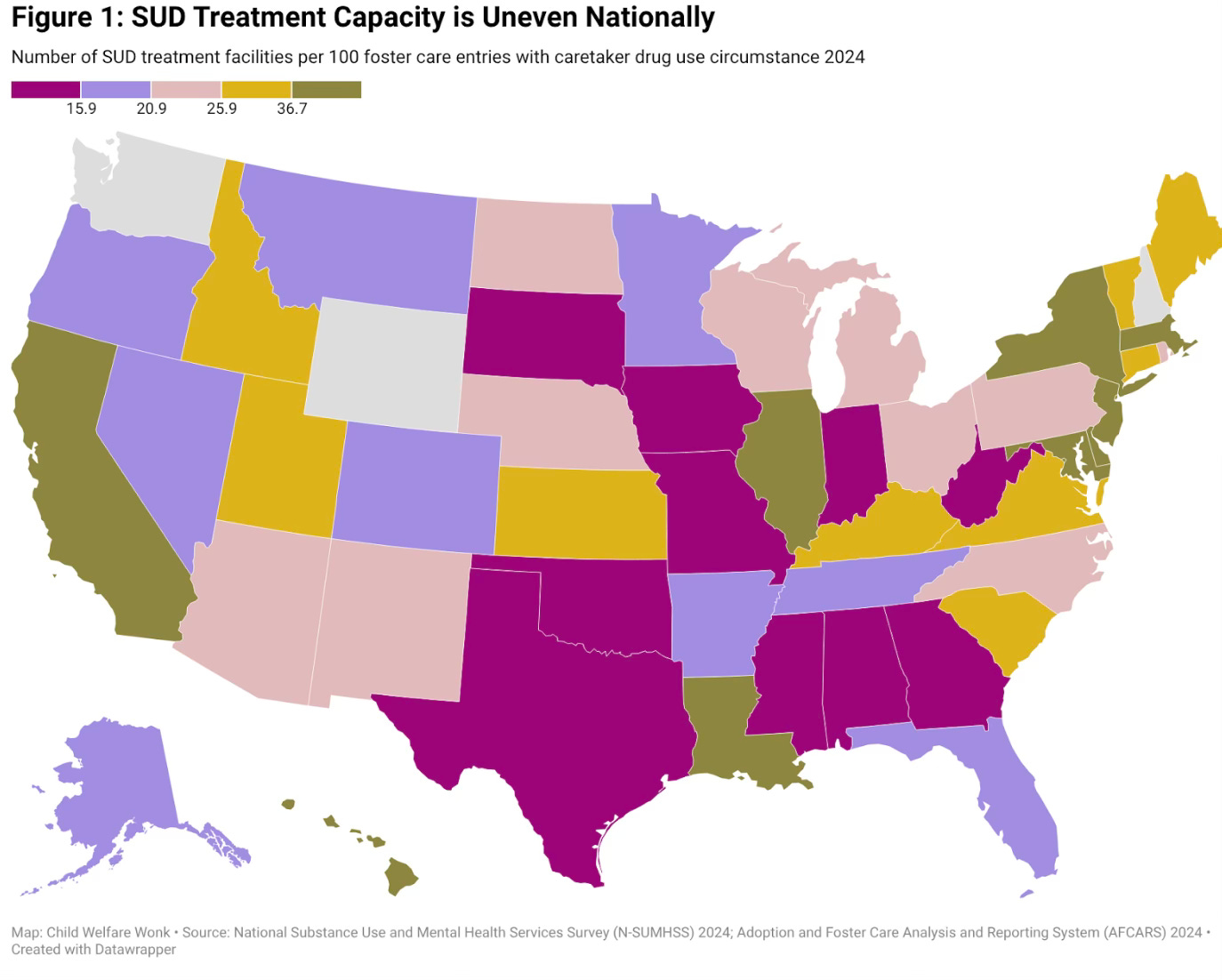
This new Data Drop shows that states where caretaker drug use drives the highest share of foster care entries also have the thinnest SUD treatment capacity.
Here’s an excerpt, with a striking map.
The Treatment Gap: States with the Most Drug-Related Foster Care Entries Have the Fewest Treatment Facilities
By Xiayun Tan, PhD
Parental substance use is among the most commonly cited reasons children enter foster care.
Child welfare agencies report persistent difficulties connecting parents with substance use disorder treatment—citing long waitlists, geographic gaps, and limited high-quality providers.
But the scale of that gap has been hard to see. How short is the system on treatment capacity relative to the families who need it?
New data from the 2024 National Substance Use and Mental Health Services Survey and AFCARS makes the pattern visible.
Wonk Briefing Room members get the full brief with further insight and state data.
Join here and get all our premium intel and access to member-only events.
Wonkatizer
ACF Expands Title IV-E Clearinghouse to Include Medications for Opioid Use Disorder
Last week the Administration for Children and Families designated three FDA-approved Medications for Opioid Use Disorder (MOUD) as “well-supported” prevention services eligible for Title IV-E funding:
Buprenorphine
Methadone
Naltrexone
ACF did this through a new Fast-Track Evidence Review Procedure that leveraged FDA’s approval and post-market surveillance to accelerate clearinghouse clearance.
What It Means: States and tribes can now add them to their Family First prevention plans and receive a 50 percent federal match for them.
Why It Matters: ACF’s new process and precedent matter here just as much as the specific medications. This kind of shift is significant and noteworthy.
Since enactment, Family First faced frustration over cautious Clearinghouse interpretations of the law.
The deeper signal here is ACF’s demonstrated willingness to find flexibility to eliminate barriers to uptake. This is key to track going forward.
What to Watch: How state capacity shapes the ability to leverage this change.
Two things are simultaneously true here:
Expanding available resources for treatment capacity offers tools to address this gap within states; and
Higher baseline capacity means stronger relative readiness between states to leverage any newly available resources
This is a critical dynamic for decision-makers, particularly in light of looming lower Medicaid investment at the federal level following the One Big Beautiful Bill Act.
What Wonks Are Watching: The Missing President’s Budget
In a typical year, the President’s FY 2027 Budget Request would already be public.
It’s worth watching for key signals when it does drop.
What’s Noise vs. Signal: Budget requests often include aspirational proposals that never materialize. But dismissing them wholesale can miss real signal.
They reveal what an administration is willing to spend political capital, time, and bandwidth prioritizing. This is especially true for major initiatives and proposals.
What to Watch: This administration has the unique combination of ACF leadership and First Lady Melania Trump focusing on child welfare.
When the President’s Budget Request drops, watch for:
Operationalization of the Home for Every Child initiative into deeper financing structure;
Signals of direction on comprehensive child welfare financing reform; and
Initiatives on older youth from the First Lady’s office
Anything in those domains will be worth watching for momentum, and is likely to point to where more time and effort will go.
That’s it for this week, Wonks.
Stay sharp,
~Z
Partners Making Your Weekly Wonk Possible


