

From the Founder’s Desk
Welcome to the latest Weekly Wonk, and we hope you had a relaxing holiday weekend.
First, some brief Wonk news. Today we’re launching something new and exclusive for public-sector agencies.
Leaders within child welfare agencies have long faced a complex and highly scrutinized decision-making environment.
What has changed is the rising risk, uncertainty, and volatility in public policy.
We’re offering public-sector partners strategic insights and resources to navigate it confidently. Interested public agencies can reach out here to learn more.
Not a public agency but looking to benefit from what Wonk offers? We’ve still got you covered too; reach out here to learn more about our organizational partnerships.
Now back to your regularly scheduled Weekly Wonk programming.
In May, the U.S. House unanimously approved the bipartisan Fostering the Future Act (H.R. 7432), to update the older youth-focused Chafee Program.
While the bill would not materially change the financial picture of Chafee, it would make broadly supported changes to how its funds and programming target housing, education, and workforce preparation.
These reforms look increasingly likely to pass this year; the question is whether Congress will find funding to accompany them.
As policymakers work their way through updates to the Chafee program, we have a new Deep Dive for you that looks at the services states select, and why that matters.
On our most recent WonkCast, I sat down with paid leave policy expert Vicki Shabo to talk about paid leave, policy design, and coalition development.
Let’s get into it.
Wonkatizer
New ASPE Brief on Title IV-E’s Declining Eligibility
What Happened
The U.S. Department of Health and Human Services’ Assistant Secretary for Planning and Evaluation (ASPE) has a new brief on a key child welfare financing trend.
The brief looks at the Title IV-E foster care program, finding that eligibility rates continue to decline, even as the cost of determining eligibility keeps rising.
Why it Matters
This tracks with what Laura Radel has recently written for us about declining federal match rates for the program, and elevates the issue of deeper financing reform.
In addition to its cost, the brief also raises questions about state compliance with the eligibility determination process.
What to Watch
Administration for Children and Families Assistant Secretary Alex Adams and Principal Deputy Assistant Secretary Cody Inman co-authored the report with ASPE.
Since briefs like this tend to precede ACF action, and the brief itself notes that prior presidential budget requests have floated finance reforms, it would be worthwhile to presume the administration will lay down a marker on finance reform.
Trump Admin’s Draft Proposal on Stay-At-Home-Care
What Happened
The Trump Administration has a draft proposal to offer married, stay-at-home parents access to funding through the Child Care Development Block Grant.
Why it Matters
This specific proposal, coming right before the midterms and framed narrowly for married parents, arrives as a politically inflected Rorschach test.
Child care policy wonk Elliot Haspel has noted the proposal would likely contradict the plain language of the law, meaning only Congress could make such a change anyway.
The draft has also drawn pushback from conservative child and family policy thinkers like Patrick T. Brown (whose Family Matters newsletter is worth reading), for not adding any new funding, thereby creating more competition for fixed funds.
What to Watch
While this reported effort to use CCDBG funds to support parental care looks legally and fiscally constrained, it’s surfacing a deeper cross-partisan policy discussion on expanded options for parents, which Elliott touched on in his WonkCast appearance.
Beyond this proposed rule, it’s worth watching the broader underlying debate, and whether further ideas for supporting families financially garner bipartisan support.
Weekly Wonk Deep Dive
Chafee’s State-by-State Service Divide
National data on how many youth receive various independent living services mask substantial variation among states in what forms of assistance are emphasized.
By Laura Radel, Senior Contributor
The John H. Chafee Foster Care Program for Successful Transition to Adulthood — usually referred to as the Chafee Program, or by its former title, Independent Living — is the primary source of federal funding for services that help older youth prepare for life after foster care.
The program distributes $143 million to states by formula. But it gives states broad discretion over how to spend their share, producing strikingly different Chafee programs across the country.
With limited funding and a wide range of allowable services, states must decide what to emphasize: education, housing, financial assistance, classroom-based life-skills training, or some combination thereof.
Where a young person lives can shape not only which services are available to them, but what kind of transition support the state’s program is built to provide for them.
Data from the National Youth in Transition Database (NYTD) make those differences visible. States report how many eligible youth receive services across 14 categories.
The national totals suggest a program without a dominant focus.
The state-level data tell a different story that matters for national policy deliberations: many states have made clear — and sharply divergent — choices about where to concentrate their limited Chafee resources.
THE NATIONAL PICTURE
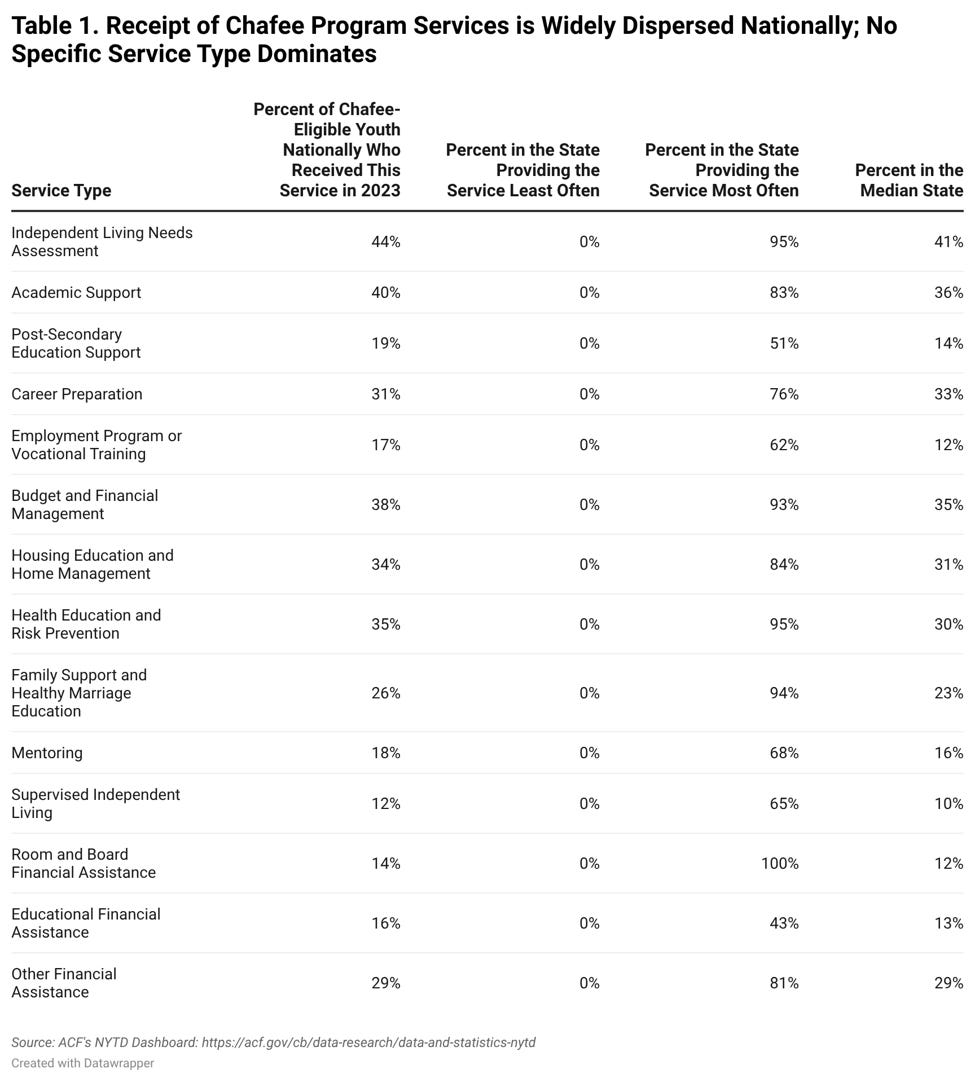
Nationally, no single type of Chafee service dominates. In 2023,the most recent year available, the share of eligible youth receiving the 14 reported services ranged from 12 to 44 percent, as shown in Table 1.
Independent Living Needs Assessment, Academic Support, and Budget and Financial Management reached the largest shares of youth.
Supervised Independent Living and various forms of financial assistance, such as Room and Board and Educational generally reached fewer.
This partly reflects cost, as direct housing and financial assistance are typically more expensive per youth than assessments, academic support, or the range of classroom-based skills classes.
But that lack of focus nationally masks the choices states are making. For each service category except Educational Financial Assistance, at least one state provided the service to over half of its eligible youth.
There is also at least one state that reported providing the service to no youth at all.
The national picture therefore looks more balanced than many state programs actually are. Beneath the averages are states concentrating their limited resources on very different forms of transition support.
FIVE WAYS STATES USE CHAFEE
The state-level data reveal five broad approaches to using Chafee funds. The groups are based on the services reaching the largest shares of youth in each state.
Because assessments commonly accompany other services, they are not used to define the categories.
These profiles do not capture every feature of a state’s program. They show where states have chosen to concentrate their limited Chafee resources.
Education-Centered Programs
Sixteen states and the District of Columbia place the greatest emphasis on Academic Support. Some also provide classroom-based life-skills, mentoring, or financial assistance, but education remains the center of the service array.
States in this group:
California
Delaware
District of Columbia
Georgia
Idaho
Illinois
Kentucky
Minnesota
Missouri
Nebraska
New Hampshire
New York
North Carolina
Ohio
South Carolina
Washington
Wyoming
Housing-centered Programs
10 states focus their Chafee funding on housing. These programs emphasize Supervised Independent Living, Room and Board Financial Assistance, and/or Housing Education and Home Management Services.
Some also provided academic other forms of financial assistance, but housing predominated.
States in this group:
Arizona
Connecticut
Hawaii
Maryland
Michigan
Mississippi
Montana
Rhode Island
Tennessee
West Virginia
Classroom-Based Programs
Eight states rely most heavily on classroom-based instruction, particularly Budget and Financial Management, Housing Education and Home Management, Health Education and Risk Prevention, and Family Support and Healthy Marriage Education services.
Some of these states provided other forms of educational support such as Career Preparation (also often a classroom-based endeavor) in addition to the classroom services that predominated.
States in this group:
Colorado
Indiana
Louisiana
Maine
Massachusetts
New Mexico
Texas
Wisconsin
General Financial Assistance Programs
Eight states concentrate their resources on financial assistance not tied specifically to housing or education. Some pair that assistance with extensive Academic Support.
States in this group:
Alabama
Alaska
Nevada
Oklahoma
Oregon
Utah
Vermont
Virginia
Broad-service Programs
Eight states spread their Chafee resources across a wide range of services rather than allowing any single type of service to dominate.
States in this group:
Arkansas
Florida
Iowa
Kansas
New Jersey
North Dakota
Pennsylvania
South Dakota
These program emphases are mapped in Figure 1.
WHAT DECISION MAKERS NEED TO KNOW
National figures provide broad-brush information about national service utilization but mask important differences in how states choose to provide services funded by the Chafee Program.
Broad federal rules establish what states may fund, but limited dollars force states to decide which needs to address and which youth to reach.
Those choices create a tradeoff between breadth and intensity.
Classroom-based services can likely reach more youth at a lower cost per person. Housing and direct financial assistance may provide more substantial help but generally reach fewer youth.
A state’s service profile therefore reflects not only what it considers important, but how it allocates scarce resources across competing needs.
The practical consequence is that where a youth lives makes a big difference in what transition services are available.
Youth in one state may encounter a program centered on education; a similarly situated youth elsewhere may receive housing assistance, financial support, or a broad menu of life-skills classes.
NYTD makes those differences visible, but it does not establish which strategy works best.
The data show what services states provide and how broadly they provide them—not their quality, intensity, or effect on youth outcomes. Future articles will address Chafee program outcomes and spending.
Laura Radel is a Senior Contributor, bringing deep expertise on child welfare policy and research about the children and families who interact with the child welfare system.
Before retiring, she spent 35 years analyzing child welfare issues for the HHS Office of the Assistant Secretary for Planning and Evaluation (ASPE).
From the Wonk Briefing Room
The latest in premium Wonk intel is an analysis of three years of all approved state plans for prevention under the Family First Prevention Services Act.
The takeaway? Even as the clearinghouse expanded, the inventory of programs states have in their plans to draw down funding has barely budged.
That doesn’t just matter for conversations about revising Family First; it’s also instructive for thinking about the purpose and design of future financing policy.
Here’s an excerpt of what our premium community is talking about.
The Clearinghouse Expanded. State Prevention Plans Barely Budged.
Dozens of programs have become eligible for federal reimbursement since 2023. Most have gained little traction in state prevention plans.
BY LAURA RADEL, SENIOR CONTRIBUTOR
The Title IV-E Prevention Services Clearinghouse governs what services are eligible for financing through the Family First Prevention Services Act (Family First). Over the past three years, it has expanded the universe of programs it permits, but that has led to little change in what states have included in their Family First plans.
Since January 2023, the Clearinghouse has added dozens of programs, and 10 additional states have received approval for prevention plans.
Since those plans must list the services for which states will claim federal funds, that expansion provides a useful opportunity to examine whether more federal options have translated into more varied state choices.
This analysis compares state plans in 2023 and 2026. It finds that most new states selected programs already used elsewhere. States updating existing plans also favored familiar interventions, particularly those rated well-supported.
Programs added to the Clearinghouse in recent years rarely appeared in state plans. Notably, no new addition was adopted by more than one state.
These findings do not resolve why Family First implementation has been slow. But they clarify where the narrative on Family First implementation holds up and breaks down.
The number of programs eligible for federal reimbursement has grown substantially while the range of programs states are preparing to deliver has not. That narrows the search for the law’s real limits.
To read the full brief and access all our premium resources, join the Wonk Briefing Room. Individuals can sign up here, or get the team membership rate here.
Organizations interested in going even deeper can reach out to learn more about our partnerships for public and private organizations to integrate our intel in your strategy.
That’s it for this week.
Stay sharp, Wonks.
~ Z
Partners Making Your Weekly Wonk Possible


