

From the Founder’s Desk
Welcome to the latest Weekly Wonk.
First, RIP to former Rep. Jim McDermott (D-WA), who died last week at 89.
He had a long history of bipartisan leadership on child welfare policy issues, which came up earlier this year in our WonkCast conversation with Laura Berntsen, who worked for him at the start of her career.
This week, we’re digging into something fundamental that matters for the future of any child welfare policy reform effort; the legitimacy of child welfare itself.
If you’re reading the Wonk, you probably already know that sighing and referring to the “pendulum swing” between child safety and family preservation is basically the free space in child welfare policy bingo.
As one example, that means we have a tendency to fit conflicts over prevention and when policy should require removal to foster care into that larger “pendulum” pattern.
But Dr. Jill Duerr Berrick has a Deep Dive for you this week arguing that today’s conflicts reflect something much deeper; a legitimacy crisis worth taking seriously.
An example of one of several drivers is the erosion of trust, from things like the cost of reunification that she analyzed earlier this year, or the collection of survivor benefits, now down to only 10 states.
Her Deep Dive today lays out her case for that legitimacy crisis.
Later this week, our premium members will receive part two; a roadmap for rebuilding public trust that can strengthen our field’s work.
If you haven’t yet given it a listen, please check out 50th WonkCast, where Jodi Hill-Lilly of the Doris Duke Foundation unpacks why the mighty waters of justice need an irrigation system.
Let’s get into it.
Why Wonk Premium
After reading the Weekly Wonk, leaders often want to know:
“Okay, but if that’s the case, how can I approach my work differently today?”
That’s exactly what our member-only Wonk Briefing Room offers.
Maybe you read Wonk Senior Contributor Doug Steiger’s piece last week on what the “Blue-Nami” means for child and family policy, and wanted guidance on how to move.
That’s what hit the inboxes of premium Wonks last Friday, with a “What You Can Do When Congress Turns Blue” guide on being effective in the lame-duck and 120th.
Premium members get this type of value every week. Join us so you can too.
Wonkatizer
CMS Extends Time to Enforce Medicaid Work Requirements
What Happened
On November 13, the U.S. Centers for Medicare & Medicaid Services announced an optional hold-harmless period for implementing Medicaid work requirements under the One Big Beautiful Bill Act, running through June 30, 2027.
Why It Matters
We’ve previously highlighted the costs and administrative effort of developing and deploying these systems. This option for flexibility is a concession to that reality.
This difficulty also underscores what came up in our conversation with Michelle Turner around the complexity of verifying exemptions, like for former foster youth.
What to Watch
Which states take the option up, and whether six months is sufficient. This timeline will also coincide with potential Congressional action to revisit the underlying policy.
Weekly Wonk Deep Dive
Child Welfare’s Legitimacy Crisis: Part I
By Dr. Jill Duerr Berrick
Child welfare’s authority to intervene in family life rests on more than law.
It also depends on public confidence that intervention is justified, decisions are fair, and agencies can protect children.
Weakening public confidence erodes the trust on which agency authority rests. When that happens, questions extend beyond how an agency handles a particular case to the very legitimacy on which institutional authority rests.
This first article in a two-part series argues that U.S. child welfare is facing a legitimacy crisis. It examines the evidence for that crisis, what is propelling it, and its consequences for our field.
The second premium piece will examine what to do about it, with a roadmap for rebuilding public trust that can inform the work of child welfare leaders, the workforce, and those working with them.
What Is a Legitimacy Crisis?
The legitimacy of any government institution rests heavily on public confidence. Faith in public institutions rises or falls based on community members’ perceptions that:
Public officials have community members’ best interests at heart;
Public servants’ decisions are fair and impartial; and
Government actions effectively resolve community problems.
According to the Pew Research Center, overall trust in government has declined precipitously in the U.S. over the past 50 years.
This matters because people who trust public authorities are also more likely to accept and adhere to policies, programs, and administrative decisions.
Child welfare operates within this backdrop, but it may be especially vulnerable to trust skeptics. Parenting is an intimate, private affair; how we raise our children is especially sensitive to outside interference.
Moreover, the U.S. Supreme Court has time and again asserted the foundational characteristics of parenting in American family life.
For example, In Meyer v. Nebraska (1923), and confirmed in Pierce v. Society of Sisters (1925) the Supreme Court argued that parents had wide latitude to “direct the upbringing of their child.”
More recently, in Troxel v. Granville (2000), Justice O’Connor argued that the parent-child relationship reflects a “fundamental constitutional right.”
She went further to argue that parental rights are “the oldest of the fundamental liberty interests recognized by this Court.” Intrusion into the family must therefore be judged against a high bar.
All of these factors converge to create the conditions for a legitimacy crisis impacting child welfare agencies. This is different from but interacts with the “pendulum swing” politics of child welfare that leaders are used to.
Understanding it is essential today, especially for those leading or working within these agencies.
What’s Driving the Legitimacy Crisis
Broad distrust of government provides context, but the case for a child welfare legitimacy crisis needs evidence of its own. Public confidence data offer one measure, and recent challenges to the system’s authority also fuel the skepticism.
The Confidence Gap
In a recent study including adult respondents from 40 of the richest, most advanced democracies, researchers found that public confidence in child welfare is generally low.
On a scale of 1 (very little confidence) to 4 (a great deal of confidence), Iceland (2.67), Belgium (2.64), and Finland (2.6) scored relatively high, with an average score of nearly 3.
U.S. respondents, in contrast, offered an especially dim assessment.
The U.S. indicator of 2.27 fell at the bottom of the range. Only 5 countries – all in Eastern Europe or Latin America – scored lower.
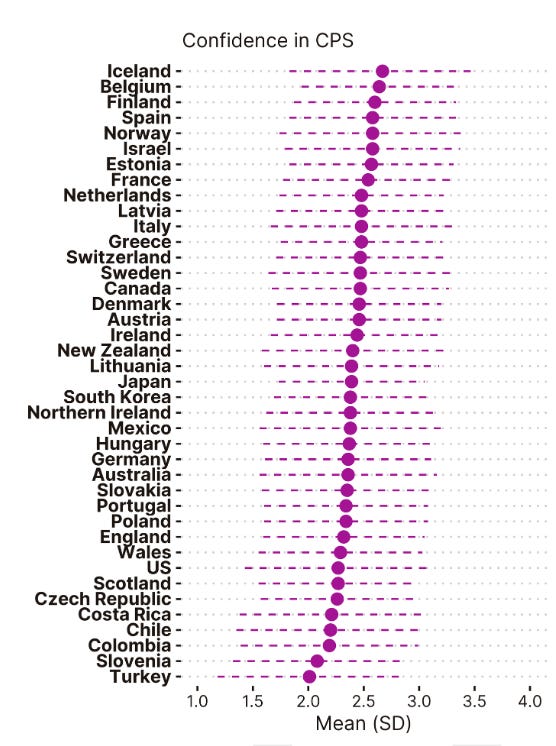
“Analysis by Berrick, J.D., Gloppen, S., Loen, M., & Skivenes, M. Visualization by Child Welfare Wonk”
Contested Authority
This context of growing discontent was lit aflame when, in 2020, a small but vocal group of advocates, researchers, writers and other influential voices began demanding that child welfare be abolished altogether.
Pointing to stark and persistent racial disproportionalities, child welfare abolitionists argued that the system was beyond reform, and that its methods of assessment, monitoring, court-mandated services, and family separation were intentionally designed to hurt families.
The child welfare abolition movement revealed deep disillusionment with current child welfare institutions and frustration with the pace of its reforms. It also generated a potentially growing ambivalence among young social workers about joining this field.
Child welfare agency managers have long faced a recruitment and retention problem among their staff.
It’s reasonable to surmise that the child welfare abolition movement likely accelerated those difficulties, as would-be child welfare professionals turned their attention to other “helping” roles less tainted by a credibility problem, and child welfare agencies carried on with a diminished, stretched, and beleaguered workforce.
How Did We Get Here?
The child welfare abolition movement is a symptom and accelerant of this trend, not its root cause.
That makes it important to understand the additional factors that explain public skepticism and whether there are aspects of child welfare practice that other public services do not share.
Child welfare may be primed for a confidence gap because it is situated at the nexus of the parent-child relationship, but media coverage, our historical narrative, dishonest practices, and disproportionate responses to family difficulties have all contributed to the current predicament too.
Media Coverage
The Casey Journalism Center found that media coverage of child welfare content disproportionately tilts negative. Stories about children harmed at home, children harmed in care, and missed opportunities for intervention dominate.
A parent’s recovery, a child’s attentive supervision, or a family’s safe reunification rarely make headlines.
The public, and even the journalists whose work they rely upon, have little basis for determining whether reported errors represent routine practice, or whether they depict unusual outliers.
That means news coverage and resulting public perceptions come without any context around how often child protection intervenes unnecessarily or fails to intervene when protection is needed.
Social media has also changed the pace and reach of troubling stories, allowing individuals to describe harm without intermediaries or gatekeepers.
Meanwhile, confidentiality rules appropriately limit agencies’ ability to respond publicly. Parents and children served well by child welfare have every reason to keep their family history private and to move on with their lives.
The result is an uneven public record: accounts of injustice and injury are highly visible, while successful interventions and the context behind contested decisions often remain hidden. That asymmetry fuels the trust gap.
Historical Narratives
All histories – personal, political, and social – are tainted by errors. Child welfare too has a checkered past.
To name but a few, the Indian Adoption Project sought to erase Native children’s culture and identity; child welfare agencies were long segregated by race and religion, leaving many Black children underserved and overlooked; and standards for removal too often relied on parental characteristics, rather than behaviors of harm.
But looking to the past is not just about identifying mistakes. Definitions of maltreatment and appropriate parenting shift across time, geography, and culture.
Some actions in the past may have been viewed as inappropriate in their historical moment, but are tolerated today.
Historical narratives remain powerful, shaping enduring perceptions of the system. They are also easy to invoke as representative of contemporary practice.
Today’s legitimacy crisis is shaped, in part, by those historical narratives of distrust that persist, and by new ways of invoking those narratives today
Deceptive Practice
Several child welfare practices may have historical or policy relevance, but they don’t hold up against the field’s goals of safety, family, permanency, and well-being.
For example, it’s a common practice in all 50 states to create a new birth certificate that replaces the original one with a legal fiction; a powerful use of the state machinery central to epistemic questions of family history.
When the state separates families and communicates a goal of reunification, but imposes fines and fees that knowingly reduce the odds of that outcome, the state’s messaging regarding reunification rings hollow, compounding distrust.
Too often, practices that may have enjoyed a certain logic in a different time or context remain today due to inertia, ignorance, or incentive tensions that make them challenging to unwind.
But these practices erode faith in the sincerity of child welfare actors as genuinely committed to its stated goals.
Disproportionate Response
Public faith is also tested when the CPS response is unnecessarily heavy-handed. In England, child welfare practice is guided by the principle of proportionality – the CPS response should be proportionate to the scope of risk or harm to the child. Too often in the U.S., this principle does not apply.
News reports about a criminal response to older children left unsupervised, parents handcuffed in front of their children when they allow them to walk to town alone, tell a tale of government overreach.
Fear of legal liability and the consequences of under-responding can lead to these disproportionate responses, which communicate to the public that CPS actions are capricious, with the unintended effect of raising fear and reducing trust.
Why Trust is Hard to Earn
Child welfare agencies have the legal authority to intervene in family life. Earning public confidence in how they use it requires answers to three questions:
Are decisions fair?
Are people treated equally?
Does intervention improve children’s lives?
The available information often makes those questions easier to raise than to resolve.
Are Decisions Fair?
Research shows that when the public views administrative and judicial decisions as fair and proportionate, trust in government rises.
This matters in a field where, as the late Richard Gelles argued, decision-making is the foundational role of child welfare professionals.
Social workers regularly make decisions about safety, care, engagement, change, well-being, and permanency. Some of these decisions serve only as recommendations to supervisors or to judicial officers, who also make consequential decisions every day.
Most of these decisions are opaque and shielded from public scrutiny. What the public sees of these consequential decisions tends to be those that get reflected in news coverage, which, as discussed above, is inherently critical.
This lack of transparency lends itself to personal anecdotes of inequity or indignity that reverberate and shape the public’s understanding of the system, making it easy to question whether child welfare is procedurally fair.
Are people treated equally?
With federal financial and regulatory support, agencies across the country have responded to concerns about transparency by making data about system performance readily available:
How many children entered foster care last year?
How long did they stay?
What was their permanency outcome?
What was their race or ethnicity?
These data tell a consistent story about the disproportionate representation of Black and American Indian/Alaska Native children in child welfare.
Researchers debate the mechanisms driving these disparities, but those debates rarely reach the general public. Because the disparities are visible and their causes are hard to establish, biased decision-making becomes a readily available explanation.
Child welfare agencies, in turn, have little data to shed light on whether different staff make different decisions about comparable circumstances, and whether those decisions vary by a family’s race or ethnicity.
The public is therefore skeptical about representational fairness, which contributes to the legitimacy crisis.
Does Intervention Improve Children’s Lives?
What does the public expect from child welfare agencies, and does it match their capacity to deliver?
For the past couple of decades, research on the outcomes of young adults who experienced foster care has painted a grim picture.
Rates of homelessness, criminal justice involvement, young parenting, and unemployment are all notably higher than the rates we see in the general population.
The evidence for school-age children in foster care is also troubling: these children are more likely to repeat a grade, be enrolled in special education services, miss more school days, and they are less likely to graduate than their peers in the general population.
These comparisons document serious challenges.
They do not, by themselves, establish what child welfare caused or how those same children would have fared without intervention. But they invite a powerful public conclusion: child welfare has poor outcomes.
When a system is expected to “fix” families and “heal” children, persistent difficulties can look like evidence of failure. The gap between those expectations and what agencies can achieve adds another strain on public confidence.
Together, these three concerns leave agencies with a difficult credibility problem: the public can see disparities and troubling outcomes, but cannot assess the decisions behind them or whether intervention inspired change.
That gap leaves unresolved questions about whether child welfare uses its authority fairly and effectively, which is the foundation of its legitimacy.
What Distrust Puts At Risk
State involvement in any family’s private life must meet a high bar to justify the breach of family privacy. At the same time, the public has an important stake in children’s health and safety.
When a state-sponsored institution that is designed to help families and ensure children’s safety loses its legitimacy, the foundation for community support crumbles and generates critical questions about why to accept child welfare authority, support its mission, or fund its work.
Those questions have practical consequences. Lawmakers may doubt that additional resources will produce better outcomes. Prospective social workers may choose other helping professions.
Agencies can retain their legal authority while losing the funding, workforce, and public cooperation needed to exercise it effectively.
That is the institutional risk of a legitimacy crisis. Child welfare needs trust to function, yet the privacy of its decisions, gaps in its data, and uncertainty about its purpose make that trust difficult to earn and sustain.
Rebuilding confidence will require addressing both how the system operates and how the public can judge its work. This is not impossible or insurmountable work, but it will take consistent and concerted strategic effort to address.
Waiting it out would mistakenly read a rising legitimacy crisis as the more predictable “pendulum swing” politics of child welfare. Too much is at stake to ignore the current situation.
The second premium brief in this series examines what child welfare leaders can do to close that gap. Join today so it hits your inbox.
That’s it for this week.
Stay sharp, Wonks.
~Z
Partners Making Your Weekly Wonk Possible


Subscribe and never miss the latest from Child Welfare Wonk.