

From the Founder’s Desk
This week we’re digging into a structural shift happening in the foster care system.
Since 2018, foster care populations have fallen by more than 20 percent.
That’s not a blip — it’s a system-wide contraction.
This week’s Data Drop is the first in a series digging into that decline, mapping where it’s happening, which children it’s affecting most, and what might explain it.
On the financing front, last week the Bipartisan Policy Center released a blueprint for child welfare financing and accountability reform (I was one of the 15 members who worked on them over the past 18 months).
It’s a serious framework to create conversations that go beyond menus of policy options and into the architecture of how federal financing and accountability works.
At its core is addressing the “Entitlement to what?” issue, in which open-ended funding has drifted away from tangible supports tied to families.
It also tackles key questions around how to approach updating Family First and what sustainable federal financing of innovation could look like.
On Wednesday, Wonk Briefing Room members will join some of the group’s leaders and members to discuss the blueprint as part of our Wonk on Washington briefing.
On last week’s WonkCast, Administration for Children and Families (ACF) Assistant Secretary Alex Adams gave his read on the next phase of child welfare policy
He discussed why the agency is using the metric of homes to children as the spine of their framework for accountability, and how he sees it going beyond recruitment and retention to encompass a broader spectrum of prevention through permanency.
We also discussed his thinking on the long-term future of federal oversight, data, and financing. Make sure to check it out here if you haven’t yet.
Special thanks to Binti for their foundational sponsorship of WonkCast.

Let’s get into it.
From the Wonk Briefing Room
Reading the current policy window means being able to shape it.
In this week’s premium brief preview, Doug Steiger maps where Washington is coalescing on older youth policy — and where the field still has room to shape what comes next.
He crosswalks what’s anchoring discussion among policymakers with ideas the field has put forward, and points to where there are openings to close the gap.
To read the rest of this premium brief and get all our others, sign up for the Wonk Briefing Room here.
Help On the Way? The Older Youth Policies Poised for Flight
By Doug Steiger, Senior Contributor
Washington has made up its mind about one thing: older and former foster youth are going to be a 2026 child welfare focus.
The signals are everywhere, including the:
Recent Trump executive order which established the “Fostering the Future” initiative to help those transitioning out of foster care access employment and education opportunities;
Two House hearings in older foster youth in the last six months, most recently in November; and
Growing bipartisan murmurs about finally reauthorizing Chafee.
But the shape of that federal attention is uneven.
What’s advancing in DC reflects a narrow slice of youth priorities, shaped less by a comprehensive proposal from the field and more by policymakers stitching together the pieces already in front of them.
The gap between what young people say they need and what Washington is gearing up to deliver is already visible.
That gap is descriptive though, not deterministic. It’s a clear reminder that any legislative or regulatory conversation is downstream of the policy vision and communication of its field.
The window remains open. The agenda isn’t set. This is the key moment to shape what is about to start seeming inevitable.
To read the rest of the premium brief and get all our premium briefs, sign up for the Wonk Briefing Room here.
Weekly Wonk Deep Dive
Data Drop: What the Foster Care Decline Tells Us, Part 1
By Laura Radel, Senior Contributor, & Brett Greenfield
Foster care populations nationally have been shrinking – and not at the margins.
Since their most recent peak in 2018, the number of children in foster care has dropped 23 percent nationwide through 2024.
A six-year contraction of this magnitude is not a blip. It’s a structural shift.
It raises real questions:
Where is this happening?
Which sub-populations are declining most?
What does the underlying pattern tell us about safety, practice, and system behavior?
Over a series of articles in the coming months, we will map that terrain.
We’ll track the geographic variation, age patterns, placement shifts – and surface the tensions they reveal.
We’ll also examine the core question for policymakers and system leaders: are the declines aligned with improved safety, or are other forces at work?
This first article presents an overview of geographic variations in foster care levels and some patterns we see overall. Subsequent articles will delve deeper
The Big Picture Nationally: The 6-Year Decline that Could Populate a City
Between September 2018 and September 2024, the number of children in foster care fell from approximately 434,600 to 329,000.
That’s more than 100,000 fewer children in care over a six-year period; comparable to the population of the New York State capital of Albany.
The overall pattern is clear.
Declines occurred in most states, but not evenly. California and Texas alone account for about one-third of the national decrease; another six states make up nearly another third.
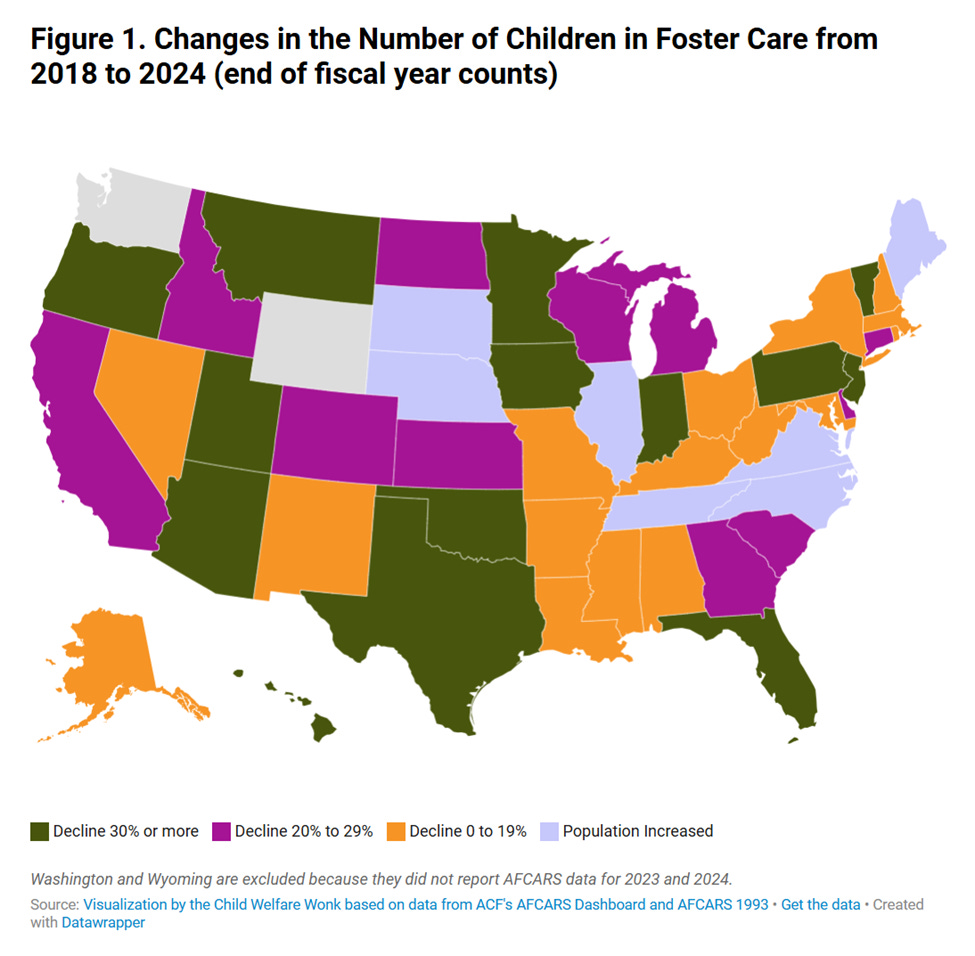
Only seven states experienced growth in their foster care populations during this period, with the largest increases in Maine (up 38 percent) and Illinois (up 10 percent).
The state-by-state distribution of changes shows (Figure 1):
13 states saw declines of 30 percent or more;
12 states plus DC saw declines of between 20 and 29 percent;
16 states saw declines of between 0 and 19 percent; and
7 states saw growth in their foster care populations during this period.
One important caveat: though substantial, the overall tally actually underestimates the magnitude of the drop.
AFCARS 2023–2024 counts include more youth over age 18 than were counted in prior years, meaning the decline in foster care for those under 18 is even steeper.
The States Driving the Trend
It is noteworthy that the states with the largest total foster care populations are important to but by no means fully explain this story.
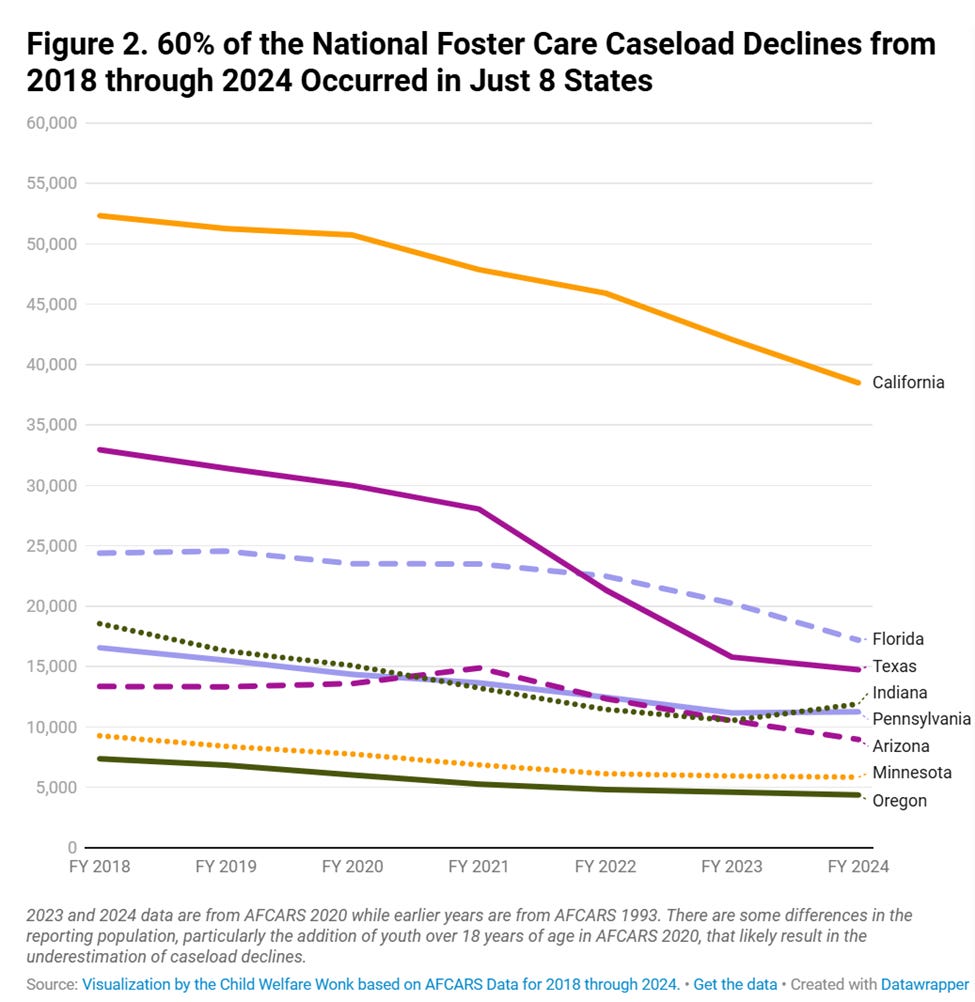
Of the eight states with the largest declines in the number of children in foster care (Figure 2), only four are states with the largest number of children in foster care overall.
Indiana, Arizona, Minnesota and Oregon each had caseload declines bigger than their population sizes would have suggested.
And notably absent from this cohort are several states with large populations of children in foster care, including New York, Illinois, and Ohio.
California, Texas, Indiana and Pennsylvania stand out for their substantial, sustained declines.
Florida and Arizona experienced significant drops that started later, during FY 2022 for Arizona and FY 2023 for Florida.
Texas’s decline accelerated during 2022 and 2023.
Other Observations at the National Level
Caseload counts don’t tell the entire story.
While individual states may differ, some national patterns emerge:
Falling entries tell the story. The system isn’t primarily accelerating permanency; mostly it is decelerating entries to foster care.
The number of entries was down 33 percent. Exits also decreased substantially, but by less (down 29 percent). The result:
In 2018, for every child entering foster care there were 0.95 exits.
In 2024, for every entering child,1.03 left foster care.
Since this period includes the first years of Family First implementation, a key question is whether prevention is driving that shift, and if so how it connects to federal financing.
Family placements declined most. At the end of 2024 there were about 96,000 fewer children in family foster homes (both relative and nonrelative) and about 12,000 fewer children in congregate care nationally than there were in 2018.
Proportionally, family placements declined slightly more than congregate care (27 percent decline compared with 25 percent).
Most significant declines were for children under 13. Of children in care at the end of the year, the number of children at each age from 0 through 12 years fell between 27 and 35 percent.
For youth ages 13 through 17, the declines were smaller, between 17 and 23 percent.
Fewer children entering because of neglect. Reductions in entries are most substantial among children for whom neglect is noted as a reason for entry.
There were over 36,000 fewer neglect-related entries in 2024 compared with 2018, down 22 percent.
Entries because of physical abuse dropped by about 4,400 (a 13 percent decline) and entries related to sexual abuse dropped by about 1,000 (down 10 percent).
Differences by race and ethnicity. Though entries were down across the board, declines in foster care entries are occurring more among White children than among children of other races or Hispanic children.
Among foster care entries, in 2024 compared with 2018 there were:
40 percent fewer White children
34 percent fewer Hispanic children
34 percent fewer Asian children
30 percent fewer Black children
26 percent fewer American Indian or Alaska Native children.
Looking Ahead
The national contraction is broad, but not uniform.
The steepest declines are concentrated among White children, younger children, children entering care because of neglect, and children placed in family foster homes.
In future articles, we’ll map how states diverge on key indicators and examine whether declines correlate with prevention investments, policy changes, and changes to child safety.
Wonkatizer
ACF Acts on SSI Benefits for Foster Youth Benefits
Last week, ACF sent a letter to 39 governors calling on them to stop intercepting the Social Security survivor and Supplemental Security Income (SSI) benefits of foster youth.
The letter proposes retaining the funds for youth as they transition out of care. This move aligns with a policy reform Assistant Secretary Adams oversaw in Idaho.
What The Practice Is
When youth in care are eligible for survivor benefits or SSI, agencies are legally able to retain those funds to offset costs associated with foster care.
Agencies act as a “representative payee” in receiving funds, a role requiring funds be:
Spent for the beneficiary’s current and reasonably foreseeable needs; or
Saved or invested for the beneficiary, after current needs have been met.
The core conflict in this issue has been over whether agencies should be preserving funds or using them for added support, rather than offsetting the cost of foster care.
ACF is calling for an end to the practice, and for states to retain the benefits for youth.
What to Watch
A central tension is the role states play in applying for benefits on behalf of children. That process is time intensive; will states continue to do it if they are not obligated to?
That especially matters for permanency, since benefits would follow a child or young person into their family.
The deeper long-term question is around asset building for youth in care.
This action could offer that for youth who receive survivor benefits or SSI, but broader access would require a larger policy conversation and legislative change.
That’s it for this week.
Stay sharp, Wonks.
Z
Partners Making Your Weekly Wonk Possible


