

From the Founder’s Desk
We’re back with your latest Weekly Wonk.
A special welcome to those finding us from this column about the child welfare workforce, which referenced our series with the Center for the Helping Professions.
This week, we’re digging into Medicaid, from an angle relevant to your ongoing work on policy around older youth in and aging out of foster care.
Wonks know that at least until Congress is back for the lame duck, the Fostering the Future Act to update the older youth-focused Chafee program is in abeyance.
Only a newbie staffer or advocate thinks recess is quiet when your policy area has unfinished business. Seasoned vets know that’s actually when deals can coalesce.
That’s why we’ve been producing new original analyses to inform your older youth policy work, digging into relevant Chafee data about:
States Chafee service strategies.
See the clear approaches that won’t show up in national data.
Homelessness outcomes among youth aging out.
An important outcome given the housing policy focus in this effort.
illuminating Chafee’s returned funds issue.
Our must-read work with new data on the key issue in current funding talks.
This policy discussion isn’t happening in a vacuum. States are preparing for significantly reduced federal Medicaid funding under the One Big Beautiful Bill Act.
Youth advocate Sierra Burns recently reminded us that youth who age out of care remain eligible for Medicaid up to age 26. And they’re exempt from requirements to demonstrate that they are working or in school. So… nothing to see here? Not exactly.
We’ve highlighted how exemptions do not happen automatically. They require technology and administrative activity, which can make friction even for the eligible.
Former Georgia child welfare director Tom Rawlings has written for us about the cost and administrative work these eligibility systems require.
An October 20 investigation report from Senate Finance Committee Democrats critiques firms doing that work, pointing to a likely oversight focus to expect if Democrats retake either chamber in next week’s midterms.
All of which brings us to why this crossroads of older youth and Medicaid matters, and merits a Deep Dive this week on what we know about coverage after aging out.
So Wonk Senior Contributor Laura Radel dug into the available survey data of young people aging out of care, to see what happens to their Medicaid coverage over time.
My recent WonkCast conversation with Medicaid expert Andy Schneider dug into Medicaid’s role in financing care for the child welfare population.
But first, we’ve got something worth having on your radar on the Family First Prevention Services Act.
Let’s get into it.
Putting the "Can" in Candidacy
The Administration for Children and Families (ACF) has released a new policy brief about what states can do to grow the reach of the Family First Prevention Services Act.
What Happened
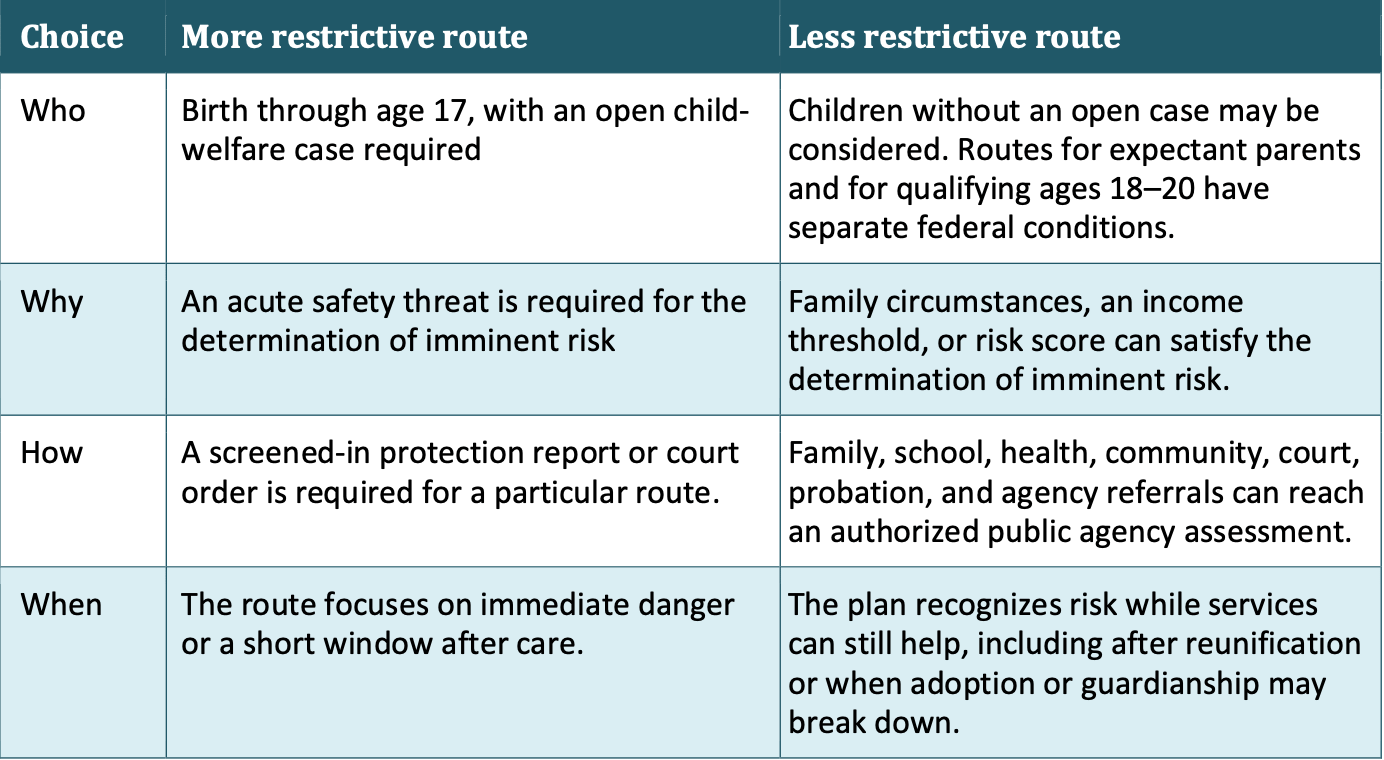
ACF’s new brief lays out a case for the ways states can much more expansively define the population they serve through Family First, expanding its reach.
In particular, the brief highlights how to use the significant flexibility available for how states define the concept of “candidacy”, a core component of eligibility in Family First.
Why it Matters
Family First allows claiming of open-ended Title IV-E funding for services to safely prevent foster care. Eligibility is tied in large part to a “candidate for foster care.”
Over multiple Administrations, ACF has intentionally kept the discretion available to states for defining that term for their Family First plan.
This latest move matters because it’s substantial encouragement to approach eligibility more expansively, with explicit examples of what states can do.
Somewhat confusingly, there is another “Candidates for Title IV-E Foster Care” definition, covering traditional foster care administrative funds for family preservation.
ACF has consistently said it is not applying that narrower definition to Family First.
What to Watch
Whether states update their plans. This would make for easier eligibility, but there are other barriers to implementation that also drive current claiming patterns.
Why Go Wonk Premium
Knowing that a Congressional hearing is happening is information. Knowing why that hearing is happening in the first place, and what opening it represents, is intelligence.
Weekly Wonk readers often see an issue more clearly after one of our pieces, and then want to know:
“Okay, but if that’s the case how can I approach my work differently this week?”
That’s exactly what our member-only Wonk Briefing Room offers.
Ali Caliendo’s recent newsletter piece showed an important issue in prevention and kinship policy; her premium brief gave an actionable framework for you to use.
Cody Cathey’s procurement paradox piece gave language to something many of you often feel stuck in. His premium brief gave a set of tools you can use to escape it.
What’s up next? This week, premium members will be getting confidential analysis of what’s new in Children’s Bureau grants, and what you can do in response.
We offer memberships to individuals and teams of 3-10. Why wait; sign up today.
Deep Dive: Remaining Gaps in Health Insurance Enrollment After Youth Age Out of Foster Care
While nearly all youth who left foster care at age 18 or later remain eligible for Medicaid until they turn 26, NYTD surveys reveal that many youth still experience coverage gaps.
By Laura Radel, Senior Contributor
This article continues a series examining outcomes of youth who aged out of foster care using data from the National Youth in Transition Database (NYTD) dashboard.
Premium Wonks previously got our premium piece looking at homelessness among young people transitioning from foster care.
NYTD surveyed this cohort at age 17 in 2020, then again at 19 in 2022 and 21 in 2024.
This article examines health insurance coverage, primarily through Medicaid.
Most young adults who aged out of foster care were eligible for Medicaid until age 26, although this cohort predates the federal requirement extending that eligibility across state lines.
Nationally, self-reported Medicaid enrollment declined from 83 percent at 17 to 75 percent at 21. But that decline was not universal: enrollment held steady in some states and increased in others.
Those different trajectories highlight the role of state enrollment and renewal practices. Eligibility exceptions and other insurance coverage further complicate the picture.
It’s also worth noting that these figures predate reduced federal Medicaid spending and more stringent eligibility requirements resulting from the One Big Beautiful Bill Act.
While former foster youth are categorically exempt from the laws’ work requirements for Medicaid eligibility, we’ve previously highlighted the way that exemptions do not merely happen, but require technology and administrative activity, putting further pressure on the maintenance of continuous coverage after aging out.
Medicaid Enrollment Fell Nationally, but States Followed Different Paths
Nationally, reported Medicaid enrollment declined from 83 percent at age 17 to 80 percent at 19 and 75 percent at 21. However, there is substantial variation among states in the proportion of youth who report enrollment.
In some states, nearly all respondents reported Medicaid coverage at each survey age. In others, only about half did. And while enrollment declined nationally, some states recorded stable or rising rates.
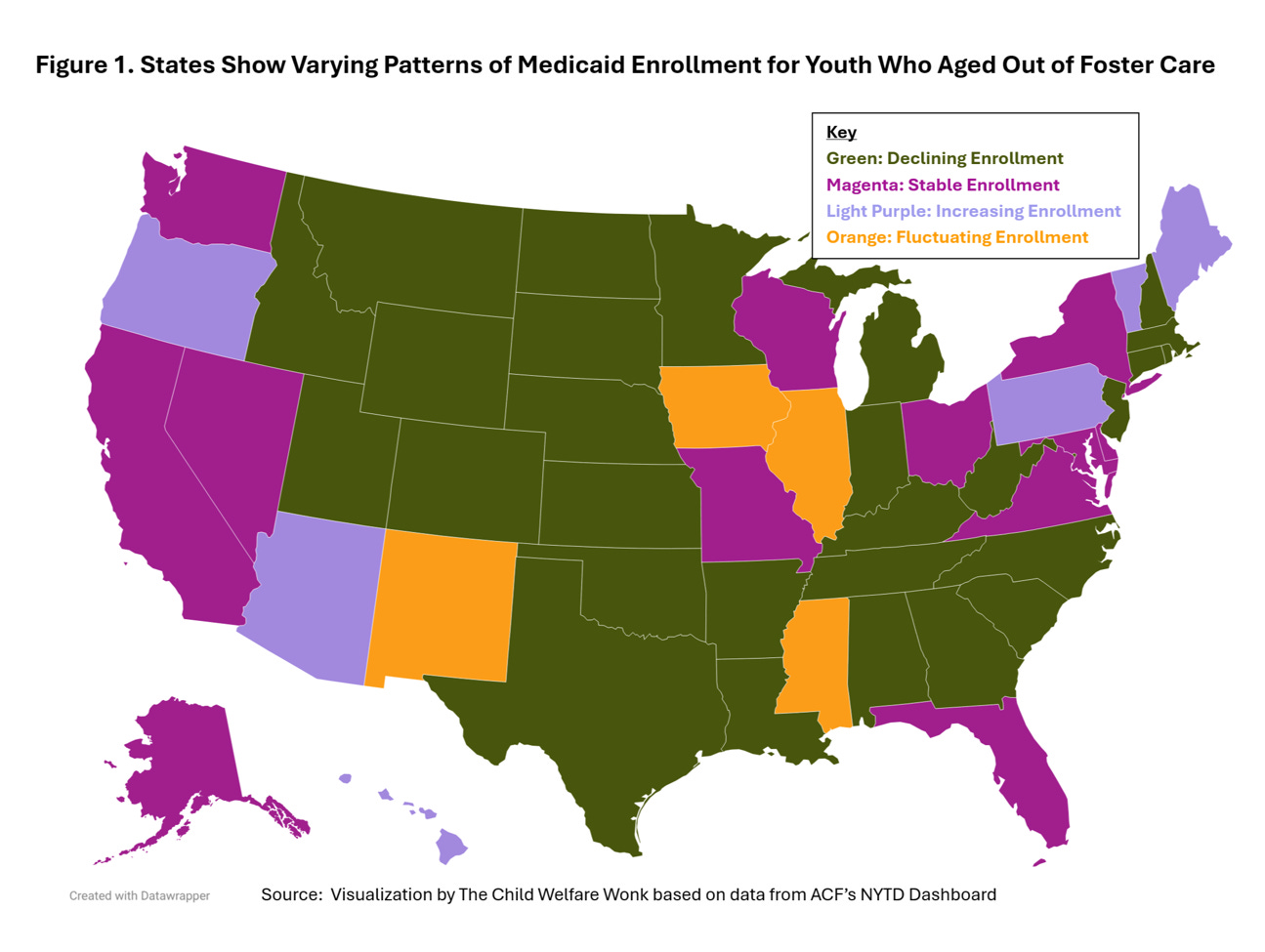
The data on Medicaid enrollment reveal four enrollment patterns. These patterns are described below and which states follow each pattern is shown on the map in Figure 1.
Decreasing Medicaid Enrollment
In 29 states, we see Medicaid enrollment declines of 8 percent or more after youth exit foster care. Declines varied in size; in 15 of those states enrollment decreased by at least 15 percent, while declines were smaller in the others.
The declines usually occurred both from age 17 to 19 and 19 to 21, but in three states the drop occurred only from ages 17 to 19 and then stabilized. The greatest declines were in:
Wyoming (down from 94 percent enrollment reported at age 17 to 48 percent at age 21)
Louisiana (down from 94 percent to 53 percent)
Idaho (down from 95 percent to 57 percent)
Alabama (down from 94 percent to 59 percent)
West Virginia (down from 97 percent to 63 percent)
Stable Medicaid Enrollment
In 12 states Medicaid enrollment rates remained approximately steady (change of 7 percent or less across from age 17 to 21).
In many of these states that relatively steady enrollment was at a high initial enrollment rate, including California where imported enrollment started at 91 percent and Virginia which started at 94 percent.
However, some were steady at lower rates. This includes Florida, with steady enrollment that started at 67 percent and Ohio which had an initial enrollment rate of 77 percent.
Increasing Medicaid Enrollment
In six states Medicaid enrollment among youth went up at each subsequent interview, including some that began with relatively low reported enrollment at age 17.
The greatest increases in enrollment were in:
Hawaii (up from 63 percent enrollment reported at age 17 to 89 percent at age 21)
Vermont (up from 61 percent to 85 percent)
Oregon (up from 70 percent to 91 percent)
Pennsylvania (up from 50 percent to 61 percent)
Maine (up from 89 percent to 100 percent)
Enrollment Was Up and Down (or Down and Up)
In four states, enrollment did not show a steady pattern but instead varied up and down at each interview. This group included Illinois, Iowa, Mississippi, and New Mexico.
Other Insurance Increased as Medicaid Enrollment Fell
Some respondents reported health insurance through a job or other source.
Nationally, the share reporting insurance other than Medicaid rose from 12 percent at age 17 to 13 percent at 19 and 17 percent at 21.
Rates of other health insurance vary substantially across states.
At each survey point there, some states reported other insurance rates in the single digits, while others exceeded 30 percent.
In some cases, states with low other health insurance enrollment have high Medicaid enrollment rates, so nearly all youth appeared to have coverage.
In others, the percent of youth reporting Medicaid and other health insurance together leave a significant gap.
The two rates cannot simply be added to calculate total coverage: some youth reported both Medicaid and other insurance, and the NYTD dashboard does not identify that overlap.
Rising rates of other insurance therefore do not establish how much of the decline in Medicaid enrollment was offset by other coverage.
What Explains The Differences?
Reported Medicaid enrollment fell nationally as this cohort moved into adulthood. But some states maintained high enrollment, while others recorded increases from much lower starting points.
Some states have used transition planning, automatic renewals, and simpler documentation requirements to help eligible youth maintain coverage.
These practices offer possible explanations for the different state trajectories, though NYTD does not establish how much they account for the results.
Looking ahead, the challenge leaders will face is the looming fiscal squeeze resulting from the One Big Beautiful Bill Act, which will constrain resources for dedicated strategies right as the added challenge emerges of demonstrating and documenting exemption from the law’s work requirements.
Across this series, young adults’ reported experiences with housing, education, work, financial assistance, and health insurance differed widely by state.
Those differences do not establish which policies worked. They show how much a national account of the transition from foster care leaves unexplained.
Partner With Wonk
Leaders often share with us that they’re tired of feeling like their organization is stuck reacting to things. They can sense they’re missing strategic opportunities.
Organizations partner with Wonk to stay in front of fast-moving policy change. Our approach has offered partners benefits that have included:
Keeping state advocates clear on why key trends and opportunities matter;
Showing state and local leaders what matters now for their top priority; and
Surfacing critical openings to shape new policy as organizations build strategy.
Partnerships combine strategic sessions and leadership briefings with broad premium access for your team.
Want to partner?
Reach out to learn about what we offer state agencies and organizations.
That’s it for this week.
Stay sharp, Wonks.
~Z
Partners Making Your Weekly Wonk Possible


