


From the Founder’s Desk
Welcome to the latest Weekly Wonk.
As someone whose prior work was in advocacy, I’m always curious about what distinguishes the influential people and organizations that have outsized impact on policy development.
Even the most sophisticated strategy will always fail without effective application of tactics that match your unique strengths.
This has only become more pronounced as the conditions within which you are trying to shape policy are harder, as we explored recently.
Child Welfare Wonk exists to provide the strategic policy intelligence anyone with a stake in child and family policy needs to be effective.
This free newsletter is our open source layer, making meaning of what matters.
Our premium Wonk Briefing Room and organization-specific partnerships go deeper, offering actionable tools and strategic application of our insights to your work.
To offer a sense of what that distinction looks like, today’s Deep Dive kicks off a toolkit on policy influence tradecraft.
We’ll be releasing all three parts through the Weekly Wonk, to show the next layer of our work.
Let’s get into it.
Weekly Wonk Deep Dive
Evolving Your Advocacy Toolkit, Part 1
Helping you to make a difference despite changing conditions.
By Doug Steiger, Senior Contributor
Advocacy for children and families is hard work. As we laid out in a recent piece on How Advocacy is Evolving, the ground has shifted in ways that have made it harder still.
The organizations that consistently move legislation share a common feature: fluency with a second layer of tools beyond relationship-building and policy pitching, including procedural levers, informational assets, and institutional mechanics that convert goodwill into durable outcomes.
A huge rally at the Capitol or marquee bill introduction with a splashy quote roll can bring visibility to an issue. As tools, that visibility also makes them quite blunt.
The tools we’re talking about are specialized ones for the craft of shaping and moving policy. They reward sustained momentum over dramatic moments.
This is the first of three installments.
The full toolkit will cover eight tools spanning the legislative and executive branches.
Part 1 begins with self-awareness about what your organization brings to the table, then turns to two underused vehicles in child and family advocacy: the appropriations process and committee hearings.
Understand Your Strengths
Effective advocacy starts with self-awareness about what your organization does uniquely well, and what Hill staff think you’re good at.
From the perspective of someone who has been lobbied a lot as a Hill staffer, advocates have different strengths.
Staffers tend to develop a mental map of who to call for what, and where you sit on that map determines whether your input shapes legislation, creates coalitions to advance it, or merely pads the press release.
The categories include:
Grassroots reach that can generate calls and emails – a role social media influencers can also play;
Grasstops reach that can target key decision-makers with individual relationships, like when you have a board member who is close with a Senator;
Technical experts to draft or fine-tune bill text so it works as intended;
Administrative knowledge of how a state or county would actually implement legislation;
Lived experience that anchors policy in on-the-ground reality and personal impact;
Thought leadership that provides the vision, theory of the case or ideological frame that defines the conversation; and
Connective capacity to assemble the broad coalitions valuable in child and family policy, given the lift necessary to get policies to be a priority
Obviously, organizations can play more than one of these roles, and each is valuable.
But nobody does them all well, and the ones you do best are where you’ll have the most influence.
Self-awareness about how inside players view your organization makes you more effective, helping you focus where you’re most effective and decide what to let others lead on.
Knowing which those are determines the difference between being pulled into a drafting conversation and being added to a coalition letter.
And if they don’t see you as filling any of those roles, you may not have any influence at all.
On to more specific aspects of working the Hill…
Tool #1: The Appropriations Process as a Policy Vehicle
An important avenue for policy-making on the Hill is the appropriations process, through which Congress funds much of the government each year.
It can be a tricky thing to influence, as it has an insular culture and distinctive approach to legislating.
This includes greater bipartisanship than the rest of Congress retains; the long-standing joke in Washington is that there’re actually three political parties, and they’re Republicans, Democrats and Appropriators.
For programs that get funded through the annual appropriations process, there are two sets of important policymaker stakeholders.
If you want to increase funding for a program, go to the Appropriations Committee.
If you want to rewrite a program’s rules, you should be looking to its authorizing committee, which designs the program through which the funds flow.
Then come the exceptions. Appropriators routinely attach policy to funding through three mechanisms:
Riders that restrict how funds can be used, often of a “thou shall not spend on x” variety
Set asides that carve out a portion of a program’s funding for a particular purpose
Congressionally directed spending (or the artist formerly known as Earmarks), which directs money to a particular activity or project, often specific to the state or district of the appropriator who secures it
Because much of the federal government shuts down when appropriations bills don’t pass, they offer a way to force Congress to deal with an issue that authorizing bills lack.
Persuading a member of the Appropriations Committee to propose a rider can often generate a real debate faster than having a junior member introduce a freestanding bill.
The children and families advocacy community underuses this avenue for two reasons.
First, the policy conversation can be overshadowed by large mandatory spending programs like Medicaid and SNAP, that largely sit outside the annual appropriations cycle.
Second, there is also a long history of tension over turf between appropriators and the authorizing committees, which can make advocates wary of risking authorizer relationships by going to appropriators for policy riders and set asides in their bills.
That’s a reasonable tension to balance, but there are ways advocates can carefully approach it, particularly by communicating clearly with staffers about the underlying goal and strategy.
Tool #2: Making Hearings Work
Committee hearings remain part of the traditional legislative path, even if they are often little more than a “check the box” performative exercise that lets a committee chair claim regular order.
Most are arranged to make a point, rather than gather facts, and advocates often respond in kind, treating hearings as visibility events to demonstrate their constituency exists and that their organization matters.
That underutilizes them. On many child and family policy issues, members at best have surface knowledge and ideological gut-reactions, rather than deeply considered positions.
A well-prepared witness can break through staff-drafted talking points with a moving story or a sharp statistic, and shift how a member actually understands the issue.
And a few strategic moves right after a hearing can elevate the consideration of an issue if you raise it the right way.
Picking and Preparing a Witness
The first step in supporting a witness is getting one on the radar of committee staff.
Witnesses get invitations from either the majority or minority party of a committee, with the majority having more of the witnesses on the panel.
What initially attracts a congressional staffer to a prospective witness?
It’s not just issue expertise, but a relevant connection to the committee’s political geography, dynamism, and typically a key “lane” to occupy.
Whether that be representing a key constituency, an essential issue, or a political wedge point
Not everyone is a good witness, even if they’re an incredible issue expert. It can be hard to look up at a dais of Senators or Representatives and speak clearly with good pacing, and unpracticed witnesses lose the room quickly.
Make your witnesses practice, and get them comfortable with communicating clearly and succinctly. The issue can be complicated, but the talking points and responses a witness has can’t be.
If you are going for the “good story” approach, particularly with witnesses who have lived experience, your witness should be comfortable sharing their story.
Child welfare, in particular, can involve traumatic experiences that are difficult for people to relate and relive.
A witness who is not ready to share their story in a high-pressure setting can be hurt by the experience, which can also undercut the message
The Window After the Gavel
The hearing is rarely the end of the play. Follow up with staff members who attended, including with those whose bosses did not.
There may be an exchange with your witness you can offer to discuss further, or state and district-specific data worth sharing.
When the hearing is tied to specific bills, the post-hearing period is when committee staff finalize legislative text and the accompanying report that lays out the intent of Congress.
If you didn’t get to weigh in on the language beforehand, this is the moment. Anything you don’t deliver gets locked in without you.
Even if you did, informing report language can shape future implementation efforts.
Hearings are inherently theatrical, but that’s not a reason to treat them as a mere play.
The witness prep, the staff briefings, and the post-hearing edits are where hearings translate into policy, and they keep momentum on your side
Engaging the Machinery
The appropriations process and the hearing room are both routine pieces of how Congress operates. Neither is hidden.
What separates organizations that use them strategically from organizations that don’t is a willingness to engage using the procedural machinery of Congress on its own terms.
What may seem like a small nuance substantially elevates the strategic impact of advocacy tactics in a challenging environment.
The next two installments turn to a different set of tools: oversight reports, report language, confirmations, and questions for the record.
Then to drafting, coalition architecture, and the long work of building champions.
Together they form the second-layer toolkit that converts motion into movement.
From the Wonk Briefing Room
The Administration for Children and Families’ A Home for Every Child lays out a numerically simple goal; have at least as many foster homes as there are children in care.
Our latest premium brief closes out a series from Senior Contributor Laura Radel, showing that gap numerically for every state for a sense of what closing it would take.
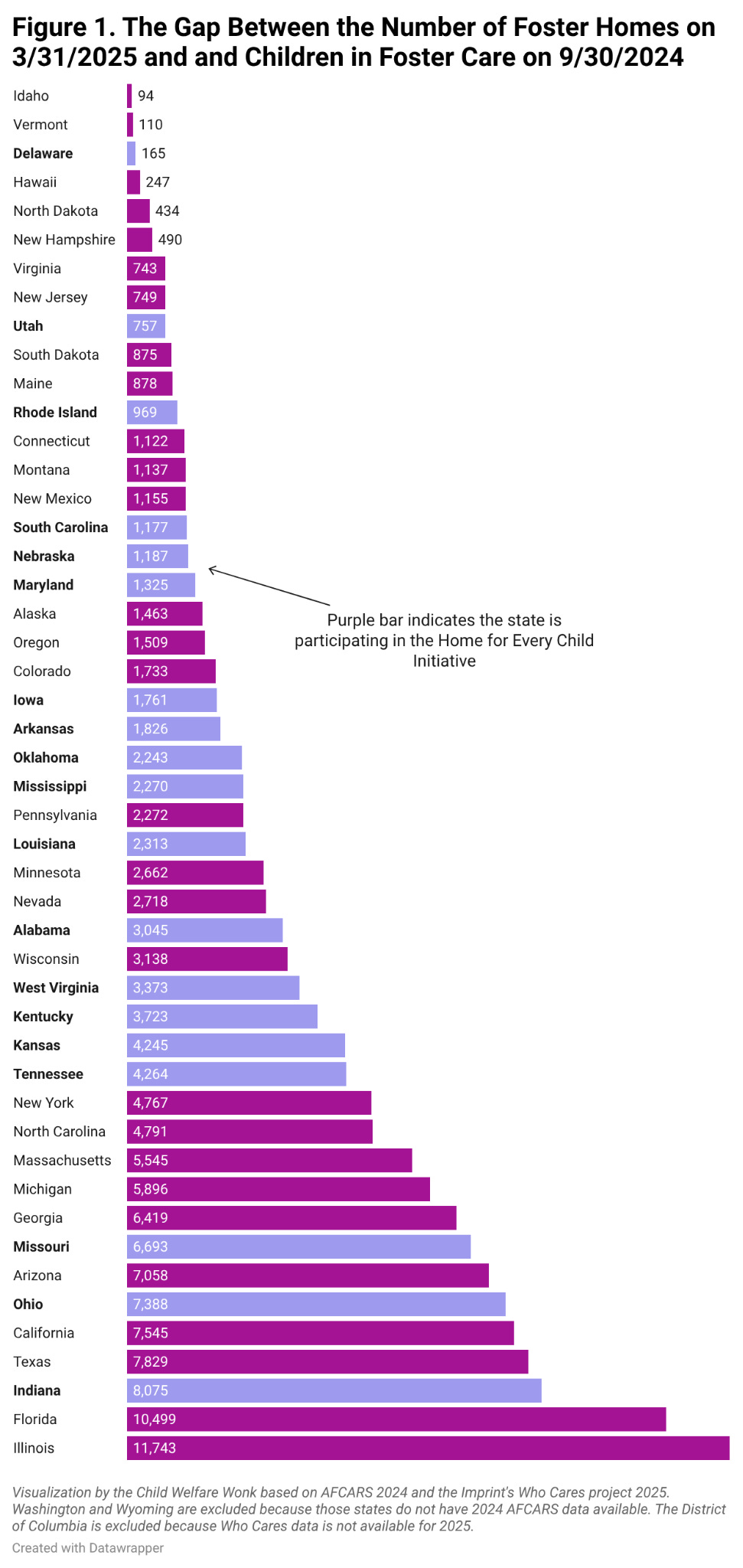
Wonk Briefing Room members get the full brief, with state-by-state data on multiple strategies that could unlock progress.
Individuals can sign up here, or get the team membership rate here.
Organizations interested in going even deeper can reach out to learn more about our partnerships that help you leverage and apply our Intel in your strategy.
Wonkatizer
Regulators, Mount Up
There are some significant new regulatory policy proposals to have on your radar.
OMB Proposes Government-Wide Grants Overhaul
What Happened: The White House Office of Management and Budget (OMB) has proposed a significant policy change to grants, cooperative agreements, and other federal funding awards.
Framed as promotion of transparency and accountability, the proposed rule would overhaul government-wide regulations for disbursement of program funds.
Why it Matters: The proposed rule would codify the Trump Administration’s shift that has moved funding award decisions away from civil servants to political appointees.
This would entail taking ad hoc policy changes under DOGE and individual agencies and making them formal, government-wide regulatory policy, including:
Eliminating the use of fixed amount funding based on achievement of negotiated milestones or deliverables, and instead reimbursing demonstrated costs incurred;
Standardizing and authorizing political appointee termination of grants; and
Restricting grant funding to exclude organizations over DEI policies or training, public discussion of issues impacting transgender people, or conducting voter registration drives.
Many of these approaches tested under DOGE have encountered legal obstacles. Encoding them in regulation would strengthen their defense in future court challenges.
What’s Next: OMB is accepting comments until July 13th.
Deeper Deregulation at ACF
What Happened: ACF announced a proposed rule purported to be the largest ever single removal of federal regulation sections.
This builds upon an earlier rollback of most ACF subregulatory policy guidance, which we unpacked here.
Why it Matters: Much of what ACF is proposing to delete appears to be proverbial deadwood; inactive rules for defunct programs, particularly Aid to Families with Dependent Children.
It would also eliminate the current rules for provisional payment of contingency funds under the Temporary Assistance for Needy Families program, which is active policy.
The question wonks will be parsing is unanticipated effects, such as whether any of what’s up for deletion is connected to current policy through reference.
What’s Next: ACF is accepting comments on the proposed rule through June 25th.
Predictive Analytics Pilot
What Happened
ACF announced a $6 million competitive grant to help state, territorial, and tribal child welfare agencies pilot predictive analytics, data-driven risk modeling.
Agencies that have joined the A Home for Every Child initiative will have priority preference.
Why it Matters
Proponents of the approach point to its ability to standardize analysis and elevate human judgment to better tailor intervention to safety risk.
Critiques center on questions about how to ensure humans are the ones making decisions and avoid amplifying biases in the models’ training data.
ACF’s issue brief from earlier this year weighs those benefits and risks and points to effective strategies for successful implementation.
What’s Next
Applications for the pilot are due by July 27th. The mix of states and variation in their approaches will be worth watching.
That’s it for this week.
Stay sharp, Wonks.
~ Z
Partners Making Your Weekly Wonk Possible


