

Welcome to the latest Weekly Wonk, and to the era of higher federal reimbursement for prevention under Family First.
As always, if you enjoy our Weekly Wonk newsletter, you should know it’s only the outer layer of what we have to offer.
Leaders across our field are inundated with information, and much of it is noise.
The hard part is knowing what matters, what’s actually moving, and what you can do about it.
We can help you separate signal from noise so that you can:
See power and policy more clearly;
Know where you can shape what’s possible; and
Make confident decisions despite uncertainty and volatility.
Reach out to learn more about what we offer public agencies and organizations.
From the Founder's Desk
This week, we’re wrapping up our series with the Center for the Helping Profession on the child welfare workforce and safety.
Part-one looked at the relationship between workforce conditions and safety.
Part-two explored how policy and institutional risk management can actually reduce safety.
Part-three unpacked how the rational focus of safety reviews can miss the root drivers of decision quality and its relationship to risk.
This final installment looks at lessons child welfare leaders have been applying to learn from other safety-critical industries, like aviation and hospitals.
Let’s get into it.
Wonkatizer
Family First Phases In
October 1 begins FY 2027. It’s a big milestone for the Family First Prevention Services Act, which just has an increase in the federal share of financing for prevention.
What Happened
Congress wrote Family First with phased-in federal financing of prevention. Until now, the federal share was 50 percent.
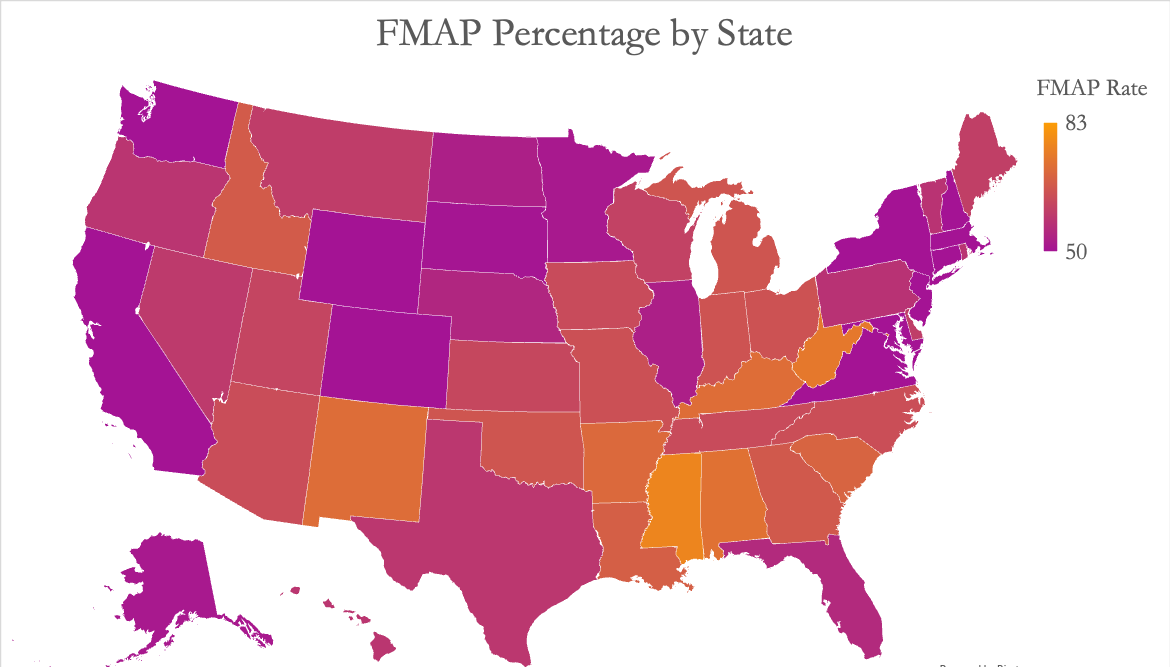
Going forward, it’s the state’s Federal Medical Assistance Percentage (FMAP), the formula that governs the state/federal split of Medicaid financing.
You can see the FMAP rates for FY 2027 here and in this map:
Why it Matters
Like Doug Steiger has shown our premium members, you can’t understand Family First without understanding the political negotiations that underpin it.
Cost containment was central to compromise on Family First; this phased-in bump made it easier to pass the law.
What to Watch
The previously lower reimbursement created a further rate limit on top of those Family First faced already. This could change the calculus.
Premium Wonks know that while official data lag, we can find more recent data.
C(FSR)-Ya Later
Today, the Administration for Children and Families (ACF) issued a proposed rule to eliminate regulations for the Child and Family Service Review (CFSR) process.
What Happened
The proposal rests upon a provision from the 2025 reauthorization of Title IV-B of the Social Security Act, which instructed ACF to reduce related paperwork at least 15%.
The most significant rollback is the Child and Family Service Plan (CFSP) requirements and CFSR reporting framework at 45 CFR 1357.
This does not eliminate data collection and oversight through the Program Improvement Plan (PIP) process.
Why it Matters
This aligns with ACF Assistant Secretary Alex Adams’ big bet on durable policy change; encoding it through voluntary lock-in.
ACF has every state participating in its A Home for Every Child initiative, which offers states an offramp from the CFSR process and alternative, streamlined PIPs.
In return for less overall reporting, states report more frequently on data relevant to A Home for Every Child. This formal deregulatory proposal locks this in further.
What to Watch
The tension to track is what this means for policy within rescinded state plans not covered by new data reporting.
For example, 2008’s Fostering Connections to Success and Increasing Adoptions Act required states to develop Health Oversight and Coordination Plans for the health care of children and youth in foster care, including psychotropic medication oversight.
A 2015 HHS OIG report underscored how little those plans alone changed access. Eliminating the requirement entirely raises the question of what ACF would do instead.
Public comment is open through November 4; expect quick implementation after that.
ACF’s Expectant Parent Policy Push
Family First also has an unexpected new eligibility population: expectant parents.
What Happened
The Administration for Children and Families has rolled out a new policy saying that expectant parents can receive services funded through Family First.
This follows a comprehensive overhaul of the Child Welfare Policy Manual, something we cross-walked comprehensively to update our premium members.
Why it Matters
Infants are the largest age group entering foster care. But there’s a complicating factor.
Family First service eligibility is predicated on the child. An option to serve expectant parents means operationalizing required data tracking for an unborn child.
What to Watch
Finding a way to satisfy or reform those data requirements without such data tracking would seem to be key for scaling this approach; watch for likely movement to use implementation flexibility to make this option appealing to more states.
Weekly Wonk Deep Dive
The Job Description No One Would Post
What the science of psychological safety reveals about leadership, and what one state built
By Michael Leach and Elizabeth Riley
Imagine a child welfare agency posting a job for its next director: “Seeking a leader with a strong track record of using fear and blame to motivate safe behavior.” No agency would post it. No one would apply.
Yet the pressures surrounding the job can push leaders toward exactly that approach. When a child dies, elected officials and the press demand answers.
Agency leaders face pressure to identify who failed, fire someone, and add a rule. Each offers visible evidence of action. Whether it makes the system safer is a different question.
Staff learn from those responses. When leaders publicly blame workers for mistakes, raising a concern can start to look like risking a job or reputation.
Uncertainty stays private. Bad news arrives late. The response to one crisis can make the next risk harder to see.
That makes leadership a safety-critical issue in systems like child welfare. Workers need to feel safe enough to speak up, admit uncertainty, and surface bad news while there is still time to act.
Leaders create the permission structure for this culture, and only then can staff enact it.
The Science of Psychological Safety
Psychological safety is a term that describes the conditions under which this culture is built.
Amy Edmondson defined it as the shared belief that a team is safe for interpersonal risk-taking, the felt permission to say: “I’m not sure,” “I missed something,” or “This doesn’t look right.”
Leaders build or erode it through their responses to errors, mistakes, and critical feedback.
The counterintuitive finding is that safe teams reported more errors, not fewer. Crucially, these teams were not making more mistakes; they were simply reporting them more consistently.
Blame does not reduce errors; it reduces the reporting of them.
Nursing units that talk openly about what is going wrong log fewer medication errors and patient falls in the months that follow, showing that speaking up isn’t just safer for morale; it’s safer for patients.
The mechanism that underlies psychological safety is disclosure. Early, open discussion of errors or questioning workflows allows teams and systems to remain watchful, pivot when necessary, and learn from outcomes.
Systems do not improve by firing bad apples. Blame that looks like accountability blinds a system to its own risks.
Accountability must be shared across a system, from frontline worker to agency director; psychological safety is the precondition for this accountability, not its absence.
Psychological safety makes that scrutiny possible. Staff can be expected to account for their decisions while leaders account for the conditions in which those decisions were made.
Culture is Measurable and Changeable
Agency culture is something leaders often gesture at vaguely. But it can be measured reliably with numbers and metrics, using validated scales, compared across teams, and tracked over time.
The TeamFirst Assessment of Safety Culture (TASC; Center for the Helping Professions) has collected more than 50,000 responses across more than twenty child welfare agencies, using validated scales adapted to child welfare, including psychological safety.
Higher psychological safety is associated with less emotional exhaustion, stronger connection, better teaming, and greater intent to stay.
Just as culture can be measured, it can be changed. Across agencies, psychological safety scores look nearly identical, but vary widely between teams across agencies. The same pattern appears in hospitals and their internal units: an organization’s average can conceal very different experiences within its teams.
Culture is built locally through teachable habits like daily huddles, structured communication handoffs, and debriefs after hard cases. Leaders provide that necessary permission structure and resources to build and sustain it.
Building Trust in South Carolina
South Carolina shows what trust looks like in practice. The system had made little meaningful progress on its settlement agreement in four years before Mike and his team took on leading the agency. Leadership had changed repeatedly.
The agency was running a deficit.
Staff had asked for help, heard “no” enough times, and stopped asking. People were leaving faster than it was possible to replace them, and too many families could not get the services they needed.
On many measures, South Carolina was near the bottom nationally.
You cannot move a system like that with a memo; it takes trust building while doing the work. That looked like talking with local office staff carrying cases to askwhat was getting in their way, and asking families what stood between them and help.
It also meant surfacing the good and bad news in the data, and returning to the same questions. Staff had seen leaders come and go. Consistency mattered more than a speech.
One of the biggest barriers was fear.
People watch what leaders do when the news is bad. That is when they decide whether it is safe to speak up next time.
What made a difference was accountability with support; asking what went wrong and what a reasonable person could have done, but also whether the agency had the conditions around them to make good decisions more likely.
What Changed, and What Took Longer
The TASC survey showed whether those SC staff actually felt the difference. Over three years and under stable leadership:
Over three years and under stable leadership:
Workplace connectedness rose from 78 to 81 percent.
Mindful organizing rose from 71 to 82 percent,
Psychological safety rose from 63 to 67 percent, and
Intent to remain rose from 62 to 70 percent.
Emotional exhaustion fell from 38 to 28 percent.
Psychological safety improved, though less than some of the other measures. That gap is itself a finding: connectedness and mindful organizing are things a team can practice together starting tomorrow, but psychological safety asks people to unlearn years of watching colleagues get blamed.
It is the slowest trust to rebuild because it is the trust leaders broke most directly. It told us trust was still work to be done.
Listening only counted if it changed decisions, which required securing funding, redesigning policy, and making culture into decisions, not just values statements.
When the Next Crisis Comes
The lesson is not that the work is easy: psychological safety is a state you maintain, not an initiative you complete. Pace and turnover pull against it constantly. The burden of maintaining it is heaviest when a crisis makes blame most tempting.
Other safety-critical fields learned this long ago.
Aviation and medicine treat a workforce that feels safe to speak up as a safety asset in its own right, because the alternative is losing experienced people who catch problems early. That is a loss child welfare can least afford.
The question is not whether psychological safety can be built. It can.
South Carolina did it over the course of three years of hard work, and many other child welfare systems in the National Partnership for Child Safety have seen similar growth over the years.
The question is whether any system can hold it long enough to outlast the people who built it.
Nobody would ever say they want a leader who rules by fear and blame, but our systems keep pulling us into that same kind of leadership anyway.1
Mike Leach is the Chief External Engagement Officer at Think of Us. From 2019-2025, he was Director of the South Carolina Department of Social Services.
Elizabeth Riley is the Chief Analytics Officer at the Center for the Helping Professions.
That’s it for this week.
Stay sharp, Wonks.
~Z
Partners Making Your Weekly Wonk Possible


Thanks for reading Child Welfare Wonk! Subscribe for free to receive new posts and support our work.
Edmondson, A. C. (1996). Learning from mistakes is easier said than done: Group and organizational influences on the detection and correction of human error. Journal of Applied Behavioral Science, 32(1), 5–28.
Edmondson, A. C. (1999). Psychological safety and learning behavior in work teams. Administrative Science Quarterly, 44(2), 350–383.
Edmondson, A. C., Higgins, M., Singer, S. J., & Weiner, J. (2016). Understanding psychological safety in health care and education organizations: A comparative perspective. Research in Human Development, 13(1), 65–83.
Vogus, T. J., & Sutcliffe, K. M. (2007). The Safety Organizing Scale: Development and validation of a behavioral measure of safety culture in hospital nursing units. Medical Care, 45(1), 46–54.
Vogus, T. J., Cull, M. J., Hengelbrok, N. E., Modell, S. J., & Epstein, R. A. (2016). Assessing safety culture in child welfare: Evidence from Tennessee. Children and Youth Services Review, 65, 94-103.