

From the Founder’s Desk
Federal grant programs operate on their own esoteric language and serious standards.
They also have their own equivalent of pulling an all-nighter to submit a paper on time.
The federal fiscal year starts October 1, aligning with neither the calendar nor most state budgets.
Surely that places a premium on lots of lead time for coordinating investment?
Alas no, as you’ll see in Laura Radel’s newest Deep Dive, the second in her three-part look at Children’s Bureau discretionary grantmaking.
Her analysis points to a growing trend that you surely feel if your work has any touch point with those funds; like the proverbial all-nighter to wrap up the semester, these grant awards are increasingly piling up to the final weeks of the fiscal year.
That, in turn, has ripple effects that include:
reduced predictability;
less time for grantees to develop quality proposals and partnerships to execute them; and
compression of the federal review and decision-making process.
On this week’s WonkCast, I sat down with one of the leading thinkers on child welfare financing policy, Dennis Blazey.
Over his 24 years as Ohio’s child welfare budget and fiscal officer and subsequent consulting career, he has shaped your work whether you know him or not.
A key takeaway; don’t sleep on the humble “bed day”, which may sound like a wonky foster care measurement but is his go-to strategic leverage point for financing prevention.
That also pairs well with the latest brief our premium members are reading, in which child welfare and Medicaid expert Uma Ahluwalia unpacks what gets in the way of using Family First and Medicaid together, and how to shift it from barrier to opportunity.
Let’s get after it.
Weekly Wonk Deep Dive
Wait For It: The Children’s Bureau Grant Calendar Is Moving Toward September
A three-year review shows a sharp change in when discretionary awards are being made—and FY 2026 may follow the same pattern.
By Laura Radel, Senior Contributor
Federal grants do not only matter because of how much money is awarded or what it supports.
Timing matters too.
Grant recipients need time to hire, contract, establish partnerships, and begin work.
Federal agencies need enough runway to publish opportunities, review applications, resolve questions, and obligate funds before the fiscal year closes.
The Children’s Bureau’s award calendar has changed considerably over the past three years.
This analysis examines that shift, what may be driving it, and what the unfinished FY 2026 calendar signals as the September 30 deadline approaches.
It is the second in a three-part series on Children’s Bureau discretionary grantmaking.
Part I examined the changing composition of awards. Part III will map where grant funding is going geographically.
What Grants Are Included in This Analysis?
This analysis examines discretionary grants and cooperative agreements awarded by the Children’s Bureau in fiscal years 2023 through 2025.
The data come from the Department of Health and Human Services’ Tracking Accountability in Government Grants System, or TAGGS.
Cooperative agreements are a type of grant that involves more direct cooperation between the federal agency and the recipient than is possible with a regular grant.
The Children’s Bureau often uses cooperative agreements for technical-assistance activities and knowledge-building Quality Improvement Centers.
Only awards with positive dollar amounts in a fiscal year are included.
Entries with zero or negative amounts—often reflecting adjustments, cancellations, or revisions to prior awards—were excluded.
The Grant Calendar Shifted
The timing of Children’s Bureau awards changed substantially over the three-year period.
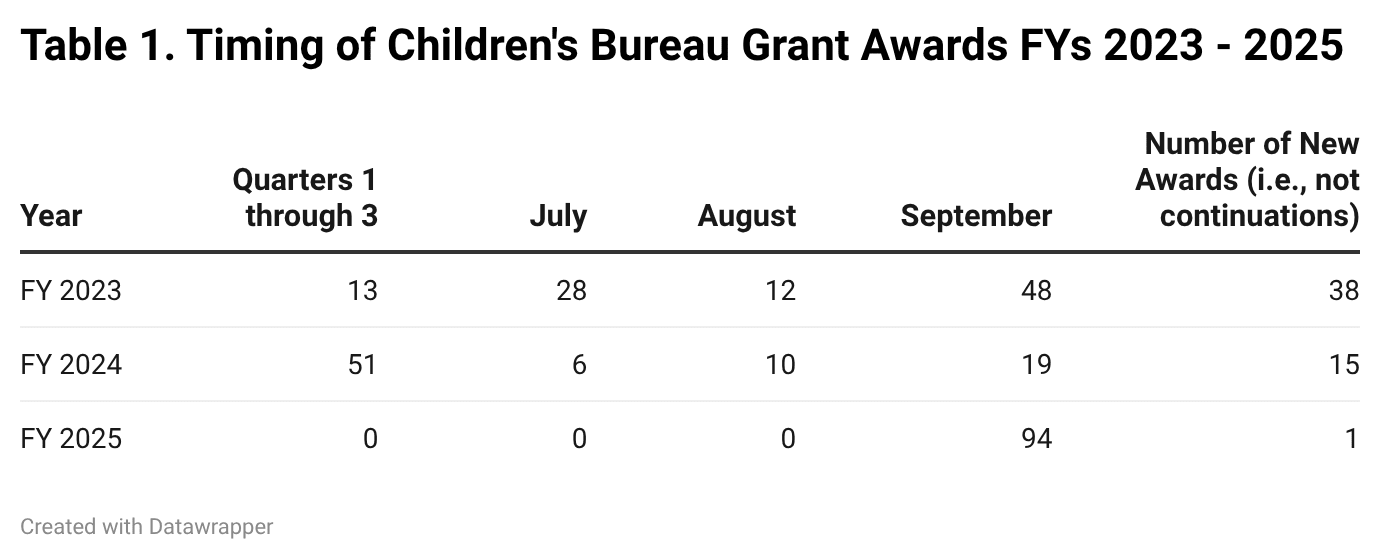
Table 1 shows when awards were made in each fiscal year and how many were new awards rather than continuations.
FY 2023 followed a relatively typical pattern.
A small number of awards were made during the first three quarters, while 87 percent of awards were spread across the 4th quarter. Nearly half were awarded in September, the last month of the fiscal year.
In FY 2024, the final year of a presidential administration, awards were made earlier.
Nearly 60 percent were issued before the fourth quarter, most of them continuations of existing awards.
The remaining awards trickled out over the fourth quarter with just 22 percent of awards made in September.
The number of new awards also fell sharply, from 38 in FY 2023 to 15 in FY 2024.
From a Fourth-Quarter Rush to a September Pileup
FY 2025 was markedly different: all 94 awards were made in September.
TAGGS data shows only one new award with a positive balance.
There were some awards listed in the data with zero dollar amounts, but those were excluded from this analysis.
The zero-dollar records may reflect awards made at the end of the fiscal year for which funding had not yet appeared in TAGGS.
That possibility makes the count of new FY 2025 awards less certain than the positive-dollar data alone suggest.
The timing pattern is clearer.
What had previously been a fourth-quarter-heavy process became concentrated entirely in the final month of the fiscal year.
FY 2026 Is Running Out of Runway
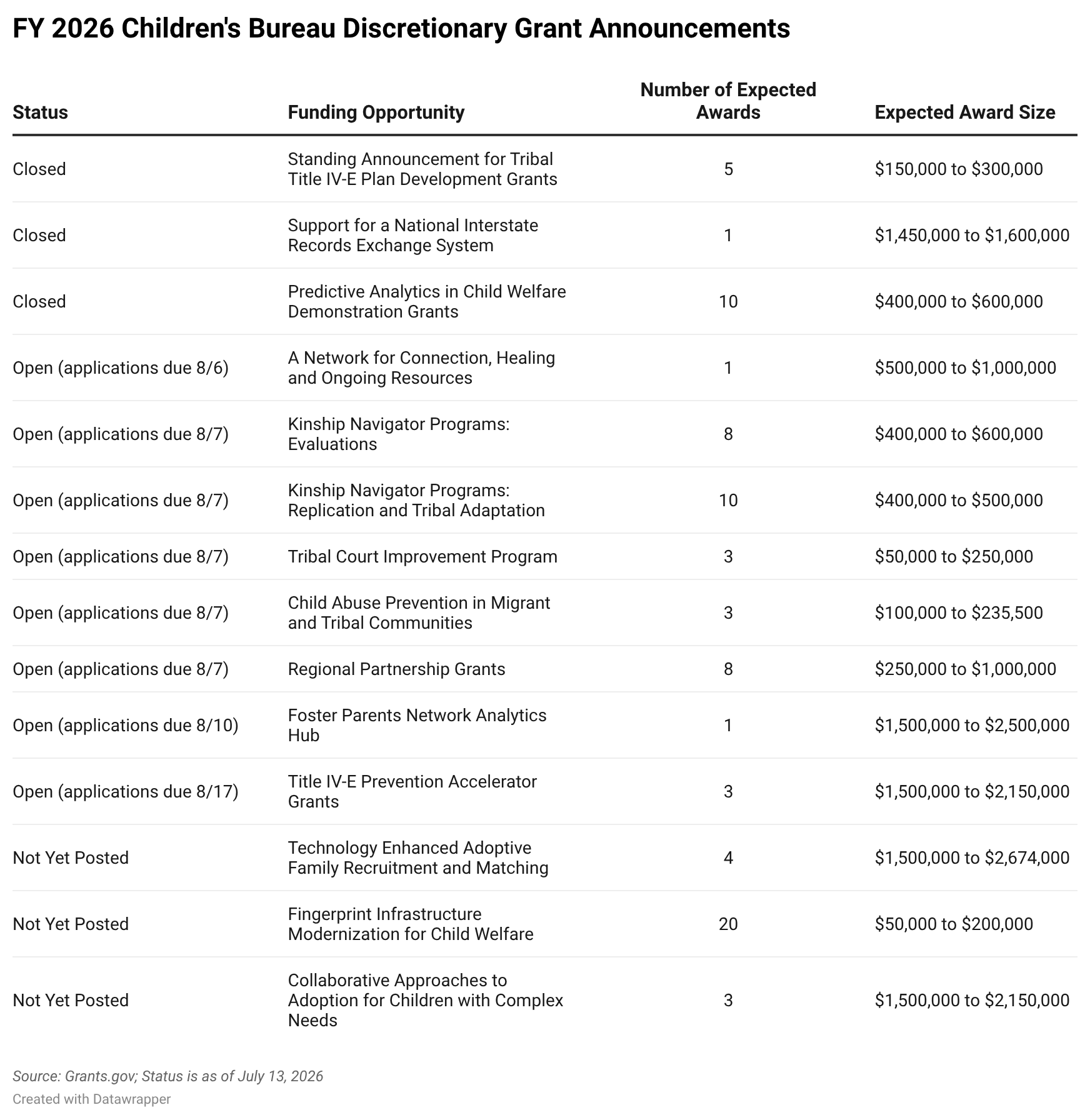
The FY 2026 grant calendar is again compressed. As of July 22, TAGGS showed no positive awards for the fiscal year, just several negative and zero dollar awards.
Three grant announcements have closed without awards (yet), eight were still open with applications due in August, and three have been forecast but as of this writing had not been published.
They may yet be published, but the proposal writing and review processes will necessarily be tight.
Funds lapse if awards are not made by September 30.
Together, the pending announcements covered kinship navigation, tribal courts, substance use, adoption, prevention, data systems, and other child welfare priorities.
A complete list of announced and forecast FY 2026 funding opportunities appears in the appendix.
That leaves little time for applications to be submitted, reviewed, and awarded before September 30, when the fiscal year ends and unobligated funds may lapse.
The pattern resembles FY 2025, when all 94 positive-dollar awards were recorded in September.
The late schedule does not necessarily mean the awards will not be made.
But it does mean that the review of grants will be rushed on a compressed schedule and there will be little time to negotiate any issues with applicants before grants are awarded.
It also increases the likelihood of another year in which grant decisions are concentrated in the final weeks of the fiscal year and may initially appear in federal data as zero-dollar or incomplete records.
Also unclear is whether more than usual political or other considerations will go into awards.
Typically grants are awarded to those applicants whose review scores are highest, with occasional exceptions to award to a high scoring (but not absolute top scoring) proposal that ensures reasonable geographic distribution and that an appropriate representation of high priority issues are covered (for instance when multiple priority topics are included in a single grant announcement).
What the Calendar Signals
Late awards are not necessarily lost awards.
The Children’s Bureau can still obligate funding through September 30, and federal data may take time to reflect the final form of awards made near the deadline.
But an increasingly back-loaded calendar changes how the grant process functions.
It gives applicants less predictability and less time to prepare quality proposals. It compresses federal review and decision-making.
And it leaves less room to resolve problems before unobligated funding lapses at the end of the fiscal year.
The key question for FY 2026 is therefore not simply whether the Children’s Bureau makes the awards.
It is whether another year of September-heavy grantmaking is becoming the new operating pattern.
Part III of this series will turn from what is funded and when awards are made to where the grants are going geographically.
Appendix: FY 2026 Children’s Bureau Funding Opportunities
From the Wonk Briefing Room
Splitting the Check: Who Pays When Child Welfare and Medicaid are Both at the Table?
BY UMA AHLUWALHIA, MSW, MHA
Every Friday, members of our premium community — the Wonk Briefing Room — get our latest brief. Where the Weekly Wonk maps the terrain, our premium resources are about how to navigate it.
This week, Uma Ahluwalia goes inside one of the most consequential financing puzzles in prevention policy: why Family First’s promise keeps stalling at the seam between Title IV-E and Medicaid.
We’ve all been there. You’re out at a meal with friends or colleagues, having a wonderful time when the check arrives. What do you do?
The most operationally smooth approach is an even split; clean, simple, and fast.
But often there’s resistance, whether it’s the colleague with a more restrictive expense policy, or that friend who ‘totally didn’t even eat any mozzarella sticks!”
At that point, everything moves at the speed of the person coordinating and spreading the costs appropriately. That’s what’s often happening with Family First and Medicaid.
Uma Ahluwalia’s expertise spans both child welfare and Medicaid, making her well positioned to explore the opportunity at their crossroads.
She lays out four structural barriers and gives leaders a sharper way to diagnose where their own system is quietly absorbing costs it could be claiming.
To read the full brief and access all our premium resources, join the Wonk Briefing Room. Individuals can sign up here, or get the team membership rate here.
Organizations interested in going even deeper can reach out to learn more about our partnerships that help you leverage and apply our intel in your strategy.
Further Reading and Listening:
Family First, Light on Families by Zach Laris
Family First and the Limits of Policy First Reform by Lynne Tiede
Is Family First Delivering on Its Promise? by Zach Laris
WonkCast #19 An Insider View on Family First with Laura Bernsten
Wonkatizer
Reconciliation 3.0, Meet the Senate Stall
What Happened
After their own party had shut down the floor and effectively shut down business for days, House Republican leaders moved a budget resolution unlocking a third party-line reconciliation bill, “Reconciliation 3.0.”
The roughly $95 billion budget resolution centers on a Pentagon funding boost tied to the war with Iran, with $60 billion for Armed Services and $15 billion for Intelligence.
The bill would also provide $12 billion in relief to farmers facing rising fertilizer prices, largely resulting from the closure of the Strait of Hormuz resulting from the war.
The bill also has up to $10 billion for the SAVE America Act’s voter-ID provisions.
Don’t expect a steady march to enactment, though; Senate Majority Leader John Thune has signaled he won’t take up the House blueprint until the chamber resolves the September 30 government funding fight.
Why it Matters
This Senate stall pushes any reconciliation bill toward the post-election lame duck, the brief session before the new Congress is seated, if it moves at all.
That’s Senior Contributor Doug Steiger’s recent analysis playing out in real time; the fault line to watch is less about partisan differences and more about structural misalignment within the GOP right now.
What matters goes beyond the horse race. For child and family programs, the central question is whether any potential bill would use spending cuts to offset the new funds, which could mean more safety net cuts.
A slip to the lame duck expands rather than erases that exposure, by circumventing the political cost of touching safety-net programs.
What to Watch
Whether reconciliation survives to the lame duck at all will be a function of whether Congress can fund the government beyond September and how the midterms play out.
Also key to watch is the $12 billion in farm aid tucked into the House resolution.
Part of Senate GOP leadership’s reticence to revisit reconciliation is that this provision would open up a new front for simple-majority SNAP amendments aimed at reversing cuts to the food assistance program last year.
That’s it for this week.
Stay sharp, Wonks.
~ Z
Partners Making Your Weekly Wonk Possible


