

From the Founder’s Desk
We’re starting the week with an expected, likely short partial government shutdown. That could be over as soon as tomorrow.
This week, we’re digging deeper into something most child welfare conversations are missing entirely: the implications of long-term fiscal pressures from deficits and debt.
You may be hearing about the impact of the shutdown on government bonds, and the growing weakness of the U.S. dollar
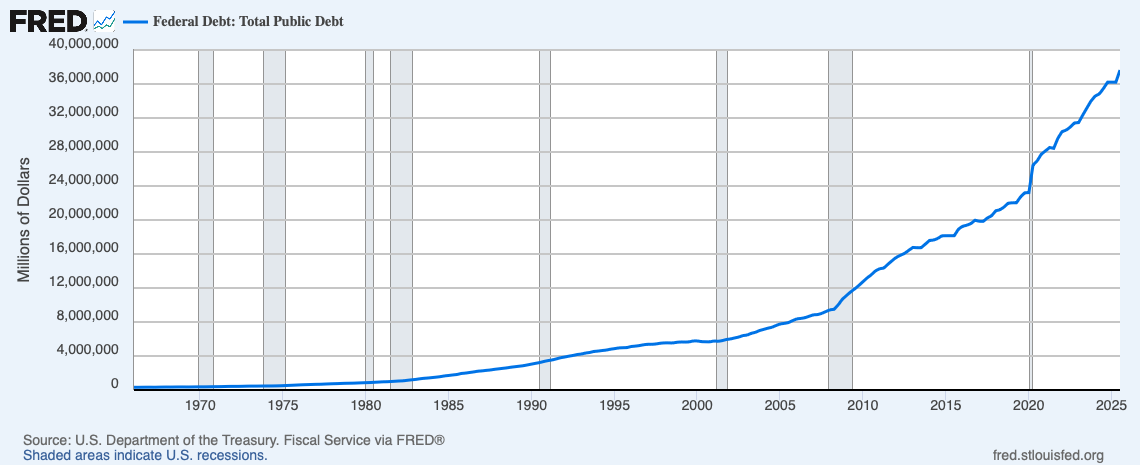
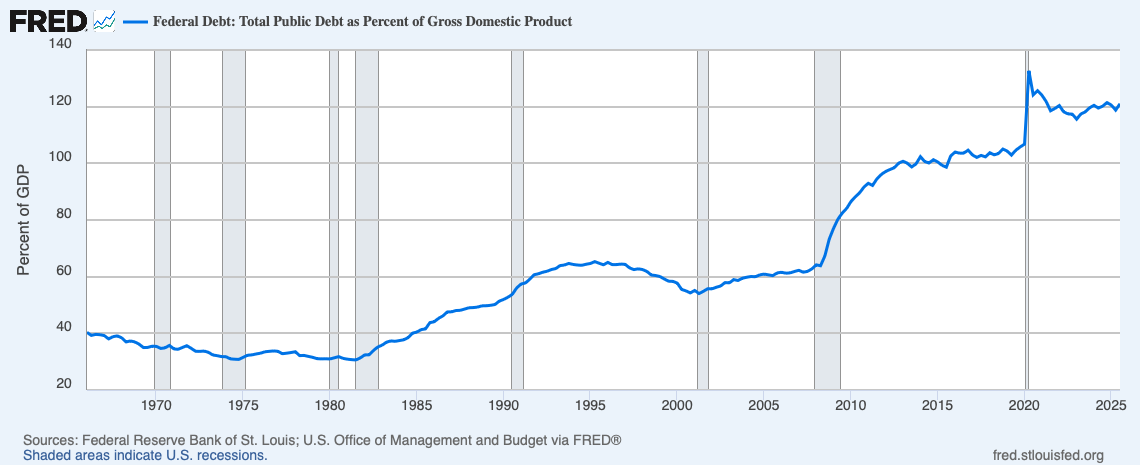
There are also longer-term structural factors that matter for policymaking, including what it means to have the federal debt rising and at historically high levels long term:
Total U.S. Federal Debt
U.S. Federal Debt as a Percent of GDP
These dynamics are going to shape what’s possible in and expected of child and family policy, which this week’s Deep Dive unpacks.
In her first Wonk contribution, Rebecca Robuck kicks off a two-part series on why these trends matter and how leaders across child and family policy can prepare.
Last week, our latest WonkCast continued our exploration of poverty, prevention, and child welfare with Jedd Medefind, President of the Christian Alliance for Orphans.
Jedd argues that material hardship is often intertwined with other forms of adversity, creating “complex poverty” that has no single solution.
That conversation sharpened my thinking, and I expect it will sharpen yours.
Special thanks to Binti for their foundational sponsorship of WonkCast.

Let’s get into it.
Weekly Wonk Deep Dive
The Next Deficit Moment—and Why Child and Family Policy Should Care
By Rebecca Robuck, Partner at ChildFocus
It’s time for the child welfare community to engage in deficit reduction conversations.
Last fall, the U.S. national debt surpassed $38 trillion. That number is not just a headline. It’s a governing constraint.
Child and family programs are not the main drivers of long-term debt growth, but they’re often among the first facing scrutiny when Congress looks for savings.
The reason for this is structural rather than moral, and it points to why this conversation is unavoidably important for child and family policy leaders to engage proactively.
In deficit moments, policy outcomes are shaped less by fiscal responsibility than by political insulation—and child and family programs have very little of it.
Recent history illustrates this point.
H.R.1, the One Big Beautiful Bill Act, included significant cuts to Medicaid and structural changes to SNAP to reduce federal spending – even though neither program is a primary driver of long-term debt growth.
Medicaid was targeted in part because it lacks the political protections of Medicare and Social Security.
SNAP, while relatively small in federal budget terms and widely regarded as efficient and effective, was also treated as a source of cuts.
These examples are not anomalies. They are previews.
First, A Primer on the Debt
The national debt is accumulated federal borrowing – which happens when spending exceeds revenues.
Today’s $38+ trillion debt works out to roughly $500,000 per child in the U.S. – which is an unprecedented level in both absolute terms and relative to the size of the economy.
It is expected to exceed its record high relative to the size of the economy – a record that occurred in the aftermath of World War II – in just four years.
Yet what matters is not the existence of debt, but how it reshapes what policymakers prioritize—and how it is used to justify those choices.
As long as debt remains abstract, child and family policy can afford to sit at the margins of fiscal debates.
But when debt becomes a governing constraint, fiscal debates stop asking what works and start asking what can be moved.
That shift exposes which programs are politically protected—and which are not.
Why Child and Family Programs Are Easy Targets
Spending on programs for children and families lacks two structural defenses against targeting for budgetary savings:
Political Vulnerability
Programs like Medicare or defense spending have clear constituencies that meaningfully mobilize, making them unavoidably legible to policymakers.
Child and family serving programs tend to be broad, and many of the people they serve cannot or do not regularly mobilize during elections or policy deliberations.
Fiscal Vulnerability
Arguments for return on investment work best for windows that fit Congressional Budget Office (CBO) timelines and savings that occur within the systems doing the spending.
Child and family policy– by definition– has a long-term fiscal value proposition.
Savings often come from unrelated programs, reducing decision-maker alignment on investment.
Taken together, these vulnerabilities explain why child and family programs face scrutiny even when they are not driving deficits.
Why National Debt Debates Will Intensify
Historically, these vulnerabilities mattered most in brief deficit moments.
The emerging fiscal environment suggests those moments are becoming longer, harder to defer, and more consequential.
Three new dynamics at play signal that a sense of urgency that hasn’t been felt in past debt debates will emerge:
First, interest payments are growing faster than most federal programs and now compete directly with discretionary spending, leaving far less room to absorb pressure without tradeoffs.
Second, deadlines to fix major trust funds are rapidly approaching.
Social Security’s trust funds are projected to become insolvent in the early 2030s, forcing Congressional action within the next decade.
Unlike past debt warnings, it is a statutory deadline that forces sustained fiscal attention that will make it harder for lawmakers to postpone difficult decisions across the rest of the federal budget.
Third, the set of politically available options for deficit reduction is narrowing.
Until big changes to Medicare and Social Security become inevitable, deficit pressure does not disappear – it concentrates elsewhere.
Taken together, these dynamics point to a shift from episodic deficit debates to sustained fiscal pressure.
As that pressure intensifies, the structural vulnerabilities of child and family programs move from background risk to front-line exposure.
What Comes Next For Child and Family Policy?
A fork in the road looms for the child and family policy community: engage strategically before the cuts arrive—or defend a fragmented status quo and hope for the best.
The next round of deficit reduction will be shaped by choices made long before it arrives.
And these decisions, in turn, will shape the foundations of future conversations about the next long-term policy structure.
The historical pattern of social programs being targeted for deficit savings reflects political choices; it is not inevitable.
Avoiding it will require the child welfare policy community to engage earlier, more strategically, and more fluently in fiscal debates it has often avoided.
That engagement will also require harder conversations: whether the programs we are defending – many designed for a different era – are structured to meet the needs of today’s families, or whether their structure leaves them exposed when budgets tighten.
Part 2 of this series will explores how the child and family policy community can come to the table in these conversations—and what it will take to build systems that are both effective for families and durable in a debt-constrained era.
From the Wonk Briefing Room
This week’s premium brief is part two of a two-part Director Perspective series on the Child and Family Service Review (CFSR) process.
Financing and accountability are two sides of the same federal policy coin.
As conversations ripen about what to do next on federal child welfare financing, similar deliberation is emerging about accountability, particularly the CFSRs.
We’ve invited reflections from former agency leaders who worked for Republicans and Democrats to share about the challenges with current child welfare oversight.
Toward Smarter Accountability: Reimagining the Child and Family Services Review
By Rebecca Jones Gaston, former Commissioner of the U.S. Administration on Children, Youth and Families
For more than 25 years, the Child and Family Services Review, or CFSR, has been the primary federal mechanism for assessing state child welfare system performance.
Its purpose is well-intended: to ensure that children are safe, supported to achieve permanency, and able to experience well-being.
The results leave more to be desired: a recent ASPE analysis confirms a striking reality—no state has ever passed a CFSR across multiple rounds of review.
This finding should not be interpreted as evidence of collective failure by states.
Instead, it signals that our accountability metrics and policies are themselves not aligned with the complexity and evolution of child welfare systems.
The process becomes the work instead of the outcomes and well-being of children and families.
I have experienced the CFSR from multiple vantage points.
As a state child welfare director in Oregon and Maryland, I was responsible for leading agencies through reviews and Program Improvement Plans.
Later, in federal government, I oversaw child welfare policy and accountability. From those perspectives, the ASPE finding is not surprising.
When distinct forms of accountability are collapsed into a single determination of substantial conformity, states can follow the law, spend funds appropriately, and still be labeled as failing.
Under those conditions, it is not surprising that no state has ever passed.
It is, however, deeply instructive, and calls us to move beyond critique and toward a clearer vision of what accountability in child welfare should be.
—
To read the entire brief and get them weekly sign up for the Wonk Briefing Room here.
Wonkatizer
ACF Launches New Public Child Welfare Performance Dashboard
The Department of Health and Human Services’ Administration for Children and Families (ACF) launched a new public dashboard showing state-by-state performance data on child safety and permanency outcomes.
What It Is
The CFSR Data Profile Dashboard makes public seven performance indicators—two safety measures and five permanency measures—that were previously only shared internally within the Children’s Bureau and state systems.
This represents an initial step toward the recent Executive Order requirement for an annual public scorecard on state child welfare system performance.
Why It Matters
For the first time, state child welfare agencies can compare their performance directly with other states using standardized methodology.
ACF plans to update the dashboard bi-annually, with monthly updates for states participating in the new streamlined Program Improvement Plan.
What to Watch
How it evolves relative to ACF’s Home for Every Child initiative, particularly as states consider new CFSR alternatives aligned with that initiative.
This is one step in a trend to track that’s reshaping considerations for leaders.
—
That’s it for this week, Wonks.
Stay sharp,
~Z
Partners Making Your Weekly Wonk Possible


