From the Founder’s Desk
Welcome back to the Weekly Wonk, and we hope you had a good July Fourth.
Here at the Wonk we’re fundamentally focused on the strategic capacity of the child and family policy field. It’s the difference between being at the table, and on the menu.
A clear and compelling vision for where to go is essential. Equally important is literacy in power; how politics and process shape what’s possible in policymaking.
The workings of Congress can seem like an arbitrary imposition that blocks obvious solutions when your expertise is research, pure policy, or direct impact.
Even when you're steeped in politics and process, an understandable cynicism can emerge that sees the whole thing as predetermined Kabuki theater.
But seeing the machinery of Capitol Hill from the perspective of someone who has operated part of it unlocks clarity around how to approach it strategically.
Wonk contributor Kristen Torres staffed Rep. Judy Chu, and in this week’s Deep Dive she pulls back the curtain on the important gatekeeping function of Congressional Committees, digging into:
How they actually work;
Why bills with bipartisan support can disappear into purgatory; and
What you can do differently when you see this machinery.
Whether you’re a neophyte or a seasoned advocate who has left shoe leather all over the Capitol complex, these are important tactics for turning strategy into impact.
For our latest WonkCast, I sat down with Oklahoma Child Welfare Director Michael Williams. We talked about the role of data in decision-making, custody relinquishment for behavioral health access, and why Oklahoma was all in on A Home for Every Child.
Let’s get after it.
Weekly Wonk Deep Dive
The Hidden Gatekeeper: How Committees Channel Congressional Power
What the Hidden Mechanics of Committee Gatekeeping and Mean for Influencing Policy
By Kristen Torres
If you’ve spent time around federal policy, you know the frustration.
A bill is introduced with bipartisan support and eclectic endorsements. Then … nothing happens.
The bill is referred to a committee and seemingly enters policy purgatory. Forget about a vote; it doesn’t even get a hearing or markup.
For advocates, it can feel like a failure of the system. If a proposal has support and solves a real problem, why wouldn’t Congress act?
The reality is that legislative success depends on timing, priorities, relationships, and political opportunity.
Nowhere is that more apparent than in committee.
Understanding how committees operate can help explain why some bills move while others stall.
More importantly, it can help advocates think differently about what meaningful policy progress actually looks like.
Committees Decide What Gets Attention
Members of Congress introduce legislation, but committees, especially their Chairs, decide which proposals receive serious consideration.
Every bill gets referred to a committee, but only a small percentage ever move beyond that point.
Committees hold hearings, debate legislation, make revisions, and determine whether a bill advances.
Those are the visible activities, which are the outcomes that commemorate decisions and negotiations behind the scenes.
Committee Chairs drive the work. They manage the input and particular views of their down dais members.
As the chair’s minority party counterpart, the ranking member has less direct power but can wield influence, especially when the vote margin is tight.
Committee work revolves around key questions that occur before a hearing notice ever drops:
Does this fit within our jurisdiction?
Does it align with current party priorities?
Will leadership support it?
How does it map to the priorities of down dais Members and their state politics?
Is there a path to implementation?
What are the budget implications?
And committees rarely operate in isolation. Their work is shaped by broader party priorities, congressional leadership, and the agenda coming from the White House.
When an issue aligns with those larger conversations, committees can dedicate time and attention to it.
A proposal can be well-designed, widely supported, and urgently needed, yet still fail to gain traction if it does not fit within the committee’s current agenda or peculiar politics.
The Mistake Many Advocates Make
The biggest gap in advocacy is between what people want policymakers to do and what is politically possible at a given moment.
We’ve all heard the reactions: “That bill doesn’t include any new funding.” “It doesn’t go far enough.” “This is just a small fix.”
Those criticisms are often accurate, but hitting the wrong target; political feasibility and policy excellence are not always the same thing.
Most transformational reforms are not the result of a single legislative victory. They are the result of years of groundwork:
Relationships built, champions cultivated, new ideas gaining credibility, and policymakers becoming more comfortable engaging on an issue.
Ultimately, small policy wins create momentum for larger ones. What looks incremental today may be laying the foundation for something much bigger.
The strategic question is not about whether a bill achieves everything advocates want.
It’s about optionality; how many degrees of freedom does it open or foreclose for reaching long-term policy goals.
A Child Welfare Example: Chafee Takes the Stage
Consider the current package of Chafee-related bills designed to improve outcomes for young people transitioning from foster care.
None of these bills represents a sweeping overhaul of the child welfare system.
They work within the existing structures and funding streams of workforce participation, educational access, and administrative flexibility.
They also largely sidestep the question of whether older youth ultimately need greater federal investment not just policy refinement
From one angle, the package may seem modest or incomplete. From another, it may be creating more champions for future action.
Each proposal aligns with priorities that committees are already working on. Each connects foster care to broader conversations happening in Congress.
Each creates opportunities for members to become champions for older youth in foster care.
The issue has also drawn attention from the Office of the First Lady, adding visibility and momentum.
The value of the package may not lie in policies alone, but in its capacity to to elevate the issue, cultivate champions, and create an set up the future fight over investment that the current window won’t allow.
That doesn’t make their policy content irrelevant, but it does require advocacy analysis that can shift between different time horizons.
How Advocates Can Improve Their Chances
Get in the Room
Engage committee staff early.
Unlike personal office staff, they tend to have a narrower set of issues to work on, which means they often combine policy expertise with political acumen.
By the time legislation is formally moving, many key decisions have already been shaped by conversations happening behind the scenes.
If you’re responding to the Chairman’s mark, you missed the chance to inform what went into it in the first place.
Read the Room
Understand what committees are already working on and how your priorities relate.
Legislative opportunities are often connected to broader party priorities, leadership agendas, and administration initiatives.
If you don’t know the context your issue has to move through you won’t see risks or opportunities.
Clear the Room
Think carefully about how your issue fits into the committee’s lane if you want any chance to move on to the Floor.
Good policy is table stakes.
The strongest proposals are often those that clearly connect to existing priorities rather than asking policymakers to create entirely new ones.
The workings of Congress shape what policy windows open, and how wide.
Moving accordingly does not mean lowering expectations or settling for less. It means recognizing that policy change is often cumulative.
Each hearing, briefing, relationship, and legislative win creates additional opportunities for future progress.
Good ideas matter. Strong evidence matters. Bipartisan support matters.
But if an idea never becomes part of what a committee is working on, it may never get the opportunity to move.
Incremental advancement toward major change matters. Insisting on perfection perpetuates the “everybody knows” problems that stay stuck.
Kristen Torres is the Founder & CEO of Torres Consulting. She previously worked for U.S. Representative Judy Chu (D-CA).
From the Wonk Briefing Room
Do We Have a “Legal Orphan” Problem?
Every Friday, members of our premium community, the Wonk Briefing Room, get our latest Wonk premium brief.
Where the Weekly Wonk gives you a map of the terrain child and family policy faces, our premium resources aim at how to navigate it.
The latest from Senior Contributor Laura Radel tackles a question that’s shadowed federal permanency policy since the Adoption and Safe Families Act (ASFA):
Have the law’s timelines for terminating parental rights created a significant population of children who lose their legal family ties, then age out without gaining new ones?
The national data say that a feared buildup of that outcome hasn’t materialized — but that’s not the whole story.
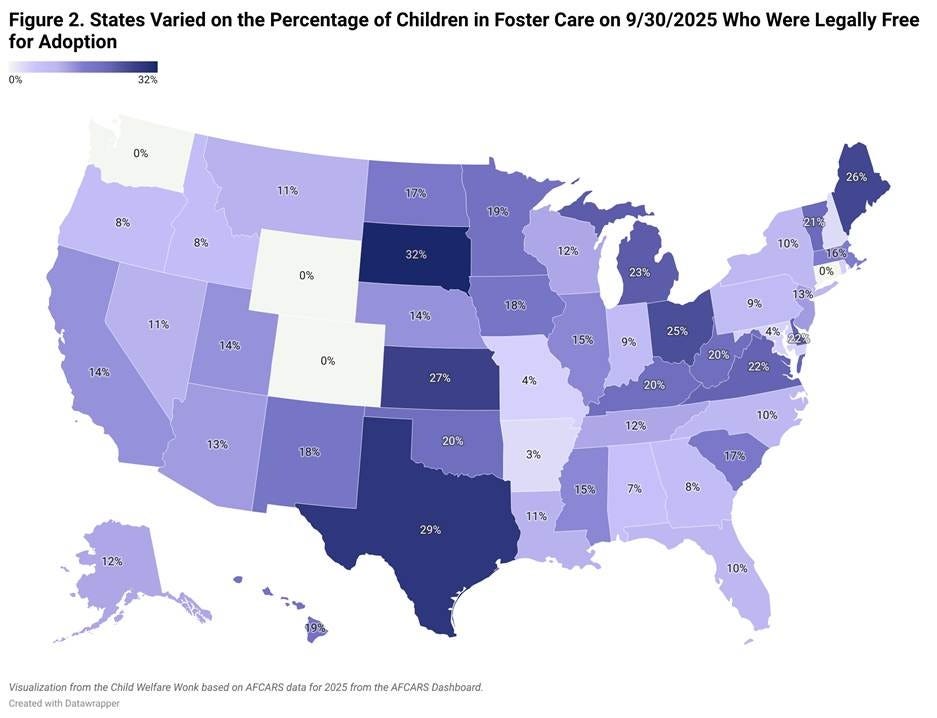
At the end of FY 2025, about 46,300 children in foster care were legally free for adoption nationally, with significant concentration in a handful of states.
Laura explores why the variation across states can’t be explained by federal law alone, and unpacks what else can explain it.
To read the full brief and access all our premium resources, join the Wonk Briefing Room. Individuals can sign up here, or get the team membership rate here.
Organizations interested in going even deeper can also reach out to learn more about our partnerships that help you leverage and apply our intel in your strategy.
Wonkatizer
Medicaid Work Requirements Hit the Courts
What Happened
Twenty-four states and the District of Columbia sued the Trump administration over its interim final rule implementing reporting requirements on work for Medicaid.
The law requires most non-pregnant adults ages 19-64 to demonstrate that they’re engaged in at least 80 hours per month of employment, education, job training, or community service.
The rule expands on those requirements.
For example, while the law waives the requirement for those deemed “medically frail”, under the rule a diagnosis alone is insufficient; you have to prove it precludes work.
Why It Matters
We’re a year out from enactment of the One Big Beautiful Bill Act that created this policy. Litigation over partisan reconciliation was practically inevitable.
Beyond the partisan atmospherics, there’s also a federalism fault line; states that planned based on a narrower understanding now have to shift their setup.
What to Watch
Whether the courts block anything before the January 1 implementation deadline, or if CMS issues any further guidance.
That’s it for this week.
Stay sharp, Wonks.
~ Z
Partners Making Your Weekly Wonk Possible