

Welcome to the latest Weekly Wonk.
Leaders in public-sector agencies: we’ve loved hearing from so many of you already about our new offering just for you. Reach out here if you want to learn more.
Not a public agency? we’ve still got you covered, too! Reach out here to learn more about our organizational partnerships.
From the Founder's Desk
This week, we’re continuing our series with the Center for the Helping Profession for Child Welfare Workforce Development Month.
Part-one looked at the relationship between workforce conditions and safety.
Part-two looked at the ways we can create risk when trying to control it.
In this installment, Michael Cull looks at what makes good decisions possible.
On WonkCast, I sat down with kinship care expert Ali Caliendo for her incisive perspective on what’s missing from conversations on kinship and prevention.
If you were intrigued by last week’s Chafee update, don’t miss our new premium brief.
Publicly available reports only cover up to FY 2022 expenditures. We built an approach to analyze the most recent funding for our premium members and partners.
It’s the kind of timely intel we provide premium members each week, and integrate into the even deeper insights we offer organizational partners.
Let’s get into it.
Weekly Wonk Deep Dive
Working at the Edge: What System Safety Reveals About Child Welfare Failure
Child welfare reviews focus on the decision that failed. Safety science asks how much room the system left for any decision to succeed.
By Michael Cull
When a child welfare tragedy makes headlines, the review that follows almost always asks the same question: what did the worker miss, and why?
The decision is placed under a magnifying glass and measured against policy, best practice, and the information available at the time. That scrutiny is necessary.
But it often rests on an assumption: that the decision was made under conditions stable enough, resourced enough, and predictable enough for the “right” call to be readily available and reasonable to expect by default.
Safety science gives us reason to question that assumption. It directs attention beyond the final decision to the conditions surrounding it:
workload;
staffing;
time;
information;
service capacity; and
the accumulated workarounds required to keep the system moving.
That changes the question.
The issue is not only whether a worker made the wrong call. It is how much room the system left for anyone to get the call right—and how long that margin had been narrowing before the case ever arrived.
Understanding that gap matters for effective leadership and policymaking.
Three Pressures, One Shrinking Margin
Safety science studies how complex, high-risk systems succeed and fail under real-world conditions. Rather than treating an error as an isolated lapse, it examines how pressures across an organization shape the choices made by people on the front line.
Two influential researchers in this field were Jens Rasmussen, who developed a model for understanding how organizations migrate toward failure, and Richard Cook, who later applied systems-safety thinking to health care.
Their work, mostly in the fields of aviation, nuclear power, and healthcare, offer a useful lens for child welfare.
Rasmussen and Cook described every operating system as moving within a space bounded by three limits:
Economic failure: the organization cannot sustain the cost of operating this way;
Unacceptable workload: the people doing the work cannot sustain what is being asked of them; and
Unacceptable performance: the system can no longer reliably prevent serious harm.
Organizations are constantly moving within this space. Pressure for efficiency pushes them away from the economic boundary. Workers adapt and triage to avoid the workload boundary.
Both responses are rational. But together, they can move the system closer to the boundary of unacceptable performance.
In child welfare, an agency may contain overtime while absorbing vacancies. Workers carry more cases and administrative demands than they can reasonably manage, leaving less time to assess risk, consult a supervisor, or follow up when information conflicts.
Management pressure for efficiency, throughput, and cost containment pushes operations toward the boundary of unacceptable performance, because that is the direction that looks like productivity, right up until it doesn’t.
Each adjustment helps meet an immediate demand. Together, they consume the margin that protects the system when something unexpected happens.
No one has to consciously choose greater risk for this drift to occur. The system appears to be doing more with less. What it is actually doing is spending down its capacity to absorb the next surprise.
When the Edge Becomes Normal
The problem is that a system can spend down that capacity without recognizing it. There is rarely a clear warning sign that a system has run out of margin.
Performance at the edge looks like ordinary work from the inside because it is ordinary work, simply performed with less and less room for anything to safely go wrong.
Cook called the condition that emerges when a system loses its remaining slack “going solid” - the slow tightening of a system until the normal variation that once absorbed small errors has nowhere left to go.
The buffers that once allowed one part of the system to absorb a disruption somewhere else are gone.
A staff absence, an urgent placement search, or a delayed record no longer remains an isolated problem. It consumes capacity elsewhere, allowing a relatively small disruption to travel across the system.
A related distinction in safety science is work as imagined versus work as done.
Work as imagined is the version that lives in policy manuals, training curricula, and job descriptions: caseloads at standard, timelines without competing emergencies, and assessments completed with full information in hand.
Work as done is what actually happens on a Tuesday afternoon with two dozen open cases and a shared car.
Some distance between the two is inevitable. The danger comes when that distance grows and becomes so routine as to render it invisible.
At that point, leaders may believe the system is operating as designed when workers are actually holding it together through constant adaptation.
The Workarounds Are the Work
Anyone who has worked in child welfare will recognize the gaps between work as imagined and work as done. Caseloads routinely exceed published workload standards.
Workers document from memory between visits because there is no time to do it any other way. Placement decisions are made within a service landscape where the right resource has a six-month waitlist or doesn’t exist at all.
None of this is hidden. In a great many jurisdictions, it is ordinary practice. Workers respond as people in constrained systems always do: they adapt.
They reorder priorities, build workarounds, and triage competing demands, trusting hard-won instinct when the system will not give them the time or information to be certain.
To describe them as corner-cutting would ascribe an intent to deplete the system, when in reality these strategies are often how experienced professionals reconcile demands that cannot all be met at once.
These adaptations can introduce risk, but they can also be what keeps a chronically constrained system functioning at all.
That is the central paradox: adaptation is both how risk enters the system and how workers create safety to reduce the risks within that system.
We rarely describe these adaptations that way while things are going well. We call them workarounds, or just “how the job gets done.”
It is only after a case goes badly that the same behavior gets a different name: a missed step, a lapse in judgment, or a failure to follow protocol.
How Reviews Learn the Wrong Lesson
This is where public, political, and organizational review can go wrong.
Once the outcome is known, reviewers reconstruct the decision as though it occurred under textbook conditions, comparing work as done against work as imagined.
Against that baseline, a decision that may have been reasonable, even skillful, under the actual circumstances, can look negligent.
Much of the “How could they have missed that?” reaction following a tragedy comes from this gap between the conditions under which the decision was made, and conditions the reviewer assumes were available.
None of this means individual judgment doesn’t matter. Some decisions are avoidable. Some decisions are indefensible under any conditions a system could reasonably provide.
But when every serious failure is treated primarily as a story about one person’s decision, the organizational response becomes predictable: retrain the worker, discipline the worker, or replace the worker.
Those actions may address the person closest to the failure. They do not necessarily address why the system had drifted so close to its safety boundary that one misstep could produce a catastrophic outcome.
The case may be closed. The conditions that produced it remain. And the next worker inherits the same shrinking margin.
Accountability Before the Tragedy
A more honest accounting would ask a different set of questions in every serious case review:
How close was this team, office, or agency to its margin before this case ever opened?
What pressures had already narrowed the room for error, and for how long?
Did the workload standards, timelines, and service expectations on paper bear any real relationship to the conditions in practice?
These are not only questions for post-incident review.
Leaders can track the conditions that narrow operating margin before a tragedy occurs: vacancies, caseloads, overtime, supervisory capacity, placement shortages, service waitlists, and the growing reliance on workarounds.
Policymakers and oversight bodies can treat those conditions as part of accountability and core elements of policy and financing design, not merely as context offered after something goes wrong.
That leads to a different set of responses. Retraining may address an individual mistake. It will not create more time, reduce an impossible caseload, open a placement, or shorten a service waitlist.
When those conditions helped produce the failure, treating them as secondary fixes the symptom while preserving the cause.
Understanding failure in child welfare requires holding two things at once: individual decisions matter, and so do the conditions under which those decisions get made.
A system that examines only the first will keep disciplining workers for adaptations upon which it uncomfortably depends, rediscovering the same pressures after the next tragedy.
Child welfare should not have to wait for a tragedy to discover that its ordinary way of working has reached the edge.
From the Wonk Briefing Room
If you’re working on older youth policy this Congress, you know that bipartisan interest in expanded Chafee investment is constrained by returned funding.
But the latest analysis of that issue is a 2025 report that goes to FY 2022.
So we developed a high-confidence1 analysis of the most recent likely returned funds.
It’s a must-read for anyone working on this issue right now.
Clarifying Chafee’s Cash Crunch
Recurring returned funds are a financing feature. It follows two very different patterns that are easy to miss.
By Zach Laris, MPH, Founder & President, Child Welfare Wonk
The primary federal funding stream for services to support young people’s transition from foster care has been essentially flat-funded since 1999, even as its purchasing power has eroded and states report substantial unmet need.
Yet states also appear to routinely return funds from this program, often only to request them right back.
But that overall rate masks a sharp divide: states likely returned just 1.1 percent of standard Chafee funds, with those returns concentrated in a small number of states, compared with 13.2 percent of ETV funds, with returns spread across more than half of states.
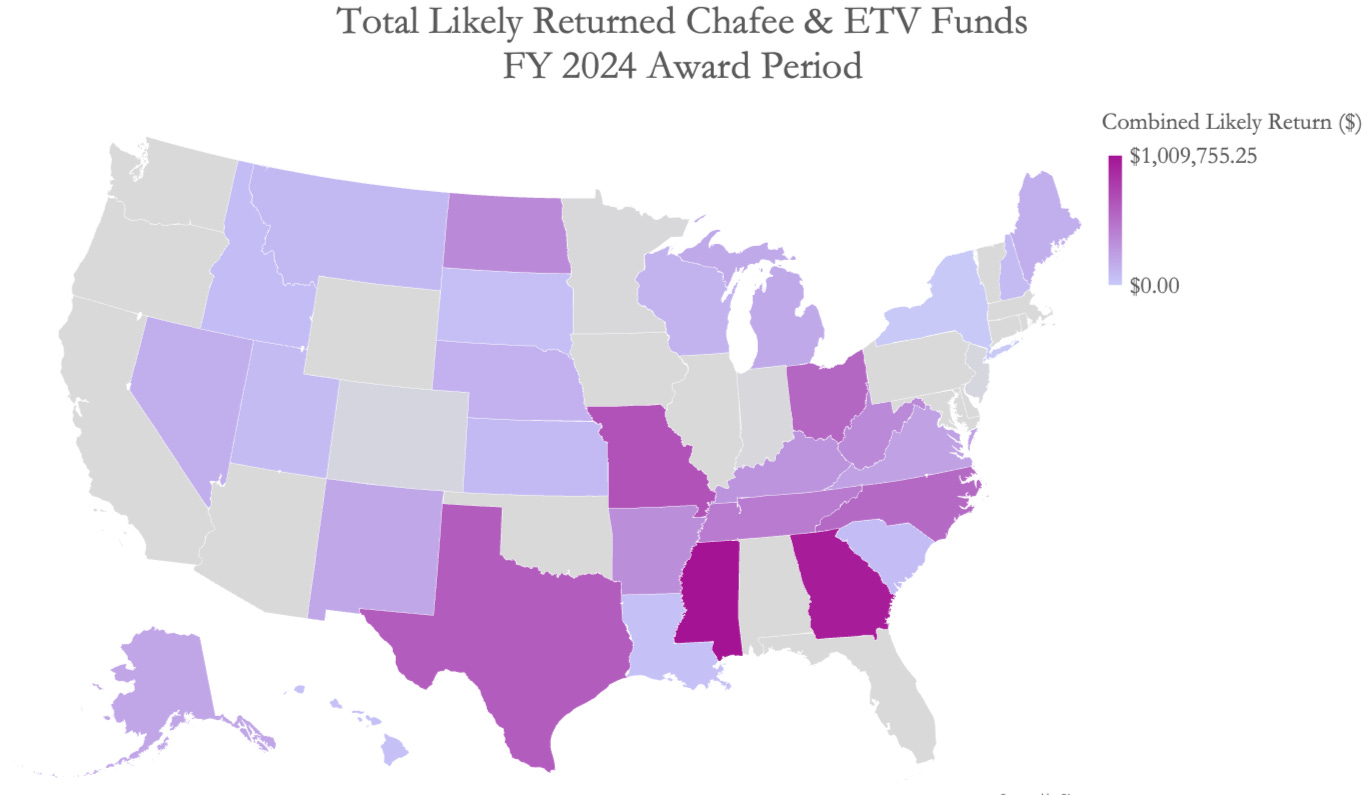
To get the full brief and much more like it, join the Wonk Briefing Room.
That’s it for this week.
Stay sharp, Wonks.
~Z
Partners Making Your Weekly Wonk Possible


So characterized because we tested our method on what GAO reviewed, and were within single-digit dollars of their findings.