From the Founder’s Desk
Welcome back, Wonks, from our spring break hiatus.
When we talk about parental rights in policy debate, do we all mean the same thing?
The surface-level version focuses on autonomy while obscuring the role class plays in what parental rights assumes and emphasizes.
For families with resources, it’s about choices and optionality on things like curriculum and medical decisions; a freedom to opt out.
For families without resources, it’s more often about avoiding punitive action and accessing due process; a freedom from state scrutiny.
This week, Kimberly J. Martin unpacks what that gap points toward; harder questions around who speaks for children, and when that authority transfers to the state.
Premium members of our Wonk Briefing Room have been reading the latest from Laura Radel, further analyzing state shifts and strategies relevant to the Trump Administration’s A Home for Every Child initiative.
On our most recent WonkCast, I sat down with Sixto Cancel of Think of Us.
We discussed what matters and what’s missing in conversations on the role of lived experience in policy deliberations, and his perspective on the role of data and technology in re-imagining child welfare financing and policy related to older youth.
Let’s get into it.
Special thanks to Binti for their foundational sponsorship of WonkCast.

Weekly Wonk Deep Dive
Say Less: Parental Rights, Depending on Who You Are
How class quietly explains core tensions between family and state power.
By Kimberly J. Martin
“Parental rights” is one of those phrases that sounds self-explanatory.
In policy debates, it is invoked as if it represents a single, clear principle: the authority of parents to make decisions about their children’s lives.
But the phrase functions less like a definition and more like a container.
Inside it are several different ideas: family privacy, parental authority, protection from government interference, and the state’s responsibility to safeguard children.
Those ideas do not always align. And in child welfare policy, where the state’s role in family life is most consequential, they regularly collide.
What those collisions reveal is that “parental rights” does not describe the same reality for all families. Its meaning shifts — quietly but systematically — along class lines.
And beneath that class divide lies a harder question that policy debates rarely name directly: not whether parents have rights, but who has the authority to speak for children, and under what conditions that authority transfers to the state.
Parental Rights Don't Mean the Same Thing for Every Family
The first complication is that “parental rights” does not describe the same reality for all families. In practice, the meaning of the phrase often shifts along class lines.
For more affluent families, parental rights frequently operate as a form of optionality.
The debates tend to revolve around questions of choice: which curriculum a child should follow, which vaccines should be required, which medical decisions parents should control, or the standards for homeschooling.
In these contexts, parental rights are about the ability to shape a child’s upbringing among multiple available paths; they shape the policy container in which parents select options to exercise.
For poorer families, the concept operates very differently.
Here, parental rights are often asserted in response to scrutiny, as a defense of having access to choice.
Families navigating poverty are more likely to encounter institutions that monitor family life — like child protective services, family courts, and mandated service providers.
Invoking parental rights in these settings can be less about selecting among options and more about asserting autonomy in the face of government judgment about competence, safety, and adequacy.
This distinction explains why policy conversations about shared responsibility between families and the state can take very different forms depending on circumstances.
When resources are abundant, shared responsibility can feel like partnership: schools, doctors, and service providers collaborating with parents around a child’s development.
When resources are scarce, the same arrangements can feel like supervision.
The data reflect a structural pattern, not an anomaly.
85 percent of families investigated for neglect have incomes below 200 percent of the poverty line.
Children in high-poverty neighborhoods are more than three times as likely to experience substantiated CPS investigations as children in low-poverty neighborhoods.
Wealth as an Off-Ramp
Financial means quietly shape how family challenges are handled, and by whom.
When wealthier families encounter difficulties— a child struggling in school, behavioral issues, mental health challenges—the solutions are frequently private: therapy, tutoring, specialized schooling, relocation, or temporary leave from work.
These responses allow the problem to remain within the family’s control.
For families with fewer resources, similar challenges can become matters of public record.
The same behaviors that lead one family to seek a private therapist might lead another family into mandated services, neglect investigations, or court oversight.
Wealth can turn unmet needs or mistakes into private problems while poverty can turn them into documented risks.
The Harder Question
These dynamics expose a deeper tension that rarely gets named directly: the question of children’s rights.
Policy conversations often frame parental rights and children’s rights as a trade-off.
Parents assert authority; the state intervenes when children are harmed. But that framing obscures the harder question.
Rights typically come with the capacity to exercise them, and assignment of responsibilities to uphold.
Children depend entirely on adults—parents, courts, or government institutions—to define and act on their behalf.
Which means the real contest is not between parents and children.
It is between parents and the state over who gets to speak for children, and under what conditions that authority transfers.
That is the question most policy debates avoid naming directly. And it is the one that matters most.
This tension is showing up across the political spectrum, and it doesn’t fit neatly into one container.
The reason topics varied as school curricula, vaccine requirements, and the role of the child welfare system seem to create strange cross-partisan resonance is we often look past class dynamics.
Despite their different ideological starting points, cross-partisan critiques can converge from a common concern: the scope of government power inside family life.
The fault line is not left versus right. It is families versus the state — and it cuts across both.
When Help Looks Like Control
Families often need support –- housing assistance, mental health services, and economic stability.
Even families with means rely upon public policy’s standards and assurances.
But support systems can expand the state’s presence in family life when it’s the only means of accessing support, especially when assistance is tied to monitoring or mandated compliance.
Families may need help and simultaneously fear that accepting it increases the state’s authority over their lives.
That fear is not irrational. For many families, it’s historical memory.
The field’s deeper challenge is designing support that doesn’t arrive with strings that look like surveillance.
That means rethinking how services are delivered, who delivers them, and whether accepting help can ever be truly voluntary when the alternative is system involvement.
It is precisely this question: how to build support without building state authority - that is producing an unlikely cross-partisan coalition.
Libertarians and progressive child welfare critics would not appear to be natural allies.
But both have arrived at the same place through different vehicles traveling the same road: skepticism of a system that presents itself as help while functioning, for many families, as control.
The Question the Field Keeps Avoiding
“Parental rights,” then, is not just a debate about family autonomy.
It is a debate about the boundaries of government power, the conditions under which the state can and should intervene in private life, and the ways those boundaries are experienced differently depending on resources.
The central question, then, is where the state’s role in children’s lives begins and where it must end.
Is it designed to strengthen families or substitute for them, and who gets to decide?
Say less.
Kimberly Martin is a policy strategist whose work brings legal insight and lived experience to the child welfare conversation.
From the Wonk Briefing Room
Where the Weekly Wonk gives you a map of the terrain child and family policy faces, our premium resources aim at how to navigate it.
Our most recent release maps how every state’s ratio of foster homes to children in foster care shifted between 2020 and 2025.
Sixteen states increased their ratios. Twenty-two saw declines.
The picture is uneven — and the direction each state has been moving matters enormously for how they approach the work ahead under HFEC.
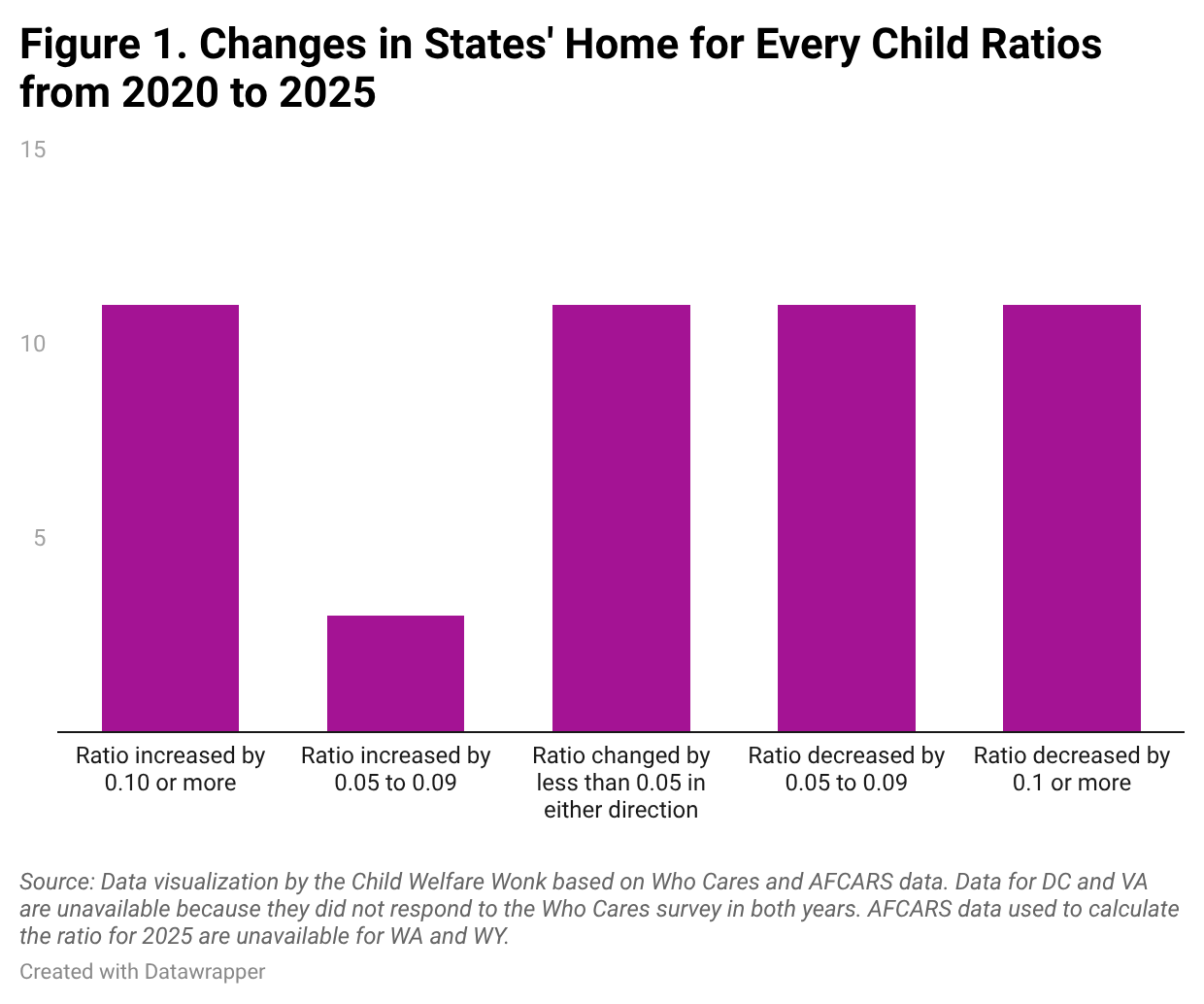
For leaders trying to understand where their state actually stands before ACF’s initiative shapes expectations, this piece is the map to drive your strategy.
To read the full brief, see the state-by-state map, and access all our premium resources, join the Wonk Briefing Room.
Individuals can sign up here, or get the team membership rate here
Wonkatizer
FY27 PresBud Drops
What Happened
Last week, the President’s Fiscal Year 2027 Budget Request dropped, along with detailed appendices by agency.
It would cut non-defense discretionary spending by 10% and increase military spending by 42%.
First Lady Melania Trump’s proposed funding for housing vouchers for youth aging out of foster care is in again, as it was last year, up to $30M from $25M last year.
Why it Matters
President’s Budget Request is a request; it’s a non-binding wish list to inform the congressional appropriations process. It doesn’t take effect or simply happen.
That doesn’t mean it’s irrelevant. It articulates priorities worth tracking.
What to Watch
How Congress approaches the appropriations process. That was already going to be hard before the looming likelihood of budget reconciliation 2.0.
We’re watching whether the process gets going in earnest this spring, or keeps slipping closer to the end of FY26 in September, and the elections.
CSBG's Reporting Problem
What Happened
A new joint ACF and ASPE issue brief argues that the Community Services Block Grant’s (CSBG) reporting requirements obscure what the program actually funds.
Congress created CSBG in 1981 to offer flexible funds to states, tribes, and territories to alleviate the causes and conditions of poverty, and promote self-sufficiency.
Why it Matters
CSBG is a block grant that can’t clearly document what its dollars produce; that’s both a feature and a weak point in financing.
Because CSBG funds are flexible, they often fill in gaps that other investments leave behind. The impact of that kind of financing role can be essential and hard to capture.
The ASPE report makes two arguments:
That current CSBG reporting overstates the case for the funds, as it represents ~5% of the budget of funded entities; and
The reporting is burdensome, and therefore misses on isolating unique impact.
This is an inherent tension in flexible financing; absent a strong narrative of purpose and impact, there’s1 vulnerability to arguments of unaccountability.
What to Watch
The brief points to ways to more effectively streamline reporting requirements.
Given ACF’s current deregulatory push, and that briefs like this tend to precede ACF action, a looming shift on CSBG reporting is a smart bet.
It’s worth tracking whether the focus remains on reporting or shifts to the funding.
That’s it for this week.
Stay sharp, Wonks.
Z
Partners Making Your Weekly Wonk Possible