

Welcome to the latest Weekly Wonk.
We’ve loved hearing from those of you in public-sector agencies about our new offering just for you. Reach out here if you want to learn more.
From the Founder’s Desk
Welcome to the latest Weekly Wonk.
We’ve got the latest on a new data dashboard you’ll want to track for the Administration for Children and Families’ (ACF) A Home for Every Child initiative
And we’ve clarified and corrected our Wonkatizer entry last week on the proposed rule that would eliminate regulations for states’ Title IV-B planning and reporting requirements.
Let’s get into it.
A Message From the Wonk Briefing Room
We’re all drowning in policy information. What matters is policy intelligence; the sensemaking that synthesizes policy change so you know what matters, what’s moving, and what’s possible.
At Child Welfare Wonk, our work is helping you do three things:
See power and policy clearly, so you know what’s actually changing;
Know where you have leverage, so you can move your priorities; and
Decide with confidence when it counts, even amid uncertainty.
If you find the Weekly Wonk newsletter and our WonkCast beneficial to your work, you should know that those are just the outer layer of what we do.
Our premium intelligence goes deeper, surfacing actionable insights you can use to move your work.
The Wonk Briefing Room is our premium community. Individuals and small teams can get memberships, which come with member-only events, weekly premium intel, and our full premium intel archive.
Organizations partner with us to go even deeper. We provide strategic sessions, leadership briefings, and other opportunities that generate candid clarity for your work, combined with broad premium access.
Just in the past couple of weeks, premium Wonks have received:
Original analyses on Chafee returned funds and homelessness outcomes;
A comprehensive breakdown of what’s changed in the Child Welfare Policy Manual; and
Time with our team and the authors of our recent workforce series
Check out the Wonk Briefing Room site to learn more, and reach out to connect about partnerships for organizations and state agencies.
Wonkatizer
The latest signals worth watching.
Data Dashboard Live for A Home for Every Child
ACF’s A Home for Every Child dashboard is now live, tracking 16 states and DC so far.
What’s Happening
This dashboard is a centerpiece of the Administration for Children and Families’ (ACF) A Home for Every Child initiative.
The dashboard tracks:
# of homes
# of children
The ratio of homes to children
% of children with kin
% of children in congregate care
% of children with substantiated maltreatment in the past month with prior substantiation in the last 6 months
% of homes caring for children that had a disruption in the past month
The current ratio ranges from 1.21 (Idaho) to 0.59 (Tennessee).
Why It Matters
A home for every child is more than a metric; it’s the central principle organizing ACF strategy.
As we’ve previously broken down, because it tracks both homes and children, it connects to strategies across the child welfare continuum, from prevention through foster care, all the way to permanency.
Now it’s encoded in monthly public data reporting.
What to Watch
All states are participating in A Home for Every Child, and 33 states, DC, and Puerto Rico have approved Program Improvement Plans aligned with it.
That means that all states are on the path to being visible in the dashboard as ACF finalizes their PIPs and begins collecting data.
Weekly Wonk Deep Dive
The Procurement Paradox
When Trying to Eliminate Risk Makes CCWIS Riskier
By Creighton Cody Cathey
After nearly a decade of CCWIS implementation, the question of whether child welfare agencies need better technology is clearly settled in the affirmative
The more important question is if the way government buys technology is actually helping states modernize— or making modernization harder.
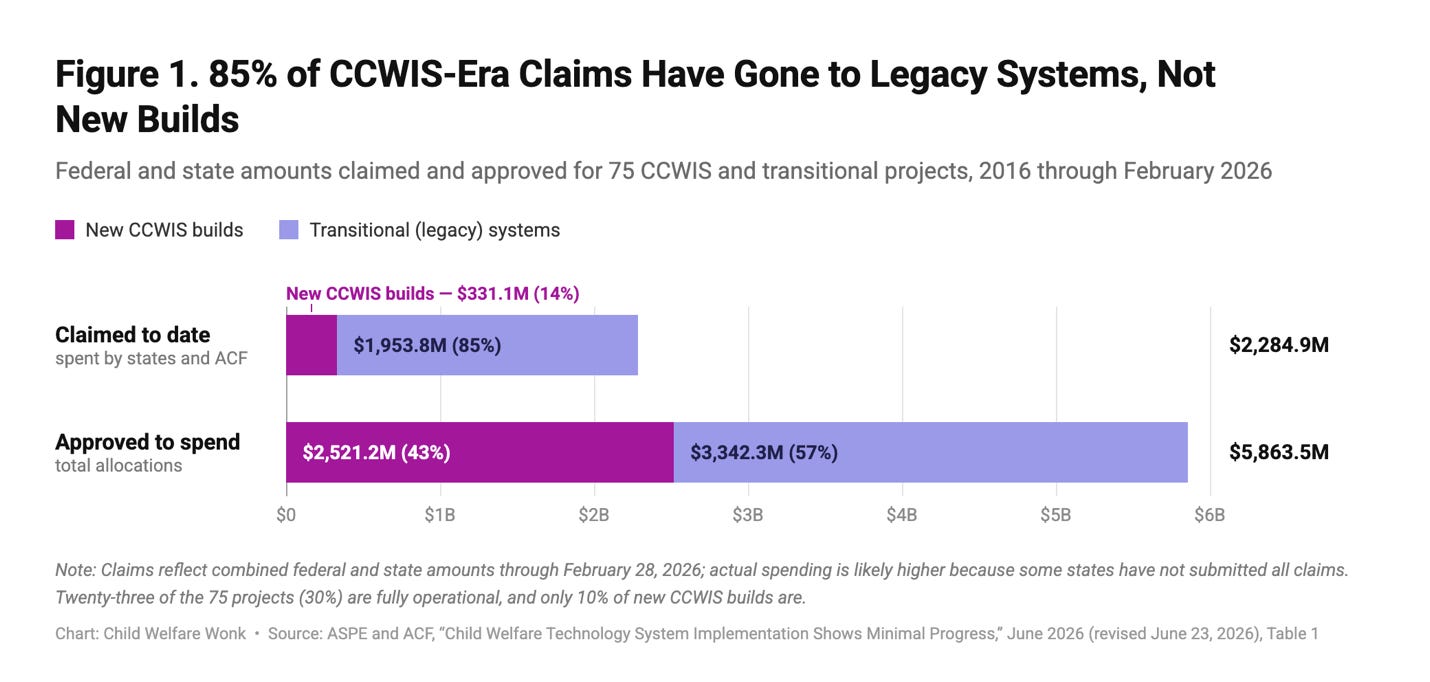
A recent ASPE report found that combined federal and state claims related to child welfare information systems had reached approximately $2.28 billion over a decade, but that only a fraction of CCWIS projects were operational.
Roughly 85 percent of those claims supported maintaining transitional or legacy systems, rather than new CCWIS development.
The report points to a familiar list of barriers:
long procurement timelines;
large bundled contracts;
limited staff capacity;
organizational readiness;
federal processes; and
continued reliance on transitional systems.
But together, those barriers point to a deeper problem for policymakers and leaders.
The structures government uses to reduce modernization risks can create a different kind of risk: they can make it harder for agencies to learn, adapt, and change course as implementation unfolds.
That is the procurement paradox.
The Appearance of Predictability
Traditional government procurement rewards the appearance of predictability more than the ability to respond when assumptions change.
That means a state may spend months or years developing detailed requirements before releasing a solicitation, and vendors then compete to deliver against those requirements.
A 500-page requirements document can feel safer than a 50-page one because more has been decided in advance. But every requirement is also an assumption about how workers should complete a task, how data should be structured, how another system will behave, what users will need, or what technology will still make sense years later.
Some of those assumptions will inevitably be wrong.
When workers actually implement a workflow, they will find the frustration points in what looked good on paper. A planned integration may depend on a system that is itself being replaced. The requirement that seems essential may become obsolete after a subsequent policy change.
But once those assumptions are embedded in a contract, adapting can become expensive and difficult, showing up as change orders, delays, disputes, workarounds, technical debt, and user frustration.
That creates a deeper problem: learning can start to look like failure.
A project may appear well controlled because it has a defined scope, a schedule, milestones, and a set price, even when those commitments are based on assumptions that no longer hold.
That can distort incentives on both sides.
Agencies may over-specify to manage ambiguity and risk in procurement. Vendors may promise unattainable compliance rather than challenge unrealistic assumptions. Frontline staff may be deeply involved defining requirements but far less involved once implementation begins.
The result is a system that can reward staying “on contract”, even when the contract itself is no longer producing the best technology or optimal outcomes for children and families.
When Accountability Becomes Dependency
Large procurements create a similar problem. Bundling a modernization effort into one large contract can make the work feel easier to manage: one implementation plan, one vendor, and one organization responsible for delivery.
States have understandable reasons for doing this. Managing multiple contracts can overwhelm already stretched procurement and project teams, and some may make the argument that it is more cost-effective to consolidate into one large contract.
But consolidation does not eliminate complexity. It often just moves that complexity inside one large vendor relationship.
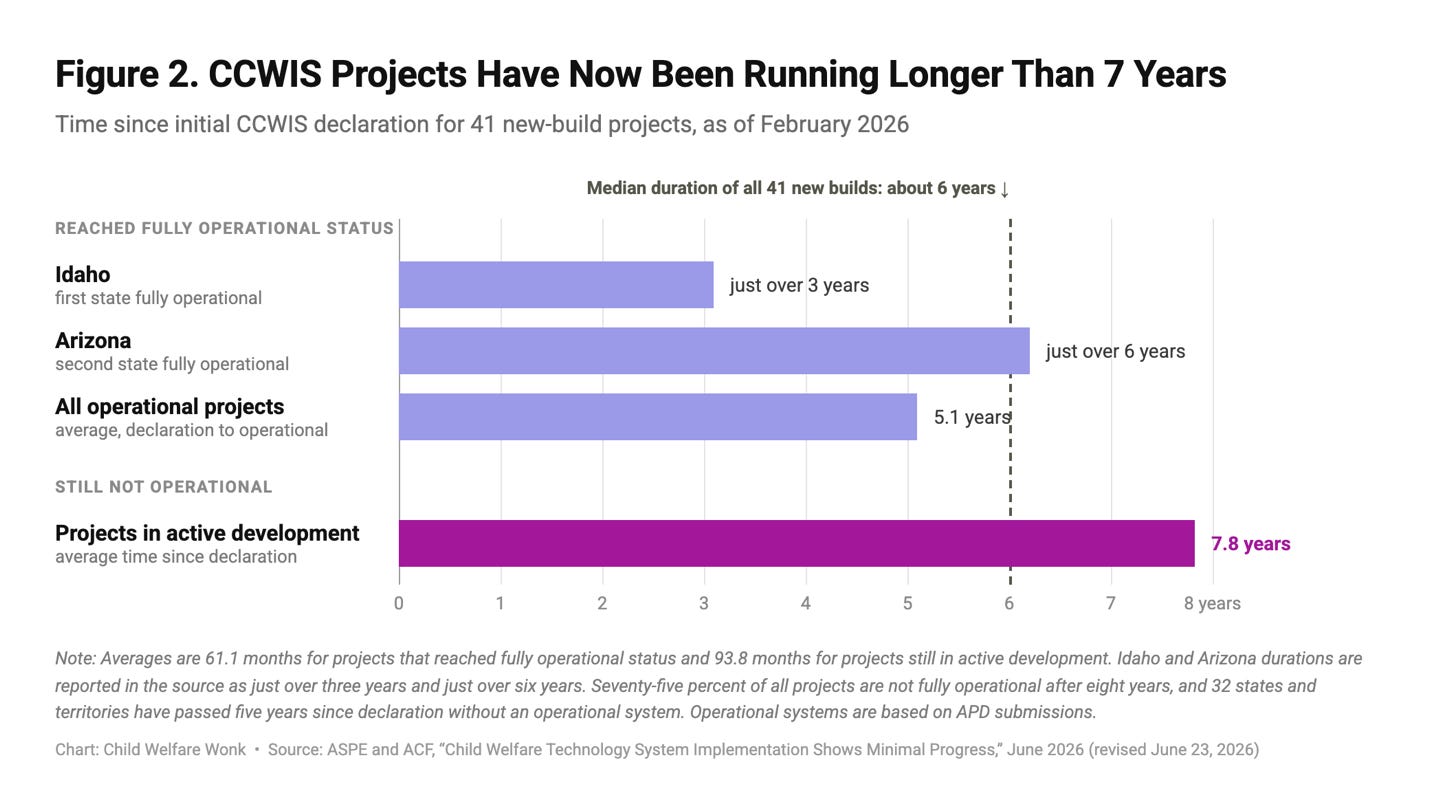
The stakes grow as implementation stretches over time. The ASPE report found that new CCWIS builds had been underway for a median of roughly six years. Active projects that had not reached operational status averaged nearly eight years since declaration. Transitional systems accounted for approximately $1.95 billion in claims.
Over that kind of timeline, states can become increasingly dependent on the vendor delivering the system. That means architecture, integrations, institutional knowledge, and technical capacity accumulate in one place, deepening a critical dependency.
And the balance of leverage changes. Competition is strongest before the contract is awarded. Afterward, switching vendors may be so disruptive and expensive that continuing with an underperforming arrangement seems like the safer option.
The contract designed to create a single point of accountability can morph into a single point of dependency.
Modularity Helps, But It Is Not Enough
One obvious response is to break large procurements into smaller pieces. While that can be part of the answer, it is not the whole answer.
Ten poorly governed contracts can be even worse than one large contract. A state can buy separate products for intake, payments, licensing, provider management, analytics, and case management and still end up with a fragmented environment that does not work together.
The real shift is not simply from large contracts to small contracts.
It is from treating modernization as the purchase of a finished system to treating modernization as a governed portfolio of capabilities that can evolve over time.
Procurement as a Governance Model
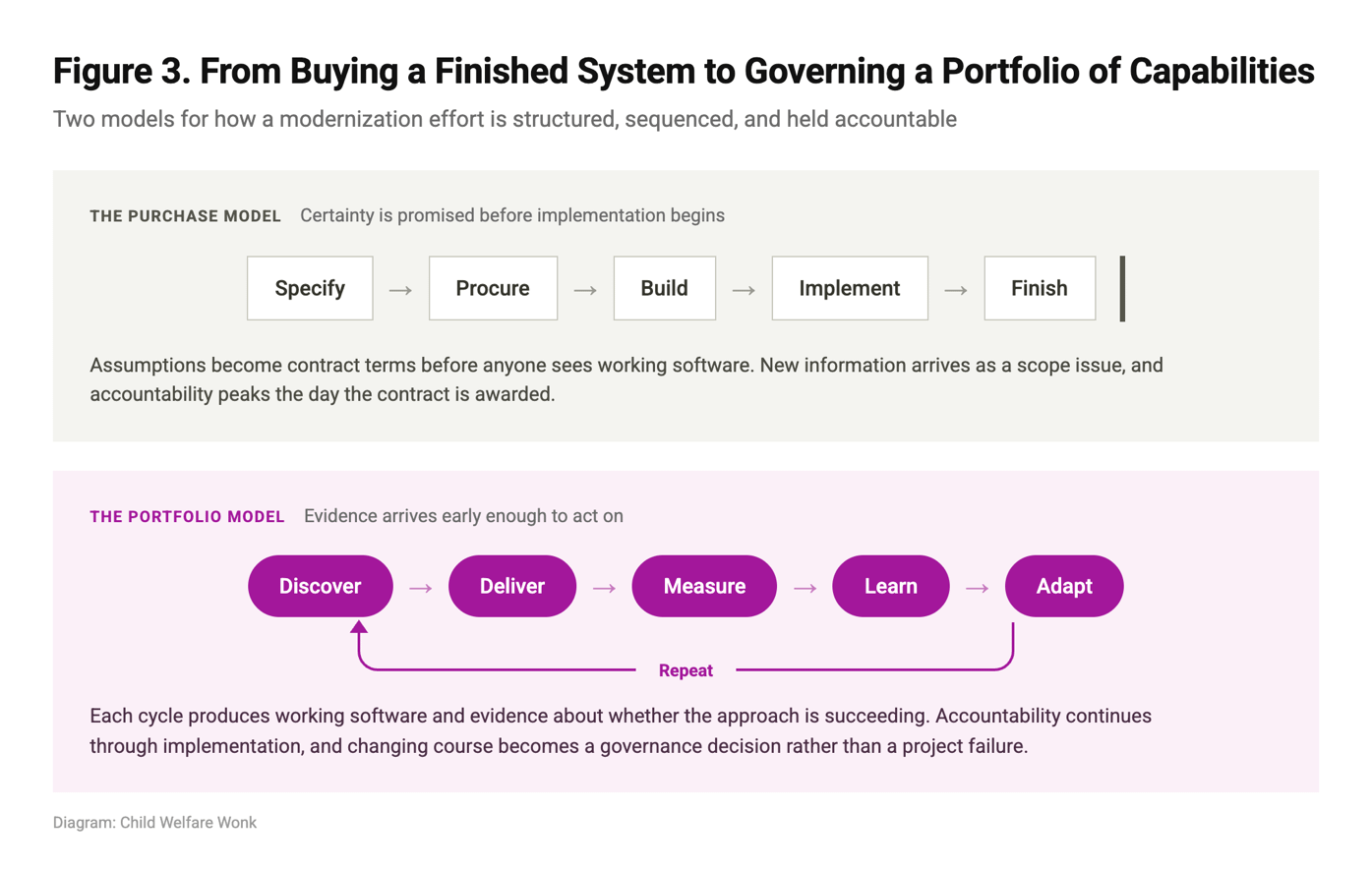
That does not mean abandoning procurement rules, planning, budgets, contracts, or oversight. It means changing the gravity of accountability, so it spreads across implementation rather than concentrating at the award. The safest procurement is not necessarily the one that promises the most certainty at the beginning. It is the one that gives leaders early evidence about whether the approach is working, and enough flexibility to act when it is not.
Procurement, in other words, is not just a procedural step that happens before modernization begins. Procurement decisions determine how modernization will be governed for years afterward.
Accountability and adaptability are not competing goals. The real challenge is designing a model that produces both.
Part II will look at what that model can look like in practice.
Disclaimer: The views and opinions expressed here are solely those of the author and do not necessarily reflect the views, positions, or policies of the U.S. Department of Health and Human Services, the Administration for Children and Families, the United States Government, or any current or former employer, client, contractor, or affiliated organization.
CODY CATHEY is a Senior Technology Advisor to the Administration for Children and Families, and a Visiting Fellow at the Foundation for Research on Equal Opportunity.
That’s it for this week.
Stay sharp, Wonks.
~ Z
Partners Making Your Weekly Wonk Possible


