

From the Founder’s Desk
Welcome to the latest Weekly Wonk.
The stories we tell about policy are most powerful when reflecting evidence of underlying reality.
The decoupling of policy and the stories we tell about it creates drift, deracinating debate about policy impact from what the policy design actually does.
Financing is an essential part of public policy, creating incentives through investment.
For child welfare financing, the largest source of federal funds is Title IV-E of the Social Security Act, a program long synonymous with foster care.
But that’s no longer its primary focus.
In this week’s Deep Dive, Senior Contributor Laura Radel analyzes new Title IV-E expenditure data to show the continued shift from foster care to adoption assistance.
This isn’t about taking a position on the relative merits of either, but seeing how financing policy can create key changes in our field’s largest funding stream over time.
This also relates to last week’s Deep Dive on Family First financing, and our recent WonkCast with JooYeun Chang, who thinks extensively about financing policy.
Let’s get after it.
Weekly Wonk Deep Dive
Title IV-E’s Quiet Makeover Continues
New expenditure data show shift continues from foster care to adoption assistance.
By Laura Radel, Senior Contributor
Title IV-E of the Social Security Act is the largest source of federal child welfare financing, and synonymous with foster care.
At one point that was the case, but the program’s focus drifted from the common understanding of what it finances.
Last June, we showed how Title IV-E transformed over several decades from a foster care program with a side investment in adoption support, to the inverse: an adoption program with a side investment in foster care.
It had also shifted from a primary focus on financing specific supports for children, to state capacity in the form of infrastructure support for state child welfare agencies.
The latest data on Title IV-E spending from the Administration of Children and Families confirm both trends continued into 2024.
Foster Care Keeps Shrinking. Now Adoption Is Too.
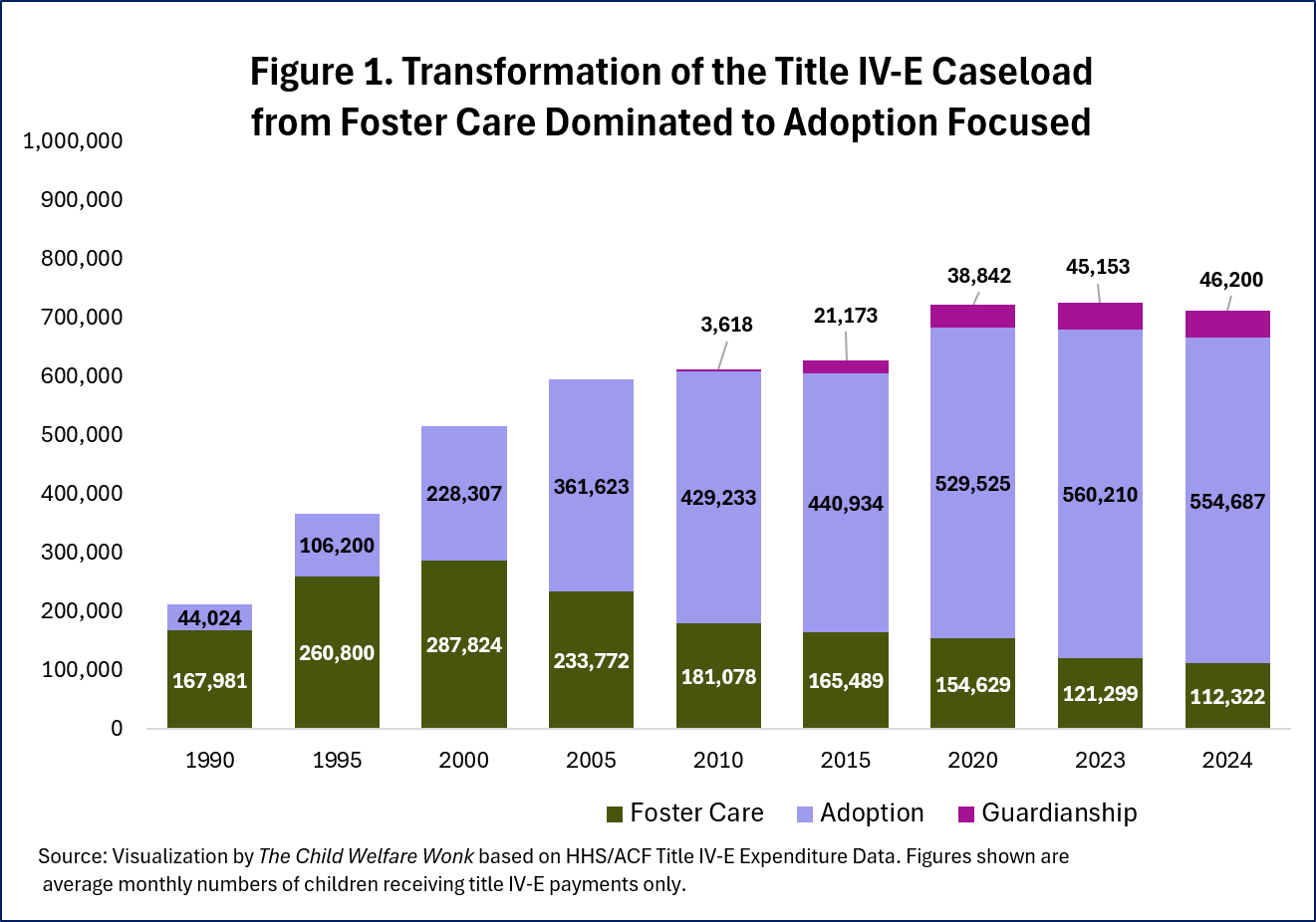
Overall, foster care’s share of the total IV-E caseload continued sliding, from 17 percent in 2023 to 16 percent in 2024, and down from 79 percent in 1990 (Figure 1).
These figures cover only children receiving foster care, adoption assistance and guardianship payments; prevention or kinship navigator caseloads are excluded but are comparatively small. If included, they would push foster care’s share lower still.
The foster care caseload continues its decline, driven largely by eroding Title IV-E eligibility.
This is the result of a lookback date that ties eligibility to the now-defunct Aid to Families with Dependent Children Program (AFDC) income and asset limits as they existed in 1996, without adjustment for inflation.
The Title IV-E guardianship caseload increased slightly by just under 1,000 children, continuing a long trend. The notable new development is adoption.
The Title IV-E adoption assistance caseload declined by about 5,500 children in 2024. That’s the first drop in the history of the program.
It reflects a straightforward dynamic: adoptions from foster care have fallen alongside the foster care population itself, from 50,717 in 2023 to 47,335 in 2024.
Two Eligibility Rates, Moving in Opposite Directions
The Title IV-E foster care eligibility rate (also sometimes referred to as the penetration rate) dropped from 35.82 percent in FY 2023 to 32.94 percent in FY 2024.
That drop of just under two percentage points is an 8 percent decline in a single year.
Meanwhile, the adoption assistance eligibility rate rose from 86.75 percent to 87.65 percent.
That’s for a very specific reason: 2024 marked the completion of the Fostering Connections phase-out of income eligibility criteria for adoption assistance.
Initiated in 2008, that phase-out expanded eligibility incrementally each year, starting with the oldest children and ending with the youngest. It is now fully in effect.
Where the Money Goes
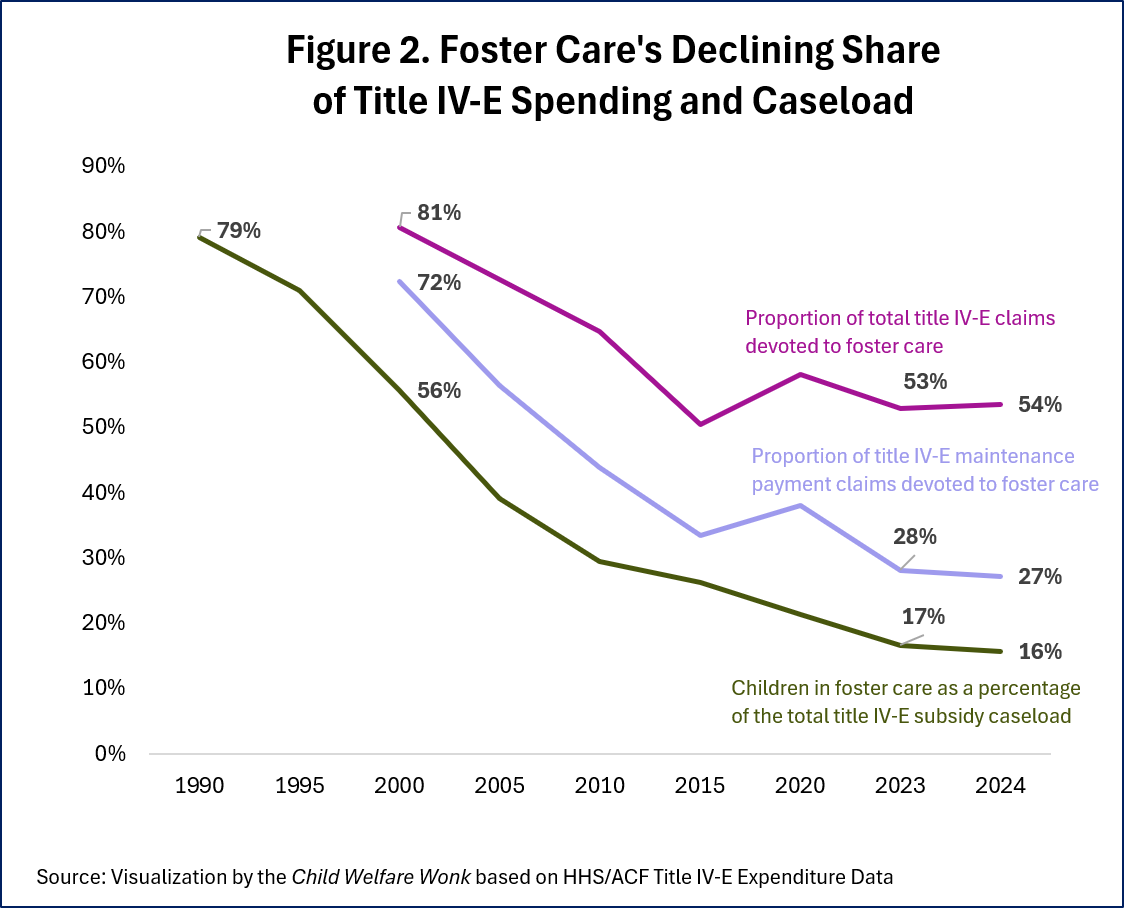
The proportion of maintenance payments devoted to foster care also declined slightly, from 28 percent in 2023 to 27 percent in 2024 (Figure 2).
However, the proportion of total IV-E claims devoted to foster care increased slightly, from 53 percent to 54 percent, likely because administrative costs, which are higher in foster care than in other program components, continued growing as a share of total claims.
The pattern is consistent with prior years: foster care is shrinking as a share of who the program serves, but its administrative footprint keeps it anchored in the spending numbers.
This is what drives the “Entitlement to What?” dynamic inherent in Title IV-E.
What the 2024 Data Tell Us
Together, the caseload and spending data describe a program whose transformation went from reasonable projection to demonstrable fact.
Title IV-E now primarily subsidizes permanent placements and funds state administrative infrastructure, with foster care a shrinking portion of both caseload and federal dollars spent.
This is drift by design; without any deliberate policy decision, the focus of our field’s largest financing stream shifted significantly, largely without public debate.
This is not suggestive of inappropriate claims inconsistent with the law, or an unexpected loophole.
Over decades, incremental changes emerged from the underlying policy design.
What child welfare financing should focus on is a question no expenditure data can answer. But the shifts those data point to make the question impossible to ignore.
From the Wonk Briefing Room
Last week we unpacked key findings from the latest expenditure data for the 2018 Family First Prevention Services Act.
Wonk premium members are getting resources that dig deeper into those driving factors, and what leaders can do about them now and in future policy deliberations.
Most recently, Uma Ahluwalia’s brief identified three operational barriers to deploying evidence-based interventions, and a framework for leaders to move on them.
To read the full brief and access all our premium resources, join the Wonk Briefing Room. Individuals can sign up here, or get the team membership rate here.
Wonkatizer
Older Youth Policy On the Move in Congress
What Happened
Policy proposals for older youth in foster care are percolating across the Capitol.
On May 19 the U.S. House unanimously passed H.R. 7432, the Fostering the Future Act. Senator Chuck Grassley (R-IA) also released a related discussion draft.
What it Means
Last amended as part of the Family First Prevention Services Act, the older youth-focused Chafee Program supports young people during and after transition from foster care.
The House bill combines six committee-passed bills that make bipartisan changes to Chafee targeting housing, education, and workforce preparation.
The discussion draft would also address Chafee reforms, including last-mile policy delivery concerns about the actual deployment of education and training vouchers.
Why it Matters
The advancement of bipartisan proposals maintains momentum on older youth policy, a priority for First Lady Melania Trump.
None of these bills will materially change the financial picture of Chafee, but incremental change can cultivate champions in a Congress with many retiring ones.
What to Watch
The process of finalizing details between Congressional chambers.
While the Senate could simply take up the House-passed bill, Senators often seek ways to emphasize their priorities.
A discussion draft is a common Congressional vehicle for floating reform ideas and gathering input to refine them before formally introducing it as a bill.
That Senator Grassley released one stakes a claim in shaping any final legislative product. That makes sense given his long-standing role as an issue champion.
This also offers an opening to engage Senator Grassley’s office with ideas for that proposal that could in turn shape what emerges.
Reconciling to Reconciliation
What Happened
Amid partisan opposition and differences within the GOP, Congress recessed without advancing a partisan proposal to fund the Department of Homeland Security via budget reconciliation.
Why it Matters
We’ve recently highlighted the ongoing negotiations to finalize this last aspect of unresolved funding for the current fiscal year.
That bill would not directly touch funding for broader child and family programs. But it matters for the timing of a potential effort that would.
House Budget Committee Chair Jodey Arrington (R-TX) continues to float the prospect of a third reconciliation bill, which would target alleged safety net fraud in closing a Pentagon budget gap from the Iran War.
Cuts to Temporary Assistance for Needy Families (TANF) and Social Services Block Grant (SSBG) were originally part of discussions for reconciliation last year.
Changes to those programs, Medicaid, and more could be on the table.
What to Watch
The timing of DHS funding, which will in turn determine remaining time for advancing a partisan reconciliation bill.
Ongoing talks with Iran and the related spending rate will also drive budget urgency.
The closer midterm elections loom, the harder it will be to advance any partisan reconciliation effort that could complicate campaigns.
The conversation on last year’s Medicaid cuts and any future ones will come following new projections from the nonpartisan Congressional Budget Office (CBO).
Factoring in implementation of the One Big Beautiful Bill Act, CBO suggests that from 2026-2036, Medicaid enrollment will drop by 9 million.
That includes 3 million fewer covered children, a 9 percent decline.
That’s it for this week.
Stay sharp, Wonks.
Z
Partners Making Your Weekly Wonk Possible


