

From the Founder’s Desk
Welcome to the latest Weekly Wonk.
Last week’s seismic shift in Congressional power will have significant implications for child and family policy, now and over the next two years.
Because you care about child and family policy, you also know that the issues our field works on are rarely the lead topic for post-election analysis of what’s ahead.
So Team Wonk has you covered, with a Deep Dive into what the “Blue-Nami” means for child and family policy, through the lame-duck and into the 120th Congress.
Later this week, our premium members will also get an actionable guide that builds on it, on what you can do to use this intel to power your work ahead. Sign up today so it hits your inbox.
If you haven’t given our latest WonkCast with Dr. Mona Hanna a listen, it’s well worth your time if you care about child health, income security, or child welfare.
Let’s get into it.
Wonkatizer
Why Picking the Next CBO Director Matters for Child and Family Policy
It was impossible to miss last week’s election results and analysis.
What you might have missed is a particularly wonky Democratic pick-up; selecting the next Congressional Budget Office (CBO) Director.
What Happened
With Democrats’ upcoming control of both chambers of Congress, Congressional Democratic leaders will select the next CBO chief.
Current CBO Director Phillip Swagel has held the post since 2019, and his term ends on January 3rd, 2027.
He can hold the post until Congress appoints his successor.
Why It Matters
Early on at the Wonk, we covered the role CBO plays in child and family policy.
The nonpartisan office plays a central role in framing policy debates through its fiscal analyses that include 10-year budget baselines and cost estimates for proposed legislation.
What to Watch
House and Senate Budget Committee chairs will offer recommendations to Congressional leaders, who will appoint the next director.
Don’t expect a partisan ideologue; the purpose of the office is neutral analysis.
But that scorekeeping is a central rate limit on legislative activity, which will matter when evaluating the fiscal implications of policies likely to come up next Congress, including Medicaid, child care, paid leave, and the Child Tax Credit.
You'll start seeing their work as the next Congress gets underway.
Why Wonk Premium
Knowing that a Congressional hearing is happening is information. Knowing why that hearing is happening in the first place, and what opening it represents, is intelligence.
Weekly Wonk readers often see an issue more clearly after one of our pieces, and then want to know:
“Okay, but now how can I approach my work differently this week?”
That’s exactly what our member-only Wonk Briefing Room offers.
For example, a major challenge with staying on top of Family First implementation is the seemingly endless announcements from the Administration for Children and Families (ACF).
If you find yourself wondering whether any particular change actually matters, or is just a form of bureaucratic throat-clearing and restating of existing authority, you’re not alone.
Over five years of Family First implementation, the claiming of funds is uneven, constrained, and concentrated.
Understanding what’s actually shifted and how to make use of it matters for maximizing the impact of Family First in service of the goals you want to move forward.
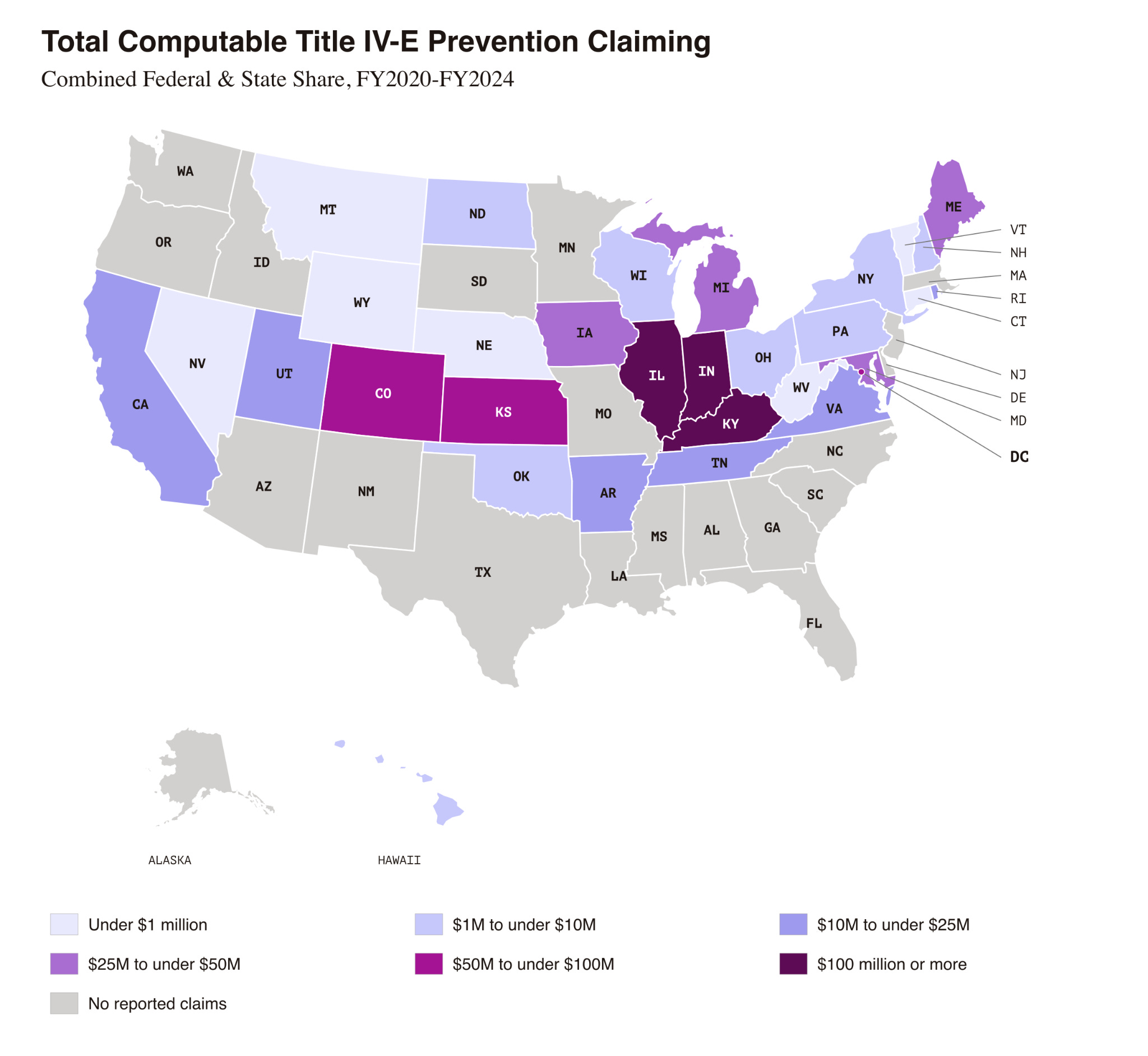
We looked across all of these shifts to figure out what actually matters, how it all fits together, and what opportunities it creates for anyone doing this work.
Our latest premium resource packages it all together as one handy guide that lays out what has actually changed and the five things you can do to make the most of it.
Premium members get this type of value every week. Join us, so you can too.
Weekly Wonk Deep Dive
What Does a “Blue-Nami” Mean for Child Policy?
After a big night for the Democrats, here’s what’s knowable, and what questions remain
By Doug Steiger, Senior Contributor
Democrats won control of Congress in landslide fashion. While the votes are still being tallied, the final outcome’s magnitude is not in question.
Sizable majorities in the House (254 as we publish, with more to call) and Senate (54 seats secured, with two more that could plausibly break Democrats’ way) mean different power players will make decisions on child and family policy issues.
This result also means we can expect difficult high-level budget and spending negotiations, though they may wait a few months.
There will also be lots of oversight and investigations.
Beyond the topline takeaways, here’s the Wonk breakdown of what we know or can reasonably foresee that matters for your work, and what questions remain that leaders across child and family policy should watch.
What We Know…and the Questions that Remain
How the results shape the lame duck session
What We Know
The Continuing Resolution (CR) funding the government ends on December 11th.
There’s talk that Congress will pass another CR into early next year to allow for negotiations to finalize spending bills.
But these negotiations could spiral into an early confrontation between the White House and Democrats, risking a shutdown.
The chances of this will become clearer this week as Congress reconvenes, having processed the results of the elections.
Remaining Questions
Congressional Republicans may support a short-term CR instead of pushing to finish appropriations while they still have control.
That would be the pathway if they decide to focus their remaining time in charge on other priorities, like a defense-focused reconciliation bill, or advancing as many Senate confirmations as possible before they lose the ability to control that process come January.
Confirmations would become especially salient if there are high-profile cabinet departures, which often happen after midterms.
Democrats have a reason to support a CR that postpones the real negotiations until next year when they will have more leverage.
But if they seek a quick end to the war with Iran as their price for a CR, we could see a government shutdown absent the President changing course.
There’s also a wide array of wild card questions, which matter but are much harder to predict:
Presidential Reaction. How will the President react to the midterm defeat, and what negotiating posture would he advance in year-end talks?
War Developments. Will the war with Iran heat up or wind down?
Leadership Dynamics. Major midterm losses come with very different reads on what happened, why, and what to do about it. Expect infighting among House Republican leadership.
Appropriations Shakeup. How will the defeat of Senate Appropriations Chair Collins have an impact?
Whither SCOTUS? The final window for any Supreme Court retirements and fast-track replacement efforts is vanishingly narrow.
Issues for the “rest of the fiscal year” appropriations negotiation
What We Know
We know several of the key priorities different parties bring into year-end talks, which matter for spending and policy related to children and families.
Republicans want a significant increase in overall defense spending and to fund the war specifically. They also want to protect the immigration enforcement funding from last year’s reconciliation bill.
These will be core positions they would hold onto, increasing the possibility of concessions elsewhere.
Democrats want domestic spending increases and changes to immigration enforcement. They also may want to use the appropriations process to force an end to the war. They may also insist on blocking administration actions, for example the proposed Head Start regulation.
Somewhat transcending party affiliation, appropriators want to end OMB impoundments and regain authority over spending decisions.
Remaining Questions
The challenges to finding common ground are obvious as is the temptation to pass a short-term CR to buy more time for negotiating.
The traditional appropriations deal has been to fund domestic and defense increases equally, which the Administration has sought to avoid and Senate Republicans have reportedly been unwilling to agree to.
One possible reason Democrats may agree to an appropriations deal is if they decide to shift the confrontation over Medicaid/SNAP cuts into a reconciliation bill they can send to the President, forcing him to veto it in hopes that bad press will make him willing to negotiate.
Oh, and if all that weren’t light enough work, the debt limit will need to be addressed at some point in 2027.
That’s another reason for a negotiation, one that could impact the timing and pace of the deal-making.
For anyone following the efforts to advance the Fostering the Future Act, all of these dynamics shape what’s possible and how any negotiations will develop.
It would seem Democrats would have expanded leverage to insist on increased Chafee funding as part of that, given that the issue is a priority for First Lady Melania Trump and current Ways and Means Committee Chairman (and soon-to-be Ranking Member) Jason Smith (R-MO).
How the Results Shape the Early Part of Next Year
What We Know
Many Hill players will be in different roles, all of which matter for shaping the operating environment for child and family policy.
Republican Leadership. Speaker Mike Johnson (R-LA) is stepping down, setting up a showdown between Reps. Steve Scalise (R-LA) and Jim Jordan (R-OH) to lead the House Rs. On the Senate side, John Thune (R-SD) may remain as leader of Senate Republicans, though Senator Ron Johnson (R-WI) is organizing an effort to potentially reconsider that.
Democratic Leadership. Prepare for an incoming Speaker, Hakeem Jeffries (D-NY), and Majority Leader Schumer.
Senator Brian Schatz (D-HI) will now be the second most powerful Senate Democrat as Whip. In the House, Rep. Katherine Clark (D-MA) will likely rise from Whip to Majority Leader.
Finance & Ways. These two committees are core to child welfare policy. They will now be run by new chairs in the form of Senator Ron Wyden (D-OR) and Richie Neal (D-MA).
The retirement of Rep. Danny Davis (D-IL) opens up the Chair role for the subcommittee over child welfare and other safety net policy issues, possibly for Reps. Judy Chu (D-CA) or Gwen Moore (D-WI). Rep. Darin LaHood (R-IL) could retain the subcommittee leadership role for the GOP as Ranking Member, but also could shift to a different subcommittee after the departure of other subcommittee leads.
Appropriations. Senator Patty Murray (D-WA) and Rep. Rosa DeLauro (D-CT) will likely take the gavels again to chair Senate/House Appropriations, bringing longstanding prior roles there, emphasizing child and family policy issues. Senator Collins will leave after her defeat, leaving Senator Lisa Murkowski (R-AK) as the likely Ranking Member.
Senator Tammy Baldwin (D-WI) and DeLauro are likely to chair the Labor-HHS subcommittees.
HELP. Senator Bernie Sanders (D-VT) and Rep. Bobby Scott (D-VA) will likely be chairs for the Senate Health, Education, Labor, and Pensions (HELP) and House Education and the Workforce Committees, which oversee CAPTA, child care, and other relevant areas of policy.
Growing the Ranks. Democrats will be adding members to committees; keep an eye on new members of committees of interest as potential champions to cultivate.
Remaining Questions
How will the President/Administration react
As we all know, the President is mercurial and unpredictable. There will be a wide array of open questions to track regarding his posture for the lame duck and 120th.
For example, what might the administration be willing to offer to get the military funding it wants in negotiations?
It’s also an open question of whether the president will prioritize traditional government policy goals or personal renovation and construction projects like the White House ballroom and Trump Arch.
It’s not yet clear whether the midterm losses will lead to an administration interested in pragmatic negotiation or one even more likely to disregard Congress and the courts.
A level of oversight scrutiny not seen since 2019 is coming for the second Trump administration, and means Democrats with committee gavels will be insisting on oversight hearings and on-the-record responses to pointed questions.
While there are others who will be further up the line for that hot seat, including HHS Secretary Robert F. Kennedy Jr., ACF Assistant Secretary Alex Adams is almost certain to face that dynamic as well.
This added pressure is likely to increase the likelihood of agency leaders and senior federal staff departing to avoid a very different leadership experience.
A potential succession campaign by Vice President JD Vance is also a wild card worth watching for how it impacts administrative policies and postures.
The 2028 Presidential cycle starts
The wide-open race started in earnest the day after the midterms. It may not have much initial impact on Congress, except through potential candidates in Congress like Ocasio-Cortez, Kelly, Warnock, Cruz, et al. trying to use it as a platform – hearings, amendments, floor speeches, etc.
As 2027 goes on, it will become more of a factor as it becomes clearer what issues are catching on in both parties - and which candidates have momentum, giving them more influence.
Child and Family Policy Issues
The biggest child and family policy issue will likely be whether the Medicaid and SNAP cuts in last year’s reconciliation bill are ameliorated in any way. These changes could happen in the context of appropriations negotiations, the Farm Bill, or reconciliation.
Child care proposals have gotten attention of late as part of addressing “affordability” concerns and may become more prominent; expansion of the child tax credit or family leave could also gain traction.
The Maternal, Infant, and Early Childhood Home Visiting (MIECHV) Program is also due to be reauthorized in 2027. It could move on its own, especially given its bipartisan history.
There’s also the possibility of its inclusion in a Democratic reconciliation bill, or addition as a “sweetener” to some larger bipartisan deal.
The House-passed Fostering the Future Act could clear the Senate during the lame-duck session but, not being a “must-do” item – since the funds continue without Congress acting – it may be left for the next Congress to address. It’s also a candidate to be dropped into a large bipartisan deal.
Conclusion
The midterm elections mean Democrats in Congress have leverage. Conflict in Washington is inevitable – but some “must do” things mean negotiations are inevitable too.
Smart advocates are planning for both the fighting and the deal-making now.
Later this week, our premium members of the Wonk Briefing Room community will get my breakdown of the concrete ways you can do that effectively.
Partner With Wonk
Leaders often share with us that they’re tired of feeling like their organization is stuck reacting to things. They sense there are strategic opportunities they’re missing.
Organizations partner with Wonk to remedy that. They stay in front of fast-moving and volatile policy change so they can move their priorities forward.
We help our partners see what’s actually changing and know where they have leverage, so they can make decisions with confidence when it counts.
We brief leadership teams so they have a shared understanding of what a federal policy change means for their new initiative, showing them an opening or stronger approach.
We also help organizations see key federal policy windows and emerging opportunities for their new approach to be the test case for future reforms.
Partnerships combine strategic sessions and leadership briefings with broad premium access for your team.
Want to partner? Reach out to learn about what we offer state agencies and organizations.
That’s it for this week.
Stay sharp, Wonks.
~ Z
Partners Making Your Weekly Wonk Possible


