


From the Founder’s Desk
Welcome to the latest Weekly Wonk.
One of the central tension points in child and family policy is the debate over universal versus targeted support. That also plays a huge role in child welfare prevention policy.
We mean so many things when we say “prevention.” Here’s just a few:
Preventing child abuse and neglect;
Helping families avoid a financial or mental health crisis; and
Avoiding foster care when a family could remain safely together with services.
It’s notable that sometimes the same policy, like expanding access to child care, can get framed around affordability and economic opportunity in one debate, and child welfare prevention in another.
In our Deep Dive today, Kimberly Martin digs into the way class can shape whether debates treat a policy as support or prevention, and why it matters for your work.
The particularly striking thing she surfaces is the way that attempts to make the case for a universal policy through a targeted one can get stuck; once the purpose of a policy is prevention, that also changes its scope, design, and success metrics.
More targeted approaches matter, and serve legitimate policy goals. The takeaway is the importance of being clear and intentional at the outset, to not get blown off course.
This also reminded me of our recent WonkCast, where Dr. Kimá Taylor talked with me about how making something Medicaid eligible also changes how it works.
We’ve also got an excerpt for you on the red shift in Children’s Bureau grants.
Let’s get into it.
Wonkatizer
Vouching for the FYI Program
The U.S. Department of Housing and Urban Development (HUD) is gathering input on the barriers to deploying housing vouchers to youth in and aging out of foster care.
What Happened
On October 30, HUD issued a Request for Information (RFI) on the Melania Trump Foster Youth to Independence (FYI) housing voucher initiative, which is accepting comments through December 14.
HUD notes that since FYI’s rollout in 2019, HUD has allocated over 9,000 FYI vouchers for individual youth, but that access barriers remain and that as of June 2026, eligible youth were only using 64% of the over 8,000 vouchers to lease a unit.
The RFI seeks input on key barriers to access and the program’s effectiveness.
Why it Matters
This is state capacity in action; vouchers being theoretically available is not the same as getting matched to eligible youth and a rental unit that will accept their voucher.
This challenge of the last-mile delivery of FYI impact to actually benefit young people was a central part of what Sierra Burns lifted up in our conversation on this exact topic.
What to Watch
Comments are due on December 14, after which it will be worth watching whether HUD makes further adjustments.
As a marquee focus of the First Lady, this is likely to maintain traction.
Why Wonk Premium
Knowing that a Congressional hearing is happening is information. Knowing why that hearing is happening in the first place, and what opening it represents, is intelligence.
Weekly Wonk readers often see more clearly after reading our work, but want to know:
“Okay, but if that’s the case, how can I approach my work differently this week?”
That’s exactly what our member-only Wonk Briefing Room offers.
For example, if you’re an organization that receives grants from the Children’s Bureau, chances are you’ve felt the way they’re changing.
Laura Radel’s latest premium brief follows the funding across all FY2026 discretionary grants to surface what matters for any organization planning their next move.
Awards alone can’t tell us why any one application won.
But in aggregate they show where federal support is coalescing, which can show us what’s important to know before future opportunities open.
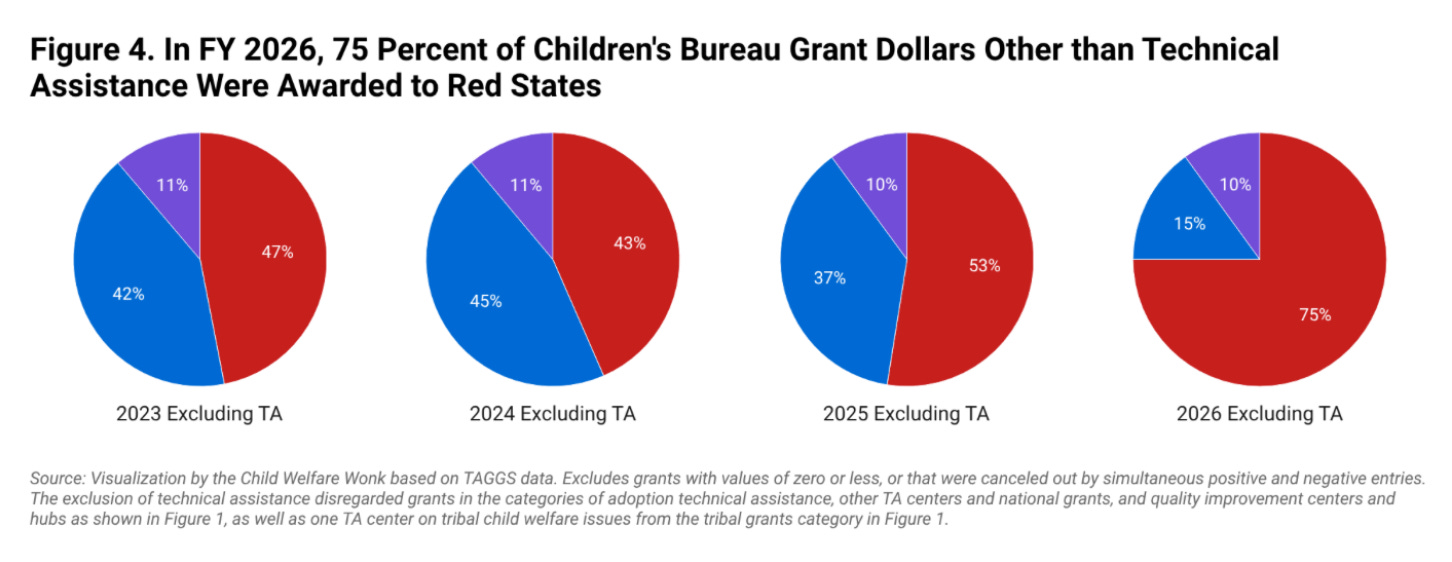
For one thing, the grant geography is looking considerably redder.
In FY 2026, 75% of discretionary grant dollars other than technical assistance went to red states, up from 53% the year before.
New issues are also getting a focus, and the timing of grant announcements and awards is shifting, with implications for anyone who seeks or receives these grants.
Analysis like this is a perfect example of why we built our premium membership community, the Wonk Briefing Room
We surface what matters in child and family policy, and what you can do about it, so you can make your decisions with confidence when it counts.
When you join you get access not only to this brief and all future ones, but to our deeper archive of policy intelligence, plus our member-only events to discuss them.
We offer memberships to individuals and teams of 3-10. Why wait; sign up today.
Deep Dive: Same Support. Different Family.
Class shapes the language, making a case for policies that support families. That language shapes what help looks like.
BY KIMBERLY J. MARTIN, JD
Child care is expensive.
For most American families, that is the beginning of a familiar conversation. Can parents afford to work? Can they find care they trust? How much of a paycheck disappears before the workday even begins?
Move that same conversation into child welfare, though, and the language changes.
Child care becomes prevention. So do paid family leave, tax credits, housing assistance, and direct cash support.
Increasingly, child welfare policy recognizes what families have long known: material conditions shape families’ level of stress, degree of stability, and range of options for the fundamentals of daily life.
Mainstream economic policy discussions broadly frame these supports as helping families manage the cost of raising children. The child welfare policy discussions often frame them around their ability to prevent maltreatment and system involvement.
There is real evidence behind this shift. Studies have linked refundable tax credits, paid family leave, and child care subsidies with reducing maltreatment and child welfare involvement.
The CDC includes economic supports like tax credits, child care subsidies, and paid leave among its recommended strategies for preventing child abuse and neglect.
So calling these policies prevention isn’t inherently wrong, but it surfaces a tension worth taking seriously.
When prevention becomes the primary justification for helping families with low incomes, support begins from a different premise and posture than it does for families with more means.
Reducing the stresses these policies target can matter for families all along the income scale. But the emphasis on preventing harm often grows in rhetorical significance when discussing lower-income families.
It’s worth asking how that emphasis changes the nature of the policy debate, and whether it not only shifts the rhetoric but the standards for assessing whether the same policies work for families with different incomes.
What Happens When Prevention Becomes the Justification
Justifying support by appealing to what it might prevent tethers access to risk.
If federal policy invests in supportive services because they give families options or promote economic mobility, the policy debate frames those families as beneficiaries of an intentional public investment.
Predicating the same services on their ability to manage a potential harm frames those families as a site of potential risk that public resources can manage.
These frames don’t just matter for messaging; they shape policy design. How policies work and benefit families is a function of their design.
When a policy issue like child care moves from a slogan into details, there are important questions to ask around things like who gets support, of what kind, for how long?
A child care policy aimed at economic mobility and affordability will answer those questions based on economic outcomes.
A child care policy aimed at child maltreatment prevention will answer differently, focusing on risk stratification and outcomes related to CPS metrics.
Those aren’t inappropriate questions. Scarce resources require choices, and preventing child maltreatment is a legitimate policy goal.
The thing worth noting, though, is how each frame takes the policy conversation in a different direction.
This is the tension at the heart of so much of the prevention narrative; appealing to a universal policy approach by connecting it to a targeted impact can actually reorient the policy to a narrower approach.
What the Risk Frame Actually Does to Families
The shift from support to prevention is not only conceptual. It changes the terms of the relationship between families and the programs designed to help them.
Consider how federal child care policy is actually structured.
The Child Care and Development Fund is the primary federal vehicle for child care subsidies. It was established alongside welfare reform in 1996.
It was designed explicitly to help low-income working families access care so parents could maintain employment. Eligibility is income-tested. It was designed principally to support employment and economic self-sufficiency, not as a universal benefit for families raising children.
That matters, because middle-income families are increasingly facing the same underlying problem.
For families earning too much to qualify for subsidies but too little to absorb the cost of care, child care can consume 50 to 70 percent of what they spend on housing. For some, the economics push them into a lower income quintile altogether.
When that conversation happens in mainstream policy circles, the language is about workforce participation, economic mobility, and the cost of raising children.
When the same conversation happens inside child welfare, the language is different. So the stakes are different too.
Low-income single parents working unpredictable shift work aren’t just navigating an affordability problem. They’re navigating a logistics problem that doesn’t have a clean solution.
Child care that’s theoretically affordable may not be available on short notice. A schedule that changes week to week makes consistent enrollment harder to maintain.
And when care falls through, the choices that remain often aren’t desirable ones; leaving a child with someone unfamiliar, or alone, because losing the job isn’t an option either.
Those situations are real. They appear in the research and occasionally in the news. They represent genuine danger, but primarily from the precarity rather than the parent.
That distinction matters enormously for policy and for the families policy is supposed to serve. The protective effect of child care is real across income levels.
Stable, affordable care reduces stress, supports employment, and creates breathing room for families at every point on the economic spectrum.
But our policy debates often ask low-income families to demonstrate their need through risk in a way that we never ask of middle-income families.
Questions Worth Considering
Preventing maltreatment or foster care entry are legitimate policy goals to pursue.
But before designing a policy case around that framing, it’s worth calibrating any framing to your longer-term goals.
Here are some questions and considerations when considering your approach.
Where To? It’s impossible to get where you want to go if you haven’t yet mapped it out.
Prevention can highlight the obstacle, but the first move is to sharpen your vision of what should be true.
Universality vs. Targeted Support. It’s hard to move from a targeted risk intervention to a universal policy approach.
Do you know which would best address the goal at which you’re aiming?
Prevention of … If your approach is targeted, what is it preventing and why?
What is its connection to the underlying policy, and what becomes possible as a result?
Where Does Risk Live? Prevention inherently targets risk.
Where does framing a particular issue as prevention place risk, and how does that track with the underlying evidence?
Mind What You Measure. The data that underpin the argument for a policy also shape its assessment.
Consider what metrics merit measurement, and what’s worth tracking beyond the theory of risk.
Sometimes support is prevention.
Sometimes…it’s simply support.
Say Less.
ABOUT THE WRITER
Kimberly J. Martin is a policy specialist examining structural misalignments in child welfare systems — the gap between policy intent and practice outcome. Informed by both professional expertise and lived experience, her work centers on how policy architecture produces inequitable results across class lines.
Partner with Wonk
Leaders often share with us that they’re tired of feeling like their organization is stuck reacting to things. They can sense they’re missing strategic opportunities.
Organizations partner with Wonk to stay in front of fast-moving policy change. Our approach has offered partners benefits that have included:
Keeping state advocates clear on why key trends and opportunities matter;
Showing state and local leaders what matters now for their top priority; and
Surfacing critical openings to shape new policy as organizations build strategy.
Partnerships combine strategic sessions and leadership briefings with broad premium access for your team.
Want to partner?
Reach out to learn about what we offer state agencies and organizations.
That’s it for this week.
Stay sharp, Wonks.
~Z
Partners Making Your Weekly Wonk Possible


