

From the Founder’s Desk
Welcome, Wonks.
You know we like digging deep into the major trends shaping what’s possible in the next era of child and family policy.
For those of you looking for the concrete things to do amid those epochal shifts, this week our Wonkatizer points to two key signals that need to be on your radar:
The Fostering the Future for American Children and Families Executive Order; and
Tomorrow’s U.S. House Ways and Means subcommittee hearing on foster care
Our deep dive data drop looks at a structural pressure impacting children’s access to mental health; the rise of for-profit facilities that don’t take Medicaid, or in some cases commercial insurance.
If you haven’t yet had a chance to check it out, we hope you enjoy my most recent podcast conversation with Prevent Child Abuse America CEO Melissa Merrick.
I appreciated digging into the inherent challenges of defining a term as broad as prevention and its relationship to child safety, a theme WonkCast will keep exploring.
Special thanks to Binti for their foundational sponsorship of WonkCast.

Let’s get into it.
From the Wonk Briefing Room
Our latest Research Roundup is out now—curating the most important child and family policy research into decision-ready insight for your work.
This month’s edition distills ten new studies, covering topics like housing, homelessness, and health access. No jargon. No paywalls. Just the signal.
Tomorrow at 1PM ET we will be hosting a policy roundtable on emerging technology and child welfare policy.
Join and ask questions of our panel, which brings expertise in policy, technology, and agency leadership. We’d love to have you there and in the Briefing Room.
To get all our premium briefs and join our member-only events, sign up for the Wonk Briefing Room here.
Weekly Wonk Deep Dive-Data Drop
The Financing Fault Line in Kids’ Mental Health
By Xiayun Tan, PhD and Robin Ghertner, MPP
BLUF:
For-profit facilities now make-up a quarter of all children’s mental health facilities, growing by 130 percent from 2021 to 2024.
This far out-paced non-profit and public facilities in 2024, which grew around 30 percent.
For-profit facilities are far less likely to accept public funding and far more likely to take cash, creating divergent access pathways depending on a family’s type of coverage and ability to pay.
Three-quarters of for-profits accepted Medicaid, compared to 95 percent of non-profit and public facilities.
95 percent of for-profits accepted cash payments, compared to less than 90 percent of non-profit and public facilities.
Access to care seems to be increasingly driven by families’ ability to pay, not need for services.
Financing Treatment is at the Center of the Growing Child Mental Health Crisis
Previous Wonk analysis pointed to the worsening of children’s mental health; particularly among kids in foster care.
The mental health system’s capacity to treat children—especially those in foster care—depends as much on how services are financed as on how many facilities exist.
As federal funding shifts following the One Big Beautiful Bill Act (PL 119-21) and state budgets tighten in response, understanding how children’s mental health facilities are actually financed is essential—and mostly missing from the debate.
We’re filling this gap using the latest data from the National Substance Use and Mental Health Services Survey (N-SUMHSS).
We looked at what funding sources children’s mental health facilities accept, and differences by who operates a facility - whether it’s a for-profit, non-profit, or government-run facility. The data don’t permit looking at funding amounts.
All differences we talk about are statistically significant at p<0.05. Details on our approach can be found in the Methodological appendix here.
Who Pays for Mental Health?
Over 8,000 facilities nationwide provide mental health treatment for children.
Understanding how those facilities are financed is central to any discussion of access or reform.
A recent premium Wonk analysis showed that Medicaid is the dominant payer for children’s mental health treatment.
But it operates within a complex patchwork of public and private sources that vary by state and ownership structure (Weil, 2025).
Facilities can take funding from several sources:
Medicaid
Private insurance
Cash payments
Other federal sources, such as the:
Community Mental Health Services Block Grant (totaling over $1 billion for FY2023);
Community Services Block Grant; and
Social Services Block Grant.
Other state and local sources, including funds from state mental health agencies or child and family services agencies.
(Note: we can’t separate state from local in the data)
Other sources, such as private foundations
Facilities routinely make decisions about which payers they will take.
Lower reimbursement, administrative burden, or reporting requirements can make some funding streams functionally inaccessible — especially for smaller or privately financed providers.
More Facilities, More For-Profits
Between 2021 and 2024, there was a 50 percent increase in mental health facilities serving children–from about 5,500 to about 8,800.
But the expansion wasn’t evenly distributed among provider types.
It was in large part driven by a rapid expansion in for-profit providers.
Three ownership types make up the landscape:
For-profit facilities, which grew by 135 percent, to 2,329 in 2024– making up 26 percent of all facilities.
Non-profits, which grew by 35 percent, now make up 61 percent of all facilities.
Public facilities – run by federal, state, local and tribal governments– which grew by 30 percent, and now make up 12 percent.
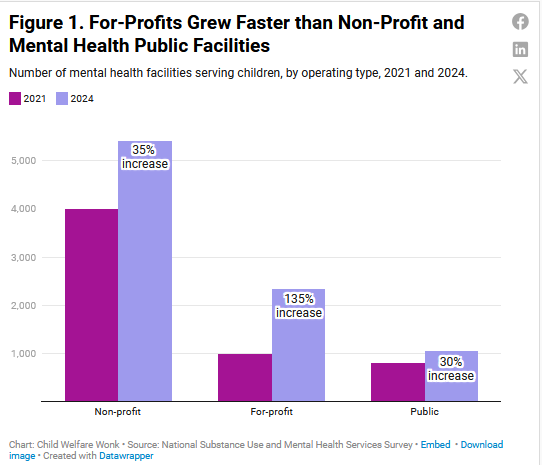
The growth in for-profits is not uniform across states. Their footprint ranges from less than 3 percent of all facilities (Kansas) to 70 percent (Indiana).
States with less than 10 percent of facilities being for-profit include: Kansas, South Dakota, Missouri, Vermont, South Carolina, Alaska, New York, New Hampshire, and Oregon.
States with over 50 percent include: Indiana, North Carolina, Utah, and Maryland.
Fewer For-Profit Facilities Accept Medicaid, More Likely to Take Cash
The impact of ownership structure on access shows up most clearly in which payment sources facilities are willing to take.
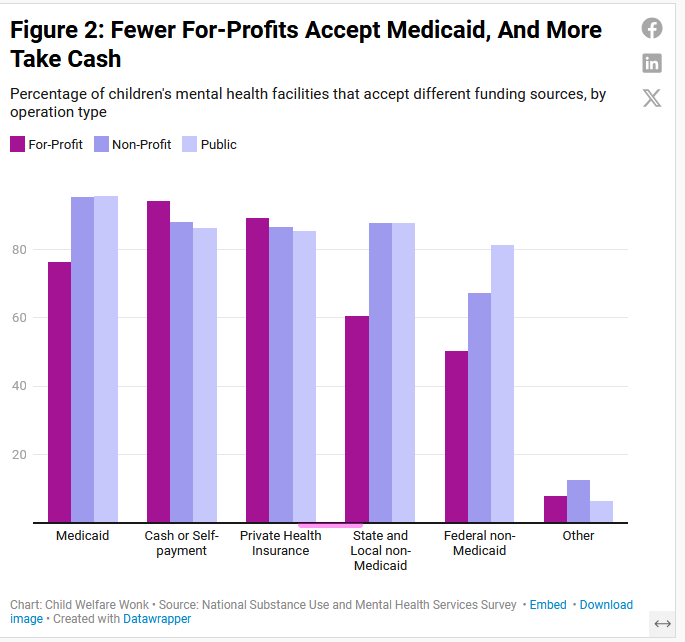
Three quarters of for-profits accepted Medicaid in 2024, compared to 95 percent of non-profit and public facilities (Figure 2). That number actually went down from 2021, when 80 percent of for-profits accepted Medicaid.
Even fewer for-profits accepted other government sources - 60 percent accepting state and local funding, and half accepting federal sources.
Nearly 90 percent of non-profit and public facilities accepted state and local funding. Two-thirds of non-profits and around 80 percent of public facilities relied upon non-Medicaid federal dollars.
Cash pay is another story. Nearly 95 percent of for-profits accepted cash payments from patient families, compared to 88 of non-profits and 86 percent of public facilities.
Will the Growth in For-Profits and Shift Away from Public Funding Continue?
Medicaid remains the backbone of treatment for children and youth, but participation varies by facility type.
Even small declines in acceptance among for-profit providers can narrow options for publicly insured families, particularly where capacity is already limited.
The financing structure of children’s mental health care is facing a turning point.
The growth in for-profits and their ability to choose which funding source to accept suggest that access could become more uneven over time—especially for families who rely on Medicaid and other public sources.
These trends are not distributed evenly across the country. States vary widely in the share of for-profit facilities, which could create regional exacerbations.
These findings don’t show a collapse in access—they signal early indicators of imbalance.
Tracking how financing patterns evolve will be critical to understanding where access is tightening, and what might stabilize it.
Wonkatizer
New Child Welfare Executive Order Points to Priorities
The White House’s November 13 Fostering the Future for American Children and Families Executive Order is dense with signals on Administration priorities.
The wide-ranging EO outlines key priorities for the Administration, and points to key roles for First Lady Melania Trump and ACF Assistant Secretary Alex Adams.
“Fostering the Future” initiative for transition-age youth
HHS and the First Lady’s office will lead public-private partnerships to support young people accessing services, and address states returning unspent Chafee funds.
Why it Matters
The First Lady’s philanthropic work has focused on older youth in foster care.
With veteran child welfare and adoption expert Sarah Gesiriech as her Policy Director, her office is well-positioned to play a lead role in the admin.
Modernization of data, technology, and analytics
The EO tasks HHS with revising regulations, streamlining reporting, releasing more data publicly, and promoting modernization of state information systems.
The EO also directs HHS to encourage expanded use of predictive analytics and AI for recruitment, retention, and matching of caregivers.
Why it Matters
There is bipartisan alignment in favor or reducing administrative burden, which is also more deeply connected to discussions of reforming child welfare financing policy.
Those are areas on which ACF Assistant Secretary Adams has previously led, and will likely drive what comes next.
Debates over the role of AI in policy and its potential to reduce or expand biases in decision making will continue to percolate as this develops.
Expanded role for faith-based organizations
The EO directs HHS to increase partnerships with faith-based providers across prevention and foster care, including through addressing state/local policy barriers.
Why it Matters
Faith-based organizations have a longstanding role in child welfare policy and service provision.
It will be worth tracking whether this revives debate over the first Trump Administration’s waiver of non-discrimination policies, and other related efforts.
What Comes Next
The EO came with a well-attended White House event, featuring multiple cabinet secretaries, the President, and the First Lady.
This signals a big commitment, but now the longer-term work comes of turning it all into concrete policy. It also aligns significantly with another key signal…
Chafee Back in Congressional Spotlight
Tomorrow, the House Ways & Means Work & Welfare Subcommittee will hold an older youth foster care policy hearing, “Leaving the Sticky Notes Behind.”
As the name implies, the hearing will focus on how innovation and technology are being used in the Chafee Program to support youth transitioning out of foster care.
Why it Matters
It’s the second time this year the subcommittee has brought Chafee to the witness table, and the hearing highlights key topics from last week’s executive order.
With the EO on the table and a second Chafee hearing in the same year, older youth are clearly moving up the congressional agenda.
We’ve discussed before the opportunity for first movers to frame the debate.
Tomorrow and the chance to provide public outside testimony until December 2 will show more of what’s surfacing.
That’s it for this week.
Stay sharp, Wonks.
Z
Partners Making Your Weekly Wonk Possible


