

From the Founder’s Desk
Child welfare policy has an “admiring the problem” crisis.
The issues our field confronts are so complex that knowing “what to do” is the table stakes; “how to do it” is the central challenge that’s too easy to avoid.
We see our role as creating clarity to make the “how” visible and impossible to ignore.
Our recent Wonk Intelligence Quarterly unpacked decisions, challenges, and opportunities ahead for leaders navigating three key constraints in child welfare policy.
These structural constraints limit what's possible in child welfare policy, regardless of political will or good intentions:
Fiscal Federalism. Rising friction for federal policy when federal investment and expectations decouple. Long-term debt and looming cuts only exacerbate this.
State Capacity. The real rate limit on last-mile policy delivery, which meters the pace of implementation and shapes nimbleness in leveraging new policy shifts.
Theory of Change. Lacking a clear one for the emerging era leads to firefighting over architecture, and a default to tools over vision.
One concrete place to confront all three of these constraints is the Administration for Children and Families’ (ACF) A Home for Every Child initiative.
The 5-word vision may be easy to oversimplify, but it sits atop a vision spanning from prevention through permanency.
It confronts the fiscal federalism fault line through a Technical Bulletin operationalizing renegotiated federal oversight with leaner metrics and a clearer unifying focus.
Those metrics and an updated data dashboard in turn create visibility into indicators intended to quantify capacity relevant to federal policy.
We are now seeing the first states adopt this approach, with Oklahoma & Missouri becoming the first to formally participate.
Given that momentum and the structural shifts it aims to generate, we’ll be sharing a series of analyses unpacking the possibilities, and the points of caution.
In this week’s Deep Dive, Laura Radel unpacks where there are constraints on what the ratio can surface, and why designing for them matters for systems’ success.
Fiscal federalism, state capacity, the need for a theory of change, and federal oversight also all coalesce in another key issue; child welfare financing reform.
We continued unpacking that with my WonkCast conversation with Wendell Primus, and a brief on why financing reform stalled before and what it would take to move.
Both explore the power structures that shape possibility within the policy-making process and what the field needs to know to navigate them effectively.
Let’s get into it.
Special thanks to Binti for their foundational sponsorship of WonkCast.

Weekly Wonk Deep Dive
When Foster Care Gets Ratioed
The limits of a Home for Every Child’s home-to-child ratio.
By Laura Radel, Senior Contributor
The Administration for Children and Families’ (ACF) Home for Every Child Initiative (HFEC) rests on a simple idea: increase the ratio of foster homes to children in care to at least 1:1.
Currently the ratio is about half that nationally.
As an organizing principle for federal accountability it offers an appealing ability to encompass the full range of child welfare; prevention through to permanency.
It also comes with important caveats that merit conversation to maximize its sharpness, and minimize mistaking the map for the territory.
Which Homes for Which Children?
An abundant supply of foster families enables agencies to assure appropriate matches between homes and children who need them, and allows agencies to avoid relying on congregate care when it is not necessary for clinical purposes.
Assistant Secretary Adams has also emphasized a core strategic feature of the metric: states can improve the ratio through either “numerator” or “denominator strategies”.
That means progress can encompass increasing the number of foster homes or decreasing the number of children in foster care, through prevention and shortening children’s lengths of stay in care.
When collapsed and oversimplified, the charge of HFEC can get framed as foster care capacity being a supply imbalance: too few homes relative to children.
But capacity isn’t just about aggregate supply; it’s about match, distribution, and whether families continue fostering.
That means a state could achieve a 1:1 ratio and still lack the right homes for the children entering care.
Holding this tension without oversimplifying in either direction matters when using this metric.
Why Sibling Groups Complicate the Math
ACF’s topline framing suggests we need at least as many foster homes as there are children in care.
But homes and children are not one-to-one units.
Roughly two-thirds of children in foster care are part of sibling groups.
Preserving sibling connections is widely considered best practice, and many placements involve multiple children in a single home.
A system could operate effectively with fewer homes than children—if those homes are able and willing to care for sibling groups.
Conversely, a system could meet a 1:1 ratio and still lack homes able to take the sibling groups actually entering care.
States’ Licensing Databases Are Messy
Current capacity for counting licensed foster homes yields more noise than signal.
The federal government does not collect data on foster home supply, and states’ administrative data on licensing are “noisy” in a number of ways:
Some licensed homes remain in licensing databases long after they stop taking in children.
Some were licensed to care for a particular relative’s child, and have no interest in caring for anyone else.
In some cases, agencies have reservations about certain licensed homes, and choose not to place children with them even while they remain technically “available”.
Even among homes actively providing care, care days are concentrated in relatively few homes.
One study of three states found the most active 20 percent of foster parents provided about two-thirds of all foster care days, suggesting that capacity is more concentrated than it may appear.
A count of valid licenses does not necessarily reflect usable capacity.
To matter for placement decisions, homes must be available and appropriate for the children who need them, a constraint on currently available data.
Existing Capacity May Not Match the Children Who Need Care
Typically states describe having abundant families willing to care for young children, particularly infants.
They often struggle to find homes for older youth, particularly those with behavioral issues, children with special health care needs, and youth who are LGBTQ+.
States often lack foster parents who speak the child’s primary language, or can maintain cultural and religious ties.
A simple count of foster homes cannot capture these differences.
A system can have enough homes in the aggregate and still lack homes that match the needs of the specific children entering care.
The Foster Home Retention Problem
Available research finds considerable turnover among foster parents.
In one state studied, the median length of service for foster homes was 11 months, and 75 percent of foster homes stopped caring for children within two years—shorter than many children’s stays in care.
Nearly one-third of homes in that state never had even a single child placed with them.
Another study across three states found that between 15 and 20 percent of foster homes provided less than 90 days of foster care during their entire fostering tenure.
While the research base is limited, findings are consistent: turnover is the most pressing issue in maintaining a robust supply of foster homes.
While a call to provide a home for every child can sound like primarily a recruitment focus, retention is essential to maintaining sufficient supply and keeping recruitment sustainable.
Without sustained support for families, agencies risk running a constant recruitment treadmill, needing to replace homes as quickly as they license them.
What the Ratio Can’t Tell Us
A home for every child is a compelling goal.
Leveraging it effectively requires ensuring goodness of fit; not just any home will do.
It depends on whether homes are aligned with the children entering care, whether families remain in the system over time, and whether states can accurately measure real availability.
A state could improve its home-to-child ratio and still struggle to place older youth, sibling groups, or children with complex needs.
A single organizing metric offers the chance to quickly quantify child welfare’s deep complexity; the risk is collapsing it.
As leaders look to operationalize this metric, they’ll also need to go deeper to ensure placements are not merely available, but also optimal for outcomes.
From the Wonk Briefing Room
The stuck-ness of child welfare financing is an “everybody knows” problem; “everybody” knows what’s broken, but “nobody” ever seems to have the structural fix.
That analysis is a dead end because it’s a category error; rather than assessing the constraints preventing reform, it describes the distortions those constraints create.
Regardless of your preferred politics or policy outcome, surmounting these constraints is a foundational challenge for our field in this emerging era.
Everyone agrees the current system misaligns federal dollars with outcomes, which is how we get the “Entitlement to What?” debate over “entitlement” vs. “block grant”.
Meanwhile, the open-ended Title IV-E foster care program mostly funds systems rather than direct care or services, pointing to different conversations entirely:
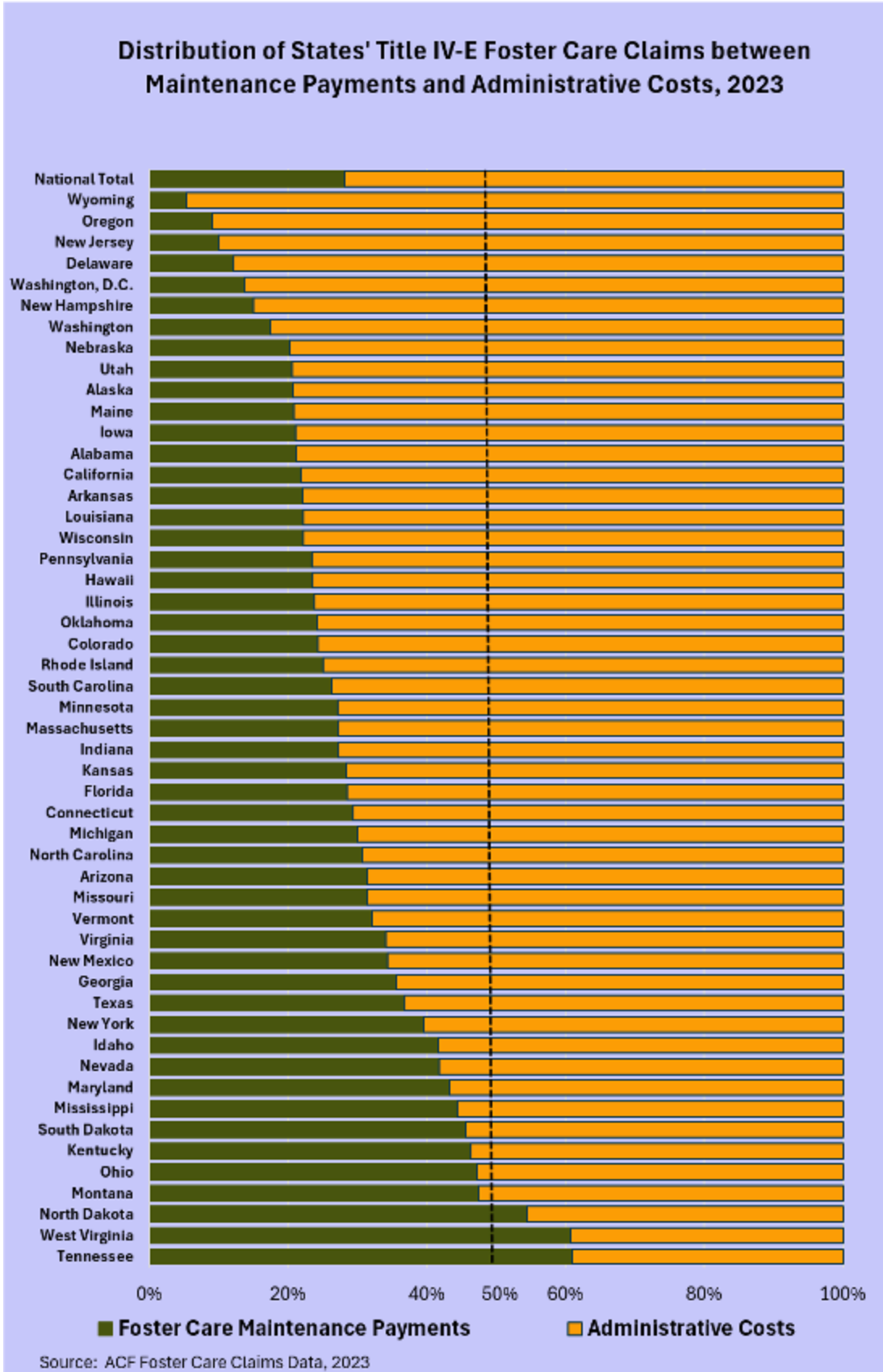
In this week’s premium brief, Doug Steiger digs into the structural constraints that keep financing reform from moving and maps what it would take to surmount them.
Why Child Welfare Financing Reform Never Quite Happens
The barriers to redesign, and what it would take to surmount them.
By Doug Steiger, Senior Contributor
Child welfare financing reform efforts encounter a Gordian knot; there is a misalignment between how federal policy finances the system and what it expects the system to accomplish.
The Bipartisan Policy Center’s recent Blueprint for child welfare financing reform is the latest attempt to draw the field and policymakers into a shared project of resolving that tension.
The mismatch between rhetorical and financial support for prevention, child protection, foster care, and permanency is glaring and has persisted for decades.
Yet the persistence of the current framework points to a deeper reality:
Prior attempts at child welfare financing reform have stalled because the system lacks both a unifying theory of purpose and the political conditions to act on one.
Fragmented jurisdiction, low salience, and cross-cutting tradeoffs have made comprehensive reform elusive; everybody knows “what to do” but the challenge is how to do it.
Why has this mismatch never been successfully addressed, and what–if anything– might be different now?
—
Wonk Briefing Room members get the full brief with further insight and state data.
Join here and get all our premium intel and access to member-only events.
Partners Making Your Weekly Wonk Possible


