

From the Founder’s Desk
Welcome to the latest Weekly Wonk.
I wasn’t surprised that my recent WonkCast conversation with Ali Caliendo about kinship care resonated with so many of you.
She’s pressing on a central question our current debates too often pass by; is kinship care a form of prevention, or is it an intervention?
This isn’t abstract dorm room philosophizing, but a way to make sense of what we can say about declining numbers of kids in care. Otherwise, we can think lower foster care entries mean more families remain intact, when separations might be continuing.
For our Deep Dive this week, we’ve invited Ali to unpack what it means when foster care prevention still results in family separation.
Later this week, Wonk premium members and partners will get her actionable framework, with guidance on what this means for your work on Family First.
We’ve also got some way-too-early Hill developments worth watching as you plan for your work in the lame duck and the 120th Congress.
Finally, if you enjoyed Rebecca Robuck’s “what if it worked?” approach to child welfare policy, you’ll want to subscribe to her new initiative, The Trellis Project.
Let’s get into it.
See. Know. Decide.
At Child Welfare Wonk, we’re here to help you do three things:
See what matters for your policy priorities;
Know the strategy that can advance your goals; and
Decide with confidence when it counts.
We do that through our team’s relentless search for and analysis of policy intelligence.
Knowing that a Congressional hearing is happening is information. Knowing why that hearing is happening in the first place, and what opening it represents, is intelligence.
More information makes more work for you. Intelligence simplifies, so you spend less time sorting and more time making informed decisions that matter to you.
We make the Weekly Wonk newsletter and our WonkCast conversations freely available because they’re the essentials our field needs to know about.
Our member-only Wonk Briefing Room community gets access to confidential events and our premium intel, which goes deeper and answers “so what can I do about it?”.
Private and public-sector partners integrate our insights into their work at scale, through broad premium access. We also apply our intel to their specific priorities in candid and confidential conversations about what matters most to them.
They leave feeling strategic and ready, rather than inundated and overwhelmed.
Reach out today to connect about partnerships for organizations and state agencies.
Wonkatizer
Ways & Means Preps for Musical Chairs
If you thought the 2028 presidential race was off to an early start, House Republicans are prepping for the race to be the GOP lead for the U.S. House Ways and Means Committee… in 2029.
This is not mere horse-race movement, though. If you care about child welfare and safety net policy, this matters for you because they that run through that committee.
What’s Happening
Rep. Jason Smith (R-MO) currently chairs the Ways and Means Committee. Under current House GOP rules, he would hit the six-year term limit for running that committee at the end of 2028. That’s waivable, but not a given.
Other committee members are already testing the waters on a push for the lead role, including Reps. Darin LaHood (R-IL) and Adrian Smith (R-NE).
Why it Matters
The oldest committee in Congress has broad jurisdiction touching the tax code, some health policy, child welfare, and a substantial proportion of safety net programs.
The game of musical chairs will shape the leading Republican perspective on the full committee and also the relevant subcommittee for child welfare and the safety net.
What to Watch
Larger House GOP leadership deliberations on waivers to allow committee chairs to stay past their term limits will shape the current Chairman’s options.
The other thing to watch is the posture of all of these aspiring members toward safety net policy issues, for signals of how they’d lead the GOP side.
Wondering what you can do about it? Later this week, our premium members will be getting concrete guidance on how to be well-positioned for any outcome.
Deep Dive
When Foster Care Prevention Still Leads to Family Separation
Kinship care can keep a child in the family, while still separating them from their parents. Assuming prevention drives falling foster care entries may miss separation outside the system.
By Ali Caliendo, PhD
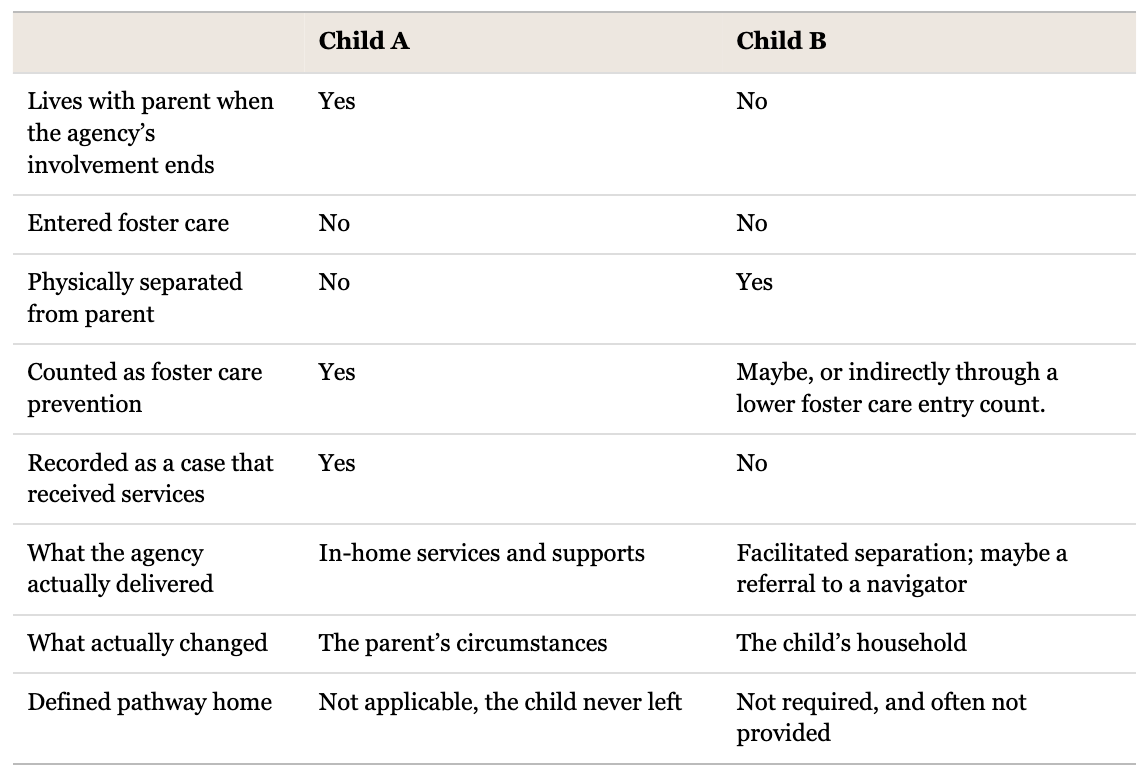
Two children come to the attention of a child welfare agency.
Child A stays home. The parent enters substance use treatment, the agency arranges in-home services and concrete supports, and the case closes.
Child B does not stay home. The child goes to live with a grandmother across town while the parent addresses the conditions that brought a caseworker to the door.
No petition is filed. No judge signs an order. The investigation closes.
In most jurisdictions, both register as prevention, but in different records. Child A appears as a family that received services. Child B may not appear at all.
Neither child entered foster care. But only one avoided parental separation.
The fundamental problem is that the child welfare field often defines “prevention” in terms of the system, rather than a child’s experience.
The system-focused question is whether the child entered care formally or not. For the child, that administrative category can be irrelevant to whether they stayed with their parents or not.
The problem is not that Child B went to a grandmother. That may have been exactly the intervention the child needed. The problem is that the system can count the arrangement as successful prevention even though the child left a parent.
Child welfare has spent the better part of a decade building policy and financing around safely preventing foster care, a necessary shift. But preventing foster care counts what did not happen, not where the child went.
Kinship care is one of the strongest resources available when children cannot safely remain with parents. But it’s a safety and well-being intervention, not a prevention of parental separation.
Relative placement can preserve siblings, extended family, language, church, school, community, and the continuity of being known, and it avoids placement with strangers.
It may keep a family connected, but it does not keep a parent and child together. “Families stay together” can hide the difference.
The distinction is not semantic. It determines what gets counted, who receives support, and who absorbs the work and cost of separation.
When a prevention framework fails to name that distinction, responsibility shifts from the system to families equipped with substantially fewer supports.
Separation Happens Without Removal
Removal is a legal action: the state takes custody and assumes responsibility for placement and permanency. Separation is a physical one. A jurisdiction can prevent the first without preventing the second.
Josh Gupta-Kagan’s work on hidden foster care documents arrangements in which agencies facilitate a child’s move to a relative without filing a petition or creating the record a foster care placement would generate (Gupta-Kagan, 2020).
Formal removal also triggers process. A petition is filed, a parent is typically appointed counsel, and a judge must find that the separation is necessary.
An agency-facilitated diversion can move the same child out of the same home without triggering those protections.
Because these arrangements are neither consistently defined nor reported, there is no reliable national count.
National data from the early 2010s suggested that kinship arrangements outside of the foster care system accounted for nearly half of out-of-home placements following a child maltreatment investigation (Walsh, 2013).
Later estimates, drawing from this work, suggested that 100,000 to 300,000 children may be diverted from foster care to relatives annually (Malm et al., 2019).
A 2026 Child Trends brief found that only 11 states could distinguish kinship diversion from agency-custody placements in their administrative data, although 14 states had reported tracking diversion in a 2022 national policy survey (Child Trends, 2026).
But a state can track only diversions that generate a document.
When diversion happened in my own family in Nevada, it generated no document.
Once the investigator learned I would pursue guardianship, the investigation closed. There was no out-of-home safety plan and no record that a child had moved.
Later, while running a kinship navigator program, I saw the pattern repeat. Separations without paperwork remain outside the count.
The absence of a record did not mean the absence of a separation.
Separation Creates Three Sets of Needs
Naming the separation raises a question the field rarely asks. If state intervention helped separate children from their parents and create a kinship family, what does the state owe that family?
The answer shapes which supports get built and which families manage on their own.
Kinship care, regardless of how it interacts with the foster care system, should be understood as an intervention for children in nonparental care, and resourced accordingly.
The relevant unit is the kinship triad of child, parent, and caregiver.
The child may face grief, divided loyalties, behavioral health needs, and a need for safe parental contact. The parent may need services, a reunification plan, and a timeline.
The caregiver faces immediate financial, legal, housing, child care, and health coverage needs.
Families outside foster care often face those demands without the infrastructure formal foster care is supposed to provide. The child may have no assessed needs, no behavioral health referral, and often no one formally responsible for arranging safe contact with the parent.
Parents may receive fewer formal reunification services or no clearly defined timeline.
Caregivers may receive limited or no training and no financial support. Some federal benefits are also tied to the formal foster care pathway.
Title IV-E KinGAP, for example, generally requires a child to have been eligible for foster care maintenance payments while living with the prospective relative guardian for at least six consecutive months (42 U.S.C. § 673(d)(3)). A diverted child does not meet that requirement simply by living with kin.
This is also the limit of a kinship navigator program. Federal law describes navigator programs as helping caregivers learn about, find, and use programs and services, through information and referral systems, outreach, and partnerships (42 U.S.C. § 627(a)(1)).
Because navigator programs do not require a child welfare removal, they are among the few supports that reach families formed outside the foster care system, which is precisely where help is most scarce.
Most navigator activity is designed to connect a family to something that already exists. If a service does not exist, a navigator cannot produce one.
A navigator can help a grandmother apply for child-only TANF or Medicaid, but cannot refer her to a Title IV-E guardianship subsidy for which she is ineligible outside the foster care pathway.
The program meets families where they are, and then can offer them only what that pathway already provides.
The separation occurred. The infrastructure did not follow.
When Prevention Hides Separation, the Burden Shifts
A system can report fewer foster care entries without knowing whether fewer children were separated from their parents, or whether those separations shifted into kinship arrangements outside foster care.
National data cannot reliably distinguish between those two stories.
Private kinship families and agency-facilitated diversions are usually folded into the same informal population, even though one formed independently and the other followed government intervention.
That data blind spot becomes an accountability blind spot. When separation occurs outside foster care, the formal system carries fewer costs, procedural duties, and monitoring obligations. The child, parent, and caregiver carry more.
That is hidden foster care: the separation produces no foster care record, no guaranteed path home, and far less support, while the agency’s role can be described as prevention.
What Decision Makers Need to Know
A declining foster care entry rate cannot, by itself, answer the separation question. It may reflect fewer separations—or more separations occurring outside foster care.
At minimum, every case counted as prevention should answer two questions:
Did the child avoid entering foster care?
Is the child still living with a parent?
A yes-then-no case achieved foster care prevention, but not prevention of parental separation. Treating both outcomes as the same obscures the different responsibilities each creates.
If a prevention framework permits children living with kin, that arrangement should be explicit in policy and data, disclosed to parents and caregivers, and paired with the financial, legal, well-being, and reunification supports the separation required.
Child Trends recommends much of the necessary data architecture: federal guidance clarifying how diversion is classified, clear state definitions, required data fields in administrative systems, and regular outcome reporting that mirrors what is expected for children in formal foster care (Child Trends, 2026).
Precision does not require bringing every child living with kin into foster care. Foster care is not a support program, and a kinship arrangement is not inherently better simply because it occurs inside the system.
Nor does precision require greater skepticism of kinship care. It requires naming the outcome accurately. A child who moves in with a grandmother may have avoided foster care, but that child did not avoid parental separation.
The system should be able to say both—and account for what follows.1
That’s it for this week.
Stay sharp, Wonks.
~Z
Partners Making Your Weekly Wonk Possible


Deep Dive References
Administration for Children and Families. (2026). ACF expands prevention services to reduce foster care entries. U.S. Department of Health and Human Services. https://acf.gov/media/press/2026/acf-expands-prevention-services-reduced-foster-care-entries
Child Trends. (2026). State tracking of kinship diversion can inform the field. https://media.childtrends.org/media/StateTrackingofKinshipDiversion_ChildTrends_July2026.pdf
Gupta-Kagan, J. (2020). America’s hidden foster care system. Stanford Law Review, 72, 841–913. https://review.law.stanford.edu/wp-content/uploads/sites/3/2020/04/Gupta-Kagan-72-Stan.-L.-Rev.-841.pdf
Malm, K., Sepulveda, K., & Abbott, S. (2019). Variations in the use of kinship diversion among child welfare agencies: Early answers to important questions. Child Trends. https://www.aecf.org/resources/variations-in-the-use-of-kinship-diversion-among-child-welfare-agencies
Walsh, W. (2013). Informal kinship care most common out-of-home placement after an investigation of child maltreatment. Carsey Institute, University of New Hampshire.
42 U.S.C. § 627 (2018). https://www.law.cornell.edu/uscode/text/42/627
42 U.S.C. § 673 (2018). https://www.law.cornell.edu/uscode/text/42/673