

From the Founder’s Desk
Welcome to the latest Weekly Wonk.
Having good policy ideas is necessary, but not sufficient.
What turns them into impact is understanding the decision-making machinery through which they must move.
This week we’re looking at that machinery.
Not the civics textbook version; the gritty reality of how child welfare policy actually gets done on Capitol Hill.
This week we have first-time Wonk contributor Kristen Torres’ insider perspective on staffing a senior House Ways and Means Committee member’s personal office.
She unpacks what Hill staff are really thinking when hearing a policy pitch.
Our inaugural Wonk Intelligence Quarterly identified a scarcity of clear theories of change as a core constraint limiting what’s possible in child welfare policy.
Kristen’s piece is about the strategic layer that converts a theory of change into a policy framework that can move through Congress.
On this week’s WonkCast episode, I talked with Adrien Lewis, Founder and President of CarePortal.
We discussed his experience taking a theory of change about social isolation and turning it into infrastructure available to public agencies.
And this week’s Wonk Briefing Room premium brief from Senior Contributor Doug Steiger offers tools for durable policy design principles learned from home visiting.
Let’s get into it.
Special thanks to Binti for their foundational sponsorship of WonkCast.

Weekly Wonk Deep Dive
What Hill Staff Wish the Child and Family Policy Field Understood
Reflections from my time as a Legislative Assistant in the U.S. House of Representatives
By Kristen Torres, Contributing Author
When I tell people I worked on child and family policy in Congress, they often assume I had a lot of direct power.
The reality is different — and understanding it is key to effectively influencing and driving impact.
Child and family policy legislative work requires more than passion or expertise.
It means navigating institutional limits, political tradeoffs, and daily behind-the-scenes effort to get results.
Staff influence is real. But it operates inside a system.
From my time on the Hill — juggling Defense, Labor, Judiciary, Immigration, Social Security, and child welfare at the same time — here’s what I wish the field understood.
Staff Influence Is Real — And Constrained
Staff can shape conversations and raise the visibility of specific issues.
But final decisions rest with the Member of Congress, who make decisions based on factors well beyond the merits of the idea itself.
That’s where advocates can get tripped up.
When I was on the Hill, every issue had to run through a filter:
How does this align with the Member’s priorities?
How does it matter to the district?
What does it cost?
Who opposes it, and why?
Is there a path to bipartisan support?
When you got my agreement that an issue was important, what you secured was an internal champion — not a decision.
I still had to convince my Legislative Director and often the Chief of Staff.
And even if they agreed, I had to coordinate with committees, stakeholders, and other offices to understand whether the timing and conditions were right.
Effective advocacy doesn’t just make the policy case.
It helps staff navigate time, capacity, and authority constraints to turn agreement into action.
Bipartisan Doesn’t Magically Mean “Easy to Enact”
One of the greatest rewards of working in child welfare policy is the bipartisan cooperation — everyone wants kids to be safe and families to thrive.
But once you get into policy details, differences show up fast, and don’t necessarily break neatly along partisan lines.
A persistent divide is the federal vs. state role.
Some members want stronger federal standards and dedicated funding for consistency.
Others push for state flexibility and fewer bureaucratic hurdles.
Even funding structure can split people — mandatory funding for stability versus annual appropriations for policymaker control.
In the 118th Congress, conversations around updating Title IV-B showed this clearly.
Members agreed that states need better tools to support families and prevent unnecessary foster care.
But the split came over how to get there.
Advocates who understand where the philosophical fault lines sit — and draft within them — accelerate movement.
Those who don’t quietly close the door on themselves.
Stories Open Doors. Solutions Move Bills.
A compelling personal story can grab a staffer’s attention and make an issue feel real. Solid data backs it up.
But the next question is always the same: Okay — what do you want us to do?
Staff don’t always have time to turn a problem into a policy solution from scratch.
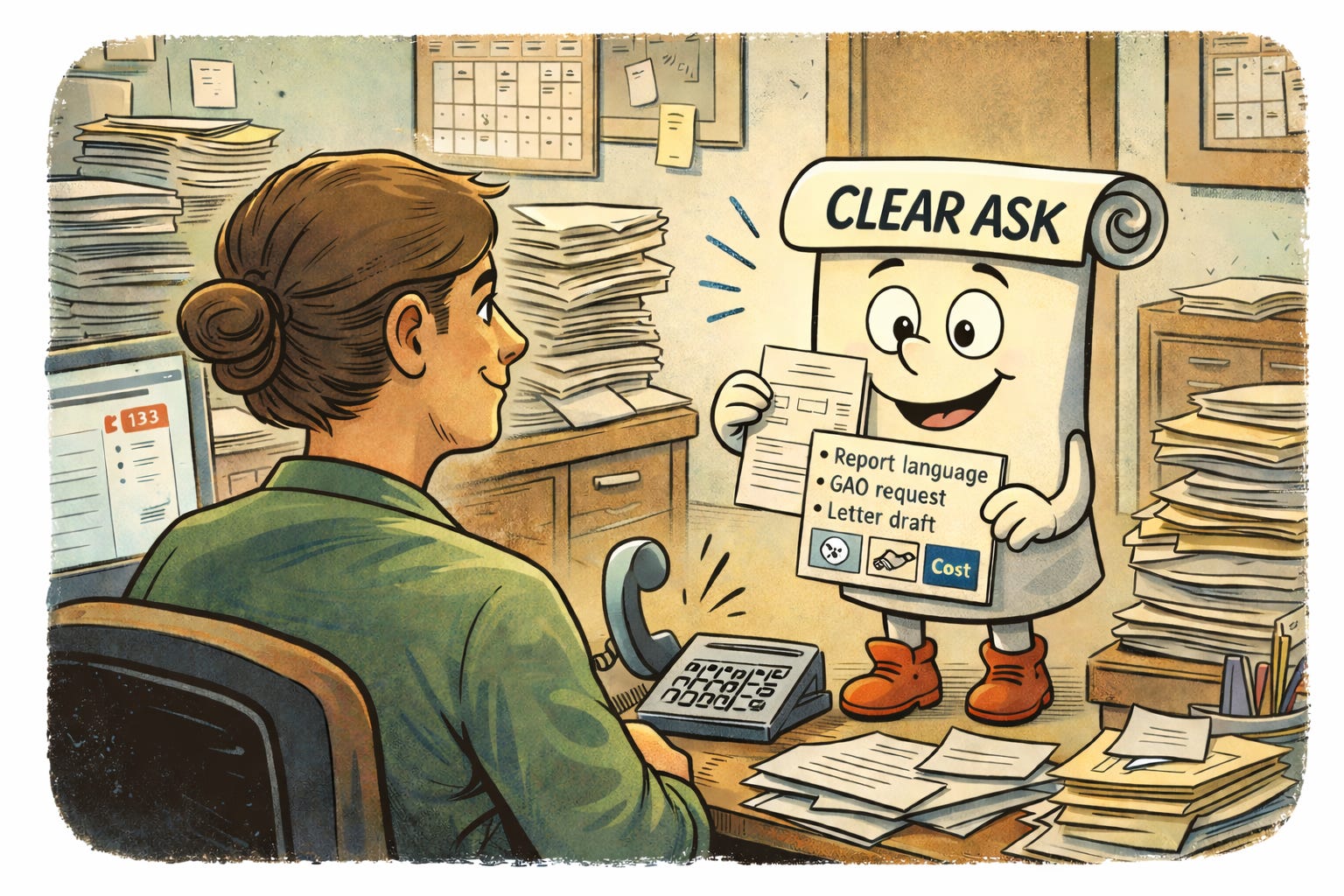
Meetings that came to me with clear next steps — a letter to send, report language to propose, a bill to co-sponsor — moved through our internal process much faster.
That didn’t mean approval. It just meant I could get the request into the queue for a decision more quickly.
The advocacy that really works combines lived experience with concrete policy asks that make it easy for staff to act.
Legislation Is Not the Only Lever
Standalone bills are the most visible form of action — and often the least likely to move. Much policy influence happens elsewhere.
Appropriations report language signals congressional intent to agencies and can shape how funds are used.
GAO report requests put real pressure on agencies — their findings get cited in hearings, report language, and member letters.
Letters from Members to agencies can ask for guidance clarification, push for waivers, or encourage use of existing authority.
Media engagement and op-eds create public momentum that pressures decision-makers.
Effective advocates are creative in their attempts to move an issue forward and are familiar with the full toolkit.
What This Means for the Field
Understand the process deeply — passion alone isn’t enough without knowing how legislation moves.
Shared values are just the starting point; turning bipartisan agreement into law requires understanding the divides.
Pair stories with solutions. And be creative with your asks — think beyond the usual requests, and consider how to help staff build momentum quickly.
Working in Congress is messy, complicated, and slow.
But when the victories come, they are built on careful coordination, incremental progress, and relentless alignment with institutional reality.
Advocates who understand that are best positioned to make a difference.
Kristen Torres is the Founder & CEO of Torres Consulting. She previously worked for U.S. Representative Judy Chu (D-CA).
From the Wonk Briefing Room
Every Friday members of our premium community, the Wonk Briefing Room, gets our latest Wonk premium brief.
Where the Weekly Wonk gives you a map of the terrain child and family policy faces, our premium resources aim at how to navigate it.
In a moment when federal support for family programs is contracting, the question of which programs survive, and why, is more than academic.
It’s operational intelligence for anyone working to protect services families depend on.
This week’s premium brief takes home visiting as a case study in program durability.
Senior Contributor Doug Steiger examines why home visiting has not only survived but grown eightfold in investment with persistent bipartisan support.
That trajectory isn’t luck; structural choices built home visiting’s political resilience.
The full brief draws out four lessons for policymakers and advocates designing or defending programs today.
Premium members get the full piece at the Wonk Briefing Room. Join here.
Wonkatizer
ACF Launches Child Welfare Technology Incubator
What Happened
ACF has launched a Child Welfare Technology Incubator, offering technical assistance and scalable CCWIS blueprints.
On February 23, ACF also announced a partnership with Iowa to establish the state’s new system as a national model for CCWIS modernization.
Iowa built its model, VISION, on modular, user-centered design principles, and did so faster than typical implementations.
What it Means & What to Watch
ACF is explicitly framing this as a part of its broader strategic shift from federal oversight to active federal-state co-design.
The Iowa partnership also directly links VISION to A Home for Every Child.
The Incubator arrives at a complicated moment for CCWIS modernization.
As we examined in December, long-standing barriers have limited implementation, and ACF restructuring has moved oversight of the program.
In an era of rapid technological development and rising expectations for its use, the key thing to watch will be whether this incubator fundamentally shifts how and why states implement the CCWIS platform.
Foster Youth at the State of the Union: A Signal Worth Watching
What Happened
Last week, Sierra Burns – a foster care alumna and participant in the Melania Trump Foster Youth to Independence Program– joined First Lady Melania Trump in the box for the 2026 State of the Union.
The White House framed her presence as part of Mrs. Trump’s Fostering the Future initiative.
What it Means & What to Watch
Events like the SOTU surface signal via political theater. Who is in the room matters just as much as the words they hear.
This persistent emphasis points to likely continuation and expansion of the First Lady’s engagement on these issues.
The signal to watch is what comes next from the First Lady’s office.
This could entail agenda items in the next budget request, or engagement around congressional conversations for older youth policy.
More States Join A Home for Every Child
What Happened
Tennessee and Louisiana this week became the third and fourth states to join ACF’s A Home for Every Child initiative, following Oklahoma & Missouri earlier this month.
Both governors signed proclamations alongside Assistant Secretary Alex Adams.
What it Means & What to Watch
State commitments are accelerating, and the political momentum behind HFEC is real.
As we’ve examined in recent weeks, what a state is committing to varies enormously depending on where they’re starting.
Watch for additional state announcements, and for whether commitments come with concrete plans — denominator strategies, recruitment targets, behavioral health partnerships.
That’s it for this week.
Stay sharp, Wonks.
Z
Partners Making Your Weekly Wonk Possible


