

From the Founder’s Desk
One year ago this week I launched Child Welfare Wonk. Today I am excited share something new with you that we’ve been building.
This week, we’re launching a new recurring premium resource, Wonk Intelligence Quarterly (WIQ).
WIQ is strategic intelligence resource designed specifically for leaders navigating child and family policy.
We’re making this first edition publicly available so everyone can see what it has to offer. Future editions will go out through our Wonk Briefing Room.
Last week, members also got our latest premium brief- Medicaid Makes Us Ask: Who Owns the American Safety Net?
It’s an essential examination of the issue of delegation of policymaking decisions to private entities, and the complex questions that raises.
And if you haven’t already, check out last week’s WonkCast episode with Tennessee Human Services Commissioner Clarence Carter on TANF’s 30th anniversary and what his Tennessee pilots could mean for federal reforms
This week’s newsletter also has updates for you on incoming leadership at the Children’s Bureau and the ongoing funding freeze for key child and family programs.
Let’s get into it.
Special thanks to Binti for their foundational sponsorship of WonkCast.

Wonk Intelligence Quarterly
This brief excerpt gives a sense of what WIQ is all about.
The full first edition is also free for all readers.
Future editions will be available exclusively to Wonk Briefing Room members, who'll receive them quarterly alongside weekly premium briefs and our member-only events.
Check out the full WIQ here.
Navigating the strategic constraints of 2026
Welcome to Wonk Intelligence Quarterly (WIQ) — a premium strategic intelligence resource for leaders, policymakers, and decision-makers navigating an increasingly complex child and family policy landscape.
Each edition identifies the key trends shaping the environment in which you’re operating and provides clear guidance on how to navigate it effectively.
Our 2025 year-end piece, Three Quiet Constraints Shaping Child Welfare Policy, gave a map of the terrain we are all navigating now:
Fiscal federalism grinding along its fault lines;
State capacity as a strategic bottleneck for reform; and
A scarcity of clear theories of change that artificially limits debate;
What this showed is that constraint is not failure; incrementalism is not a moral outcome but an environmental and architectural one.
Fiscal federalism, state capacity, and vision scarcity are load-bearing forces that contribute to that reality.
This edition of WIQ provides strategic guidance on how to move through and navigate this terrain.
This is not a forecast of specific events. It’s a high-altitude analysis for decision-makers in a world where:
Volatility is a permanent operating condition;
Sustainable architecture is the fundamental unit of durability;
State capacity for delivery determines optionality in navigating the policy environment; and
Vision informed by on-the-ground reality must precede the apparatus of policy making.
Leaders at every level and across the child and family policy sector have a role to play in navigating this era effectively and shaping what comes next; this WIQ unpacks how to think about your role and opportunities.
Visualizing Fiscal Federalism’s Squeeze
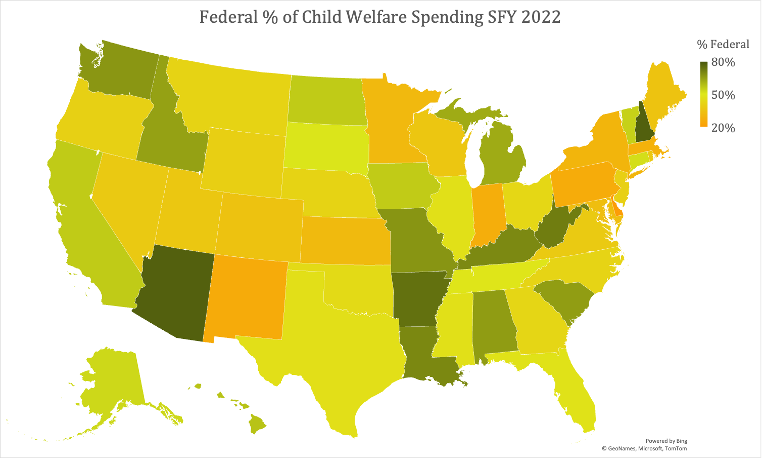
Nationally, federal funds cover just under half of child welfare spending. That average masks variability.
The latest survey data1 show states vary widely, ranging from less than 20% in federal share to over 75%.
Most states have taken a larger role since SFY 2004; the average is obscured by a few significant outliers.
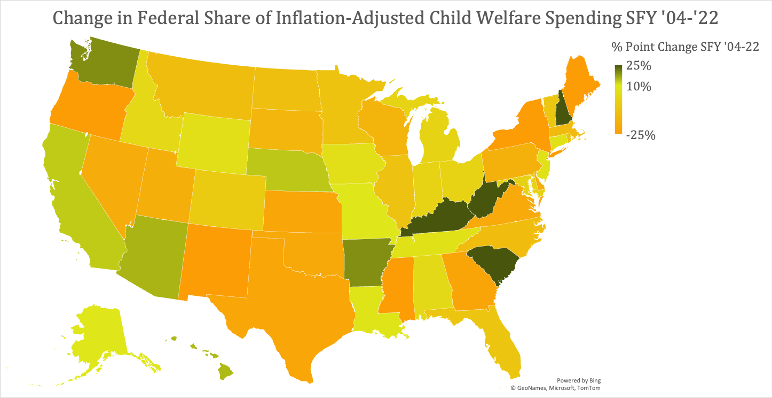
The result is a widening gap, with persistently uniform federal expectations and uneven fiscal responsibility distribution.
This is a key driver to watch for what reforms are possible, sustainable, or politically viable.
Wonkatizer
Personnel is Policy: Hanlon to Run CB
Last week the Imprint reported that President Trump will appoint former National Council for Adoption President & CEO Ryan Hanlon to run the Children’s Bureau (CB).
CB is the subagency that oversees child welfare policy and programs at the Administration for Children and Families.
The Associate Commissioner role does not require Senate confirmation.
Who He Is
Hanlon has served as President and CEO of NCA for the past three years, and worked for the organization since 2017.
He previously served as executive director of America World Adoption.
Why it Matters
Incoming Associate Commissioner Hanlon brings extensive child welfare policy and advocacy experience, with deep ties to domestic and international adoption.
His leadership is likely to bring a renewed focus to adoption-related policy issues within federal financing and accountability.
What to Watch
The ambit of his decision-making authority.
The breadth of influence exercised by Children’s Bureau Associate Commissioners tends to encounter its limits where more senior ACF leaders have staked out a role.
Given ACF Assistant Secretary Alex Adams’ emphasis on child welfare policy, it will be worth watching where CB leadership is operationalizing the ACF agenda, and where there’s a carved-out opportunity to independently shape and guide on key issues
Funding Freeze Temporarily on Ice
On Friday, a federal judge temporarily blocked the Trump administration from freezing over $10 billion in federal funds for child care and family assistance to California, Colorado, Illinois, Minnesota, and New York
What Happened
Last week, ACF sent letters to the five states highlighting concerns around accountability controls and eligibility determinations related to immigration status.
ACF notified the states that they would be unable to draw down funds from key programs until providing detailed data on individual and organizational fund recipients.
What’s Affected
The action would freeze roughly $10B from programs that include:
Temporary Assistance for Needy Families (TANF)
Social Services Block Grant (SSBG)
Child Care Development Fund (CCDF)
In addition to the actions toward these five states, all other states continue to face the administration’s added oversight requirements through Defend the Spend.
Democratic leaders have questioned the merits of the freeze and elevated concerns that the focus on states led by Democrats suggests a politicization of fund allocation.
What to Watch
Whether the freeze persists and becomes a template for similar actions with additional states or other programs.
Elevated requirements for detailed enumerated spending data also raises tensions with ACF’s priorities around maximizing flexibility and reducing administrative burden.
It will be worth watching how the administration approaches that dynamic going forward, and how those countervailing trends interact.
—
That’s it for this week.
Stay sharp, Wonks.
~Z
Partners Making Your Weekly Wonk Possible


ChildTrends’s SFY 2022 Child Welfare Financing Survey. The CA figures use SFY ‘18 numbers, the most recent the state reported.