


From the Founder’s Desk
Welcome to the latest Weekly Wonk.
Last week, we kicked off Doug Steiger’s series on advocacy tradecraft with tactics for informing key moments of the appropriations process and committee hearings.
This series offers three free actionable resources we normally make available only to premium members, showing what we offer in that deeper layer of our work.
In this week’s Deep Dive, Doug turns to tools that work across time. These are moves that are more often under the radar for people outside of the DC Beltway.
What they lack in flash, these moves deliver in duration by compounding over time, by building evidence, shaping regulations, and maintaining attention.
That matters because policy takes years to develop, often building momentum across multiple Congresses and Administrations.
We’ve also got updates on the new Medicaid work requirement rules from the One Big Beautiful Bill Act.
Our most recent WonkCast with Rebecca Robuck emphasized the importance of clear vision, with “what if it worked?” as her invitation to see new options for what’s next.
Let’s get into it.
Weekly Wonk Deep Dive
Evolving Your Advocacy Toolkit, Part 2
By Doug Steiger, Senior Contributor
Moving child and family policy has always required patience, and as we laid out in How Advocacy is Evolving, the ground has shifted in ways that demand more of it.
Traditional pathways have eroded as power has redistributed inside Congress, regular order has given way to leadership-driven vehicles, and the media environment has fragmented in ways that reshape which inputs reach members before advocates do.
That diagnosis is what this series is built to answer.
The organizations that consistently move child and family policy share a common feature: fluency with a second layer of tools beyond relationship-building and policy pitching — the procedural levers, informational assets, and institutional mechanics that convert goodwill into durable outcomes.
Part 1 covered the first two: the appropriations process and committee hearings. Part 2 introduces three more:
Building the Paper Trail: GAO and OIG studies
Communicating Congressional Intent: Report language
Nominating Your Ideas: Confirmations, QFRs, and commitments
Tool #3: Building the Paper Trail- The GAO and OIG For The Long Game
Many advocates have studies and data they rely on to make their case.
That information often faces skepticism because of distrust in the source, an obstacle that has sharpened as parts of the political ecosystem have turned against the mainstream media, academia, and the research establishment.
The Government Accountability Office (GAO) and the departmental Offices of Inspector General (OIG) sit in a different category.
Both are generally perceived as having less of an agenda than advocacy research organizations, and both produce findings that members and staff treat as authoritative.
The GAO in particular is a familiar feature of life on the Hill. GAO is an arm of Congress.
Committee leaders use GAO as a source of oversight information, requesting studies on agency actions or the implementation of legislation. In child and family policy, GAO routinely surveys state agencies or visits states or communities for in-depth research.
OIGs sit inside executive branch departments and operate semi-independently from agency leadership.
They focus primarily on fraud, waste and abuse, but they also conduct implementation studies that bear on policy questions.
How to Use Them
GAO prioritizes requests from committee leaders, but any member can ask it to review a program’s operations or a law’s implementation.
OIGs are less accessible from the outside, though they will sometimes meet with advocates who can surface evidence of waste or fraud to investigate.
Sophisticated advocates know they can plant the seeds for the future elevation of issues they care about by asking a Congressional champion to request a GAO report, or prompt an OIG one through legislation or oversight.
Both produce reports slowly, and that is part of the value.
A GAO and OIG report can be cited for years, building an evidentiary record that policy isn’t working as intended.
They can demonstrate that state agencies are slow to implement a new requirement, that a regulation is producing unintended consequences, that a program’s structure is failing the population it was designed to serve.
These agencies are also persistent.
GAO tracks whether its recommendations have been followed for years. OIGs do the same, though they draw less Hill attention since they don’t work directly for Congress.
For advocates working on issues that won’t resolve in a single Congress, that durability is the point.
Tool #4: Communicating Congressional Intent- Report Language
When a committee approves a bill, it usually issues a report alongside it.
The report lays out the context for the legislation, the reasoning behind it, and how the Committee intends it be interpreted.
Conference reports, which are produced when the House and Senate reconcile differing versions, carry particular weight as the final statement of intent before a bill goes to the President.
These reports are important even though they lack the force of statute.
Courts look to report language to discern legislative intent when statutory language is ambiguous.
More routinely, agency career staff read report language alongside statute when drafting regulations and implementation guidance.
This is the real leverage point for report language, which can shape how an agency translates the law into rules. Agencies that disregard report language risk the ire of the legislators who wrote it.
This dynamic is sharpest in annual appropriations bills. Ignored report language one year can become statutory language the next, or trigger painful oversight, targeted budget or staffing cuts.
Drafting Language That Gets Picked Up
Advocates who get into the process early can help shape report language directly.
The best report language follows a consistent pattern: it states factually what the statutory provision does, then describes the intent behind it.
Vague aspirational language gets ignored.
Specific language tied to concrete expectations is harder for an agency to wave off, including implementation timelines, populations to be served, and data to be reported.
When a bill represents only a partial step towards an advocate’s goal, report language can lay groundwork for the next step.
For example, a report might state that if the enacted provisions prove insufficient to achieve the committee’s intent, further legislation will follow.
That kind of forward-looking text builds a record advocates can point to in the next Congress and future ones, building the long game needed to inform policy over time.
Tool #5: Nominating Your Ideas- Confirmations, QFRs, and Commitments
The Senate confirmation process for Administration appointees is another opportunity for advocacy, And not just in the obvious ways of how a vote might go.
Organizations can collaborate with congressional staff on questions designed to get a nominee on the record about a key issue, extract policy commitments, and build accountability that travels with the nominee into office.
The leverage is greatest at the sub-cabinet level, such as Deputy and Assistant Secretary level.
Confirmation hearings for Cabinet Secretaries are often consumed by the political crisis of the day or page one issues like health care, leaving little room for child and family questions.
However, the press pays little attention to the confirmation process for sub-cabinet posts, giving advocates more ability to get attention from Senators and their staff.
Sub-cabinet nominations operate under different conditions: less press attention, more space for substantive questioning, and Senators who are often genuinely looking for sharp questions from informed outside parties.
It is also a process, not just a single moment at a hearing. Senators can press for answers before, during, and after a hearing itself. Advocates who understand the full arc have more entry points than are typically used.
Working the Process
If you can’t get a question asked in the hearing itself, the next vehicle is the question for the record or QFR. QFRs let a Senator submit a written question after the hearing and require a written formal answer from the nominee.
They are well-suited to detailed policy questions that wouldn’t translate to oral exchange.
Typically, a nomination will not move until QFRs have been answered, which can take weeks, even months. That timing creates real pressure on the nominee to engage seriously.
One further step is asking a Senator to extract a commitment from the nominee: a promise to rescind specific guidance to meet with advocates on an issue, to issue a particular kind of regulation.
Commitments made on the record create accountability that outlasts the hearing itself.
If the nominee fails to follow through, the failure registers as disrespect to the Senator, not just the advocates who sought the commitment. That changes the dynamics of follow-up substantially.
The Senator’s office has its own reason to press the agency, which gives advocates a partner in enforcement rather than the burden of carrying it alone.
Tools that Work on Time
The three tools in this installment share a property the first two don’t.
Appropriations riders and committee hearings work on live moments; GAO and OIG studies, report language, and confirmation commitments compound over time.
They plant artifacts that exert influence long after the immediate fight has moved on in the form of evidentiary records that build across Congresses, instructions that guide rulemaking years into the future, and commitments that travel with appointees into office.
For organizations working on issues that will not resolve in a single legislative window, the long-horizon tools are often the ones that matter most, even if a “win” on them doesn’t have the glamour of a big vote..
The third and final installment in this series will turn to the tools that operate closest to the legislative product itself: technical assistance on bill text, coalition architecture, and the long work of cultivating champions on child and family issues.
Together they cover what it takes not just to engage the machinery, but to shape what comes out of it.
From the Wonk Briefing Room
Entitled To What?
Title IV-E of the Social Security Act is synonymous with foster care, for which it provides states open-ended federal funding on behalf of all eligible children.
In this premium brief, Senior Contributor Laura Radel maps the difference between what we assume Title IV-E foster care funds pay for and what it mostly covers in reality.
Rather than funding room and board for foster care, it’s primarily a federal investment in state capacity through administrative funds. That matters for the future of financing policy.
In the technical sense, Title IV-E foster care is an entitlement program. But as Laura points out, the deeper question is “entitlement to what?”
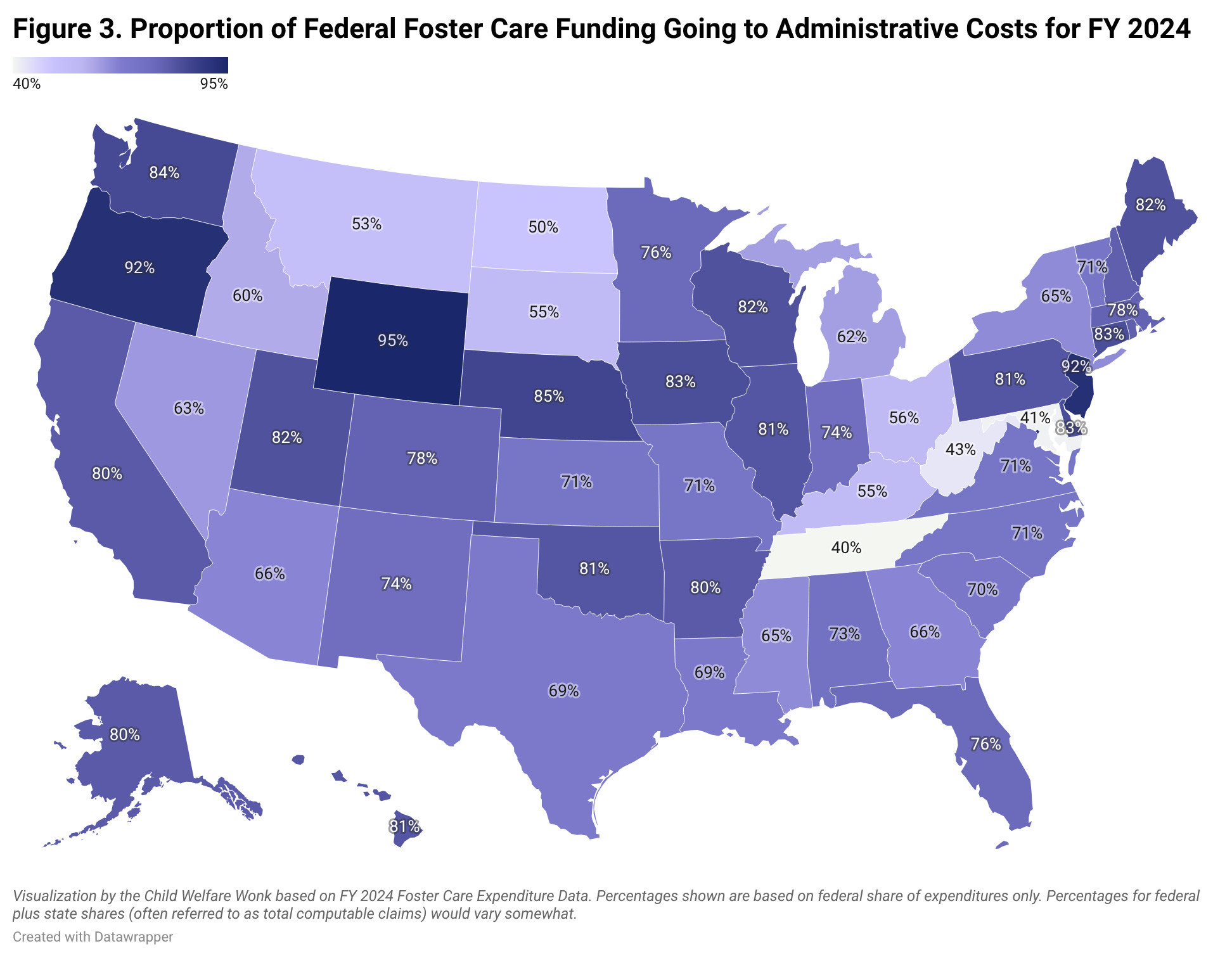
As always with our premium resources, it not only analyzes but offers actionable steps, with a framework of questions for leaders to shape strategy.
To read the full brief and access all our premium resources, join the Wonk Briefing Room. Individuals can sign up here, or get the team membership rate here.
Organizations interested in going even deeper can reach out to learn more about our partnerships that help you leverage and apply our intel in your strategy.
On Our Radar
Medicaid Work Rules Force a Late, Costly System Rebuild
What Happened
On June 1, the U.S. Centers for Medicare and Medicaid Services (CMS) released an Interim Final Rule implementing the One Big Beautiful Bill Act’s Medicaid work requirements.
The law requires most non-pregnant adults ages 19-64 to demonstrate that they’re engaged in at least 80 hours per month of employment, education, job training, or community service.
The rule expands on those requirements.
For example, while the law waives the requirement for those deemed “medically frail”, under the rule a diagnosis alone is insufficient; you have to prove it precludes work.
As part of a concerted rollout strategy, the HHS Assistant Secretary for Planning and Evaluation team released a report arguing work requirements incentivize employment and reduce poverty.
Notably, the report acknowledges “Our analysis assumes no implementation delays”.
Why it Matters
Regardless of your perspective on the merits of connecting safety net benefits to work, the policy architecture itself is built on documenting and verifying work.
The policy rollout will be focused not on promotion of and connection to community engagement, but procurement of technological infrastructure, with a reasonable assumption of implementation delays based on state experiences.
Kristi Putnam oversaw an earlier high-profile rollout of Medicaid work requirements in Arkansas. In our recent WonkCast conversation, she highlighted the challenges of setting up technology systems, and how central they are to the policy working as designed.
Former Georgia child welfare Director Tom Rawlings previously wrote for the Wonk about how that friction plays out and how it can impact child welfare systems.
A majority of Medicaid beneficiaries already work or attend school.
Beneficiaries the law exempts, including former foster youth and parents, can still face potential impacts, since the policy hinges on proving exemption.
For example, we’ve previously projected that up to 68,000 eligible children could lose coverage purely through administrative burden.
What to Watch
States have a relatively short runway to get their systems set up, and that will come right as state budgets tighten in anticipation of reduced federal Medicaid funding.
The rule does allow self-attestation of work or exemption status through 2027, but in 2028 states must have data systems working to verify exemptions.
CMS is accepting comments on the rule until July 31st.
That’s it for this week.
Stay sharp, Wonks.
~ Z
Partners Making Your Weekly Wonk Possible


