

From the Founder’s Desk
Welcome to this week’s Weekly Wonk.
The Administration for Children and Families’ (ACF) A Home for Every Child initiative is the organizing principle behind virtually every major ACF child welfare initiative.
With an increasing number of states formally aligning to the priority, it’s a key moment to look beyond the top-line national goal and average.
This week, Laura Radel gives us the literal map.
Her state-by-state benchmark of current foster home ratios illustrates the highly varied baseline from which every state will begin its journey toward the 1:1 goal.
That piece kicks off a series, with future analyses for our premium Wonk Briefing Room members on recent trends and projections for how each state could reach 1:1.
On WonkCast, Noah Duncan of Foster Insights joined me to talk about the analytical layer underneath initiatives like HFEC: metrics quietly reshaping policy.
And at a moment when ACF is rolling out a Child Welfare Technology Incubator and an issue brief on predictive analytics, our latest member-only brief breaks down the six barriers standing between child welfare agencies and meaningful AI adoption.
Let’s get into it.
Special thanks to Binti for their foundational sponsorship of WonkCast.

Weekly Wonk Deep Dive
Mapping A Home for Every Child: Where Do States Stand?
How many homes does each state have for every child in foster care?1
By Laura Radel, Senior Contributor
Editor’s note: This is the first in a three-part series examining where states stand on ACF’s Home for Every Child ratio goal.
Parts two and three will be available exclusively to Wonk Briefing Room members.
We’ve been examining the constraints facing the Administration for Children and Families’ (ACF) A Home for Every Child initiative.
That includes the limits of the 1:1 ratio as a metric to the behavioral health ceiling that shapes what foster homes can actually sustain.
This piece adds a foundational piece to that picture: a state-by-state benchmark of where things actually stand today, and from which all states will start
ACF’s A Home for Every Child initiative sets the goal that states have at least as many foster homes as there are children in foster care – a 1:1 ratio.
As we’ve previously described, that’s about double the current ratio of homes to children nationally.
But we know national averages often mask significant state variability.
So, where does each state stand on this goal today?
There is no authoritative federal data on states’ stock of licensed foster homes.
The best data on the topic has been collected by The Imprint’s Who Cares: A National Count of Foster Homes and Families, which has tracked foster homes counts from states since 2019.
This analysis is based on the Who Cares counts of foster homes, and on federal AFCARS counts of children in foster care.
For each year we calculate the ratio of foster homes available on March 31 of a given year in the Who Cares data to the AFCARS count of children in care the previous September 30.
These September AFCARS figures offer a representative and official indicator from which to benchmark.
The National Picture
First, let’s start with the national picture.
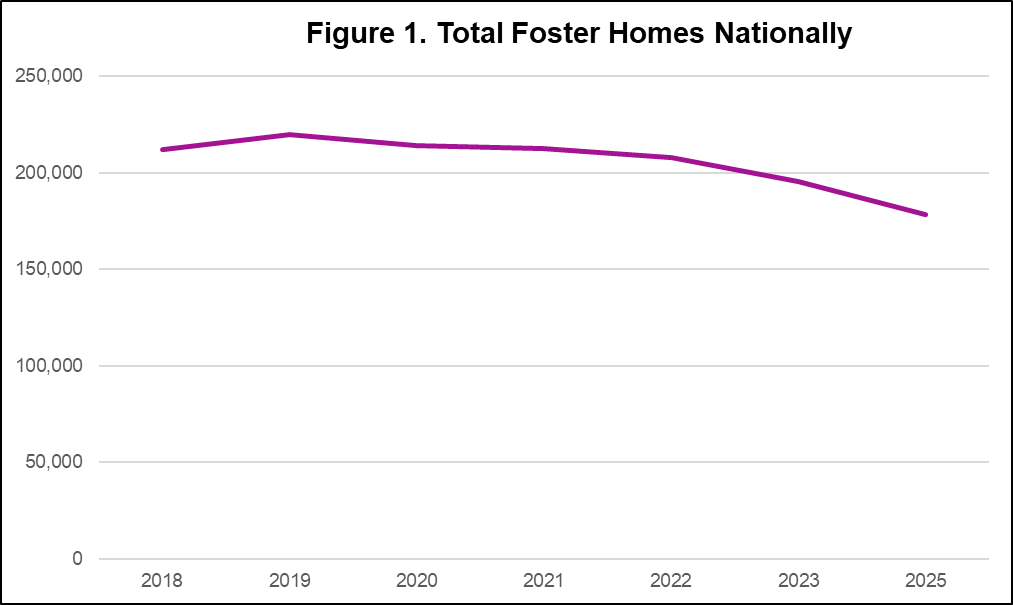
Nationally, the number of foster homes declined from about 212,000 in 2018 to 178,000 in 2025 – a loss of 36,000 homes or 17 percent.
Most of that decline has occurred since 2022.
There were 0.53 foster homes in 2025 for every child who was in foster care on September 30, 2024.
The ratio has been increasing incrementally in recent years, from 0.51 in 2019 to 0.53 in 2025.
That national figure masks enormous variation across states.
Where Every State Stands
No state currently achieves the 1:1 ratio goal.
However, six states come close:
California
Idaho
Pennsylvania
Vermont
Virginia
Wyoming
Each has ratios of 0.8 or higher
States range from a low of 0.21 in Arizona to 0.93 in Idaho.
There are 26 states with ratios greater than 0.5, which means they currently reach at least half of ACF’s goal.
There are 12 with ratios greater than 0.66, or about two-thirds of the way to the goal.
Always Be Closing: Why the Gap Persists
Most states have a long way to go to meet ACF’s challenge of achieving a 1:1 ratio of foster homes to children who need care.
Gains needed in most states far outstrip any changes in either the supply of foster homes or the decline in children in care in recent years.
In the states with ratios below 0.5, meeting the goal of a 1:1 ratio would require doubling or more the number of licensed foster homes, halving the number of children in foster care, or some combination in between.
We’ll explore this dynamic in greater depth in a forthcoming piece.
In addition, high turnover among foster parents means many more new foster parents would be needed than are apparent from calculations like those presented here.
That’s because recruitment would need to account for turnover.
There’s also a supply-side risk worth watching.
If states add hundreds or thousands of new foster homes to their supply while further decreasing the number of children in foster care, and continuing to follow best practice of placing siblings together whenever possible, many of those new homes will never see a child placed in them.
That could manifest as mirage; as we’ve examined, raw home counts don’t measure how well matched a home is to the unique needs of:
Sibling groups;
Older youth; and
Children with complex behavioral health needs.
A ratio alone won’t tell us if the supply is matched to the population’s needs.
The Road to 1:1
A Home for Every Child is now the organizing principle behind all major ACF child welfare policy initiatives.
Seeing it clearly, state by state, is essential for looking at what’s possible and what’s next.
The next two pieces in this series will go deeper on both the trajectory and the math.
The second will examine how the ratio has changed over time in each state: which states are gaining ground, which are losing it, and how fast.
The third will model what it would actually take to reach 1:1 under different strategies.
Several states have announced their participation in ACF Assistant Secretary Adams’ challenge to strive toward a 1:1 ratio with more likely to follow.
For most, the starting line is farther back than the goal may suggest.
From the Wonk Briefing Room
The federal government is preparing to push hard on AI adoption in child welfare.
May 2026 is a key deadline from the Trump Administration Executive Order on foster care, for rolling out expanded use of technological solutions, including predictive analytics and AI.
We saw ACF deliver on part of that last week, with a new issue brief on predictive analytics, and more is likely ahead.
In the latest premium brief, Kurt Heisler of ChildMetrix names the six specific barriers standing between the federal push and state readiness.
Like all our premium resources, it goes beyond diagnosis to offer concrete strategies and approaches for leaders navigating this complex terrain.
To read the full piece and access all our premium briefs, join the Wonk Briefing Room here.
Wonkatizer
ACF Rescinding “Designated Placement” Rule
What Happened
On March 6th, ACF issued a Notice of Proposed Rulemaking (NPRM) to rescind the Biden era regulation Designated Placement Requirements Under Titles IV-E and IV-B for LGBTQI+ Children.
That rule had established requirements for child welfare agencies to provide “safe and appropriate” placements for LGBTQI+ children in foster care.
Why It Matters
While implementation had been blocked following a June 2025 court injunction, the rule was a significant Biden Administration priority.
This latest step was not a surprise; the Trump Administration telegraphed this action in a September update to its Regulatory Agenda.
A noteworthy step here is on process.
Last year, HHS rescinded requirements for formal notice and comment rulemaking on many HHS programs.
Despite that shift, ACF issued this as an NPRM.
What to Watch
HHS is collecting comments until April 6.
It will be worth watching both the content of those comments and how the agency responds when it likely moves forward with formal repeal.
GAO to HHS: Clarify Congregate Care Guidance
What Happened
A new GAO report finds that 26 of 49 states surveyed have not decreased congregate care use since Family First’s 14-day limit on Title IV-E reimbursement took effect in October 2021.
Many states responded by shifting to state, county, or local funds to sustain those placements.
Given wide variation of interpretation, GAO recommended that HHS clarify guidance around settings serving sex trafficking victims, though HHS signaled it will not do so.
Why It Matters
All 49 responding states reported challenges securing and financing appropriate non-congregate placements.
As policy makers look ahead to the future of child welfare financing and Family First 2.0, this only reinforces the connection between:
Limits on prevention implementation;
Barriers to kinship care;
Constrained foster home supply; and
Continued congregate care use.
What to Watch
How financing policy conversations evolve to address these and other barriers Family First has encountered in implementation, and any reception in Congress.
ACF Letter Targets Removals Over Gender Identity
What Happened
ACF sent letters to all 50 states last week stating that children may not be removed from a home solely because a parent rejects their child’s gender identity.
Citing alleged examples from Illinois and California, the letter warned that states removing children for this reason risk losing federal grant funding.
Why It Matters
As a legal matter, the letter largely restates existing Child Abuse Prevention and Treatment Act (CAPTA) standards: removal requires evidence of abuse or imminent harm, not parental disagreement alone.
ACF is also linking the letter to the A Home for Every Child initiative, framing unnecessary removals as an impediment to that goal.
News reports note that multiple child welfare professionals and legal advocates say they are not aware of states removing children on this basis at scale.
What’s equally noteworthy is what’s not in the letter; any argument that provision of gender-affirming care itself constitutes abuse or neglect.
What to Watch
Whether ACF takes any formal action following these letters and guidance, and how states respond to the rising risk profile they face for federal funding across programs.
That’s it for this week.
Stay sharp, Wonks.
~Z
Partners Making Your Weekly Wonk Possible


Since publication of part 1 in this series, further analysis revealed both an error in my initial calculation of the ratio change for one state (Washington) and that the substitute data used for both Washington and Wyoming (which did not submit AFCARS data for 2024) had produced results that suggested potential data comparability issues.
Therefore, we’ve updated the map for this piece to drop WA and WY from the analysis, and will be leaving them out for subsequent analyses of this data set.